

TL;DR:
- Design research faces an underappreciated risk of becoming invalid due to evolving contexts, user behaviors, and technologies. Regularly revalidating methods across five key validity types prevents research debt, ensuring ongoing relevance and accuracy. Embracing continuous, adaptive research practices and leveraging emerging trends like AI maintains organizational competitiveness and design excellence.
Design research carries a hidden vulnerability that many professionals underestimate: the assumption that validated methods from a previous project cycle remain equally valid in a new context. Contexts shift, user behaviors evolve, technologies reconfigure interaction patterns, and the measurement instruments once considered rigorous can become structurally misaligned with current realities. For design professionals and students operating in increasingly complex product environments, treating research as static foundational knowledge is not a conservative position; it is an active risk factor that compounds over time into what researchers now identify as research debt.
Table of Contents
- Why outdated research risks your project's success
- Emerging trends transforming design research in 2026
- Essential validity types and how to address them
- Practical strategies for keeping your research current
- Why continuous research is the real differentiator
- Connect with deeper design insights at DesignDex
- Frequently asked questions
Key Takeaways
| Point | Details |
|---|---|
| Validity depends on updates | Keeping research current ensures findings remain valid across evolving contexts. |
| AI reshapes insights | Integrating AI and new tools strengthens research and unlocks deeper user understanding. |
| Mixed methods matter | Combining qualitative and quantitative data handles complex design challenges. |
| Continuous research prevents debt | Ongoing validation avoids invalid assumptions and outdated knowledge. |
| Resilience relies on edge cases | Addressing edge cases early leads to more maintainable and user-friendly designs. |
Why outdated research risks your project's success
Outdated design research does not fail catastrophically at first. It fails quietly, through accumulating invalid assumptions, misapplied frameworks, and findings that no longer generalize to the populations they were derived from. This gradual erosion of validity creates what practitioners call research debt, a backlog of unverified assumptions that must eventually be reconciled, often at significant cost to project timelines and outcomes.
Mapping validity in design research identifies at least five distinct validity types that a research framework must satisfy, and outdated methods frequently compromise multiple types simultaneously:
- Instrument validity: The measurement tools (surveys, observation protocols, interaction logs) must accurately capture what they claim to measure within the current technological and behavioral context.
- Technical validity: The analytical processes and statistical techniques applied must remain appropriate for the data structure and sample characteristics of the current study population.
- Design validity: The overall research design must align with the questions being asked; a protocol designed for desktop-centric products, for example, introduces structural distortion when applied unchanged to voice-interface products.
- Purpose validity: The research must remain aligned with the actual decision-making needs of the project, not legacy organizational assumptions about what stakeholders need to know.
- Generalization validity: Findings must be transferable to the intended target population, accounting for demographic, cultural, and technological shifts since the original data collection.
Conducting rigorous design analysis in UX requires acknowledging that each of these validity types is susceptible to decay as contexts evolve. A usability protocol developed in 2019 for smartphone interfaces, for instance, may demonstrate strong instrument validity within its original context while exhibiting significant design validity failures when applied to augmented reality interfaces in 2026.
"Validity is not a property of a method in isolation; it is a property of the relationship between the method, the context, and the claims being made." This framing, supported by contemporary design research scholarship, clarifies why periodic revalidation is not optional rigor, but foundational practice.
Applying a structured design evaluation process that explicitly checks each validity type against current project conditions is one of the most effective defenses against research debt accumulation.
Emerging trends transforming design research in 2026
With the risks clearly established, attention turns to the forces actively reshaping what current, valid design research looks like. UX research trends 2026 identifies several converging shifts that collectively demand methodological updating across the profession.
AI-assisted research workflows
Artificial intelligence is fundamentally altering the scale and speed at which design research can operate. AI tools now support automated thematic coding, real-time sentiment analysis from usability sessions, and pattern recognition across large qualitative datasets that would previously require weeks of manual synthesis. The implication for validity is significant: AI-assisted workflows can process edge-case data that smaller manual studies would statistically obscure, improving generalization validity when implemented correctly.
Democratization of research practice
Cross-functional teams, including product managers, engineers, and marketing strategists, increasingly participate in research activities alongside dedicated UX researchers. This democratization introduces methodological diversity and organizational breadth, but it also requires updated governance frameworks. Without shared standards for instrument and technical validity, democratized research risks producing conflicting findings that undermine rather than support design decisions. Exploring resources on identifying design trends can help cross-functional teams align on what signals are genuinely significant.
Mixed methods as standard practice
Single-method research designs, whether purely quantitative or purely qualitative, are increasingly recognized as insufficient for complex user contexts. Mixed methods (combining behavioral data, contextual inquiry, and quantitative usability metrics) provide triangulated findings that are more robust across multiple validity dimensions. Referencing design intelligence frameworks can support teams in structuring mixed-method programs systematically.
| Research approach | Validity strengths | Primary limitations |
|---|---|---|
| Quantitative only | Technical, generalization | Design, purpose |
| Qualitative only | Design, purpose | Generalization, technical |
| Mixed methods | All five validity types | Resource intensity |
| AI-assisted mixed | Instrument, generalization | Technical oversight required |
Key statistic: Organizations that integrate continuous research cycles report a measurably faster identification of usability failures compared to those relying on point-in-time research, with some studies indicating failure detection rates improving by over 40% when research is embedded iteratively throughout the design lifecycle rather than conducted as a single pre-launch activity.
The structural shift from episodic to continuous research practices reflects a broader recognition that design research, like the products it informs, requires iterative updating to maintain its evidentiary value.

Essential validity types and how to address them
Understanding the trends reshaping design research sets the foundation for addressing its most technically demanding requirement: ensuring that updated research satisfies all five critical validity types systematically.
Ordered approach to validity assurance
-
Audit existing instruments first. Before any new research cycle begins, review current data collection tools against the intended measurement targets. Survey items calibrated for pre-pandemic remote work behaviors, for example, may no longer accurately capture the hybrid work patterns that now characterize the dominant user context.
-
Reassess technical processes. Confirm that analytical methods remain appropriate for current data structures. If your team has shifted from Likert-scale surveys to behavioral trace data, the statistical models applied must change accordingly to preserve technical validity.
-
Realign design validity with current research questions. Map each research design component against the specific decisions stakeholders need to make now, not the decisions that motivated the original research framework. This realignment directly addresses purpose validity as well.
-
Revalidate generalization claims. Examine whether the user populations sampled in prior research still represent the intended target users. Demographic shifts, geographic expansion, and the introduction of accessibility requirements all alter the population parameters against which generalization validity must be assessed.
-
Document validity decisions explicitly. Each update to a research instrument, analytical process, or sampling strategy should be formally documented with rationale, creating an audit trail that supports both internal quality assurance and external citation credibility.
The five essential validity types (instrument, technical, design, purpose, generalization) provide a structured checklist that design teams can apply iteratively rather than treating validity as a one-time verification step. Examining modern research methods specifically calibrated for contemporary contexts ensures that instrument and design validity are addressed from the outset of each cycle.
A solid grounding in research methodology principles provides the conceptual scaffolding necessary to recognize when a particular validity type is at risk before findings are committed to product decisions.
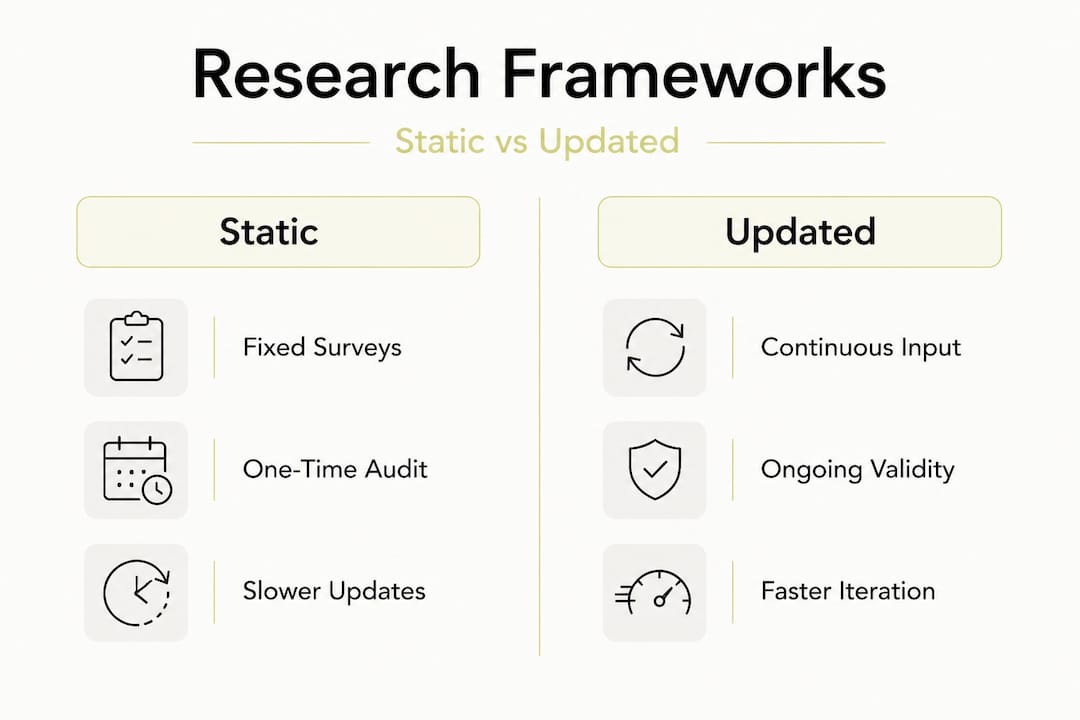
Comparison: static vs. updated research frameworks
| Validity dimension | Static research framework | Updated research framework |
|---|---|---|
| Instrument | Fixed survey items, legacy protocols | Periodically recalibrated instruments |
| Technical | Unchanged statistical models | Methods matched to current data types |
| Design | Original research design reused | Redesigned per current research questions |
| Purpose | Aligned to legacy decision needs | Aligned to current stakeholder needs |
| Generalization | Original sample population assumed | Resampled or re-weighted for current users |
Pro Tip: Schedule a structured validity audit at the start of every major project phase, not only at the beginning of a new project. Contexts shift mid-project, and a validity checkpoint at phase transitions can prevent compounded research debt from distorting late-stage decisions.
Practical strategies for keeping your research current
Now that the structural requirements of valid design research are clear, the question becomes operational: what specific practices allow design professionals and students to maintain research currency across active project portfolios?
Research on static versus dynamic design knowledge identifies a critical tension in how practitioners conceptualize their own research: those who treat prior findings as settled, reusable knowledge (a static orientation) accumulate research debt at a substantially higher rate than those who treat every prior finding as a provisional input subject to contextual validation (a dynamic orientation). Experts consistently emphasize that ongoing validation is the primary mechanism for avoiding invalid assumptions.
The following practices operationalize a dynamic research orientation:
- Adopt mixed-method and AI-assisted workflows. Combine behavioral analytics with contextual inquiry; use AI coding tools to surface patterns in qualitative datasets at scale, then validate those patterns through targeted human interpretation.
- Interrogate "happy path" assumptions actively. Most research protocols over-sample successful task completion scenarios. Deliberately designing for edge cases, error states, and interruption scenarios produces more resilient and generalizable findings. Effective synthesis of actionable insights depends on including failure-mode data, not just success-mode data.
- Build continuous professional development into team rhythms. Assign team members to monitor emerging method publications, attend research-focused conferences, and participate in peer review exchanges. Updated knowledge at the individual level prevents methodological stagnation at the team level.
- Integrate cross-functional collaboration into research design. Engineering, product management, and customer success perspectives surface validity threats that dedicated research teams may overlook. Embedding design systems for teamwork creates the shared language necessary for cross-functional validity reviews.
- Connect research updates to a structured design process. Research currency is most valuable when findings feed directly into defined design decision points rather than accumulating in reports that are referenced infrequently.
Incorporating iterative design ideation steps that explicitly require research validation at each stage creates natural checkpoints for assessing whether current findings remain sufficient to support the next decision.
Pro Tip: Establish a "research currency log," a simple version-controlled document that records when each major research finding was validated, against what population, and under what contextual conditions. This log functions as a research maintenance schedule, flagging findings that are approaching expiration based on elapsed time or significant context changes.
Why continuous research is the real differentiator
The technical arguments for updating design research are well-supported by validity frameworks and trend analyses. What these arguments do not fully capture is the organizational and professional differentiator that continuous research practice creates. The separation between designers who produce reliably excellent outcomes and those who produce intermittently good work often traces back not to technical skill but to research discipline.
There is an uncomfortable truth in contemporary design practice: many practitioners wait for a trend to become prominent before updating their methods, which means they are operating on the leading edge of yesterday's consensus rather than the emerging edge of current knowledge. By the time a methodology reaches widespread adoption in mainstream toolkits, its competitive differentiation has already been captured by earlier adopters.
Designing for resilience by interrogating happy path assumptions early, ensuring recovery paths for common edge cases including errors and interruptions, exemplifies the mindset that distinguishes continuously updated research from episodic research. Edge cases are not peripheral concerns; statistically, they represent the conditions under which user trust is most severely tested and most durably formed.
The product lifecycle does not have a research phase followed by a design phase. Research is a concurrent, continuous activity that must evolve with the product. Treating a research finding from year one as authoritative in year three of a product's life is methodologically equivalent to using a two-year-old usability benchmark to evaluate a newly released interaction paradigm. The finding is not wrong in itself; it is simply no longer measuring what you think it is measuring.
Building effective research methods into every phase of the design lifecycle, rather than front-loading research into discovery and then deprioritizing it through execution, is the structural commitment that separates organizations with consistently strong design outcomes from those that produce inconsistent results. Iterative learning, sustained validity assurance, and a dynamic orientation toward research currency are not supplementary best practices. They are the core competencies of evidence-based design leadership.
Connect with deeper design insights at DesignDex
For design professionals and students ready to move beyond episodic research and into evidence-driven practice, DesignDex provides the structured, continuously updated research intelligence needed to stay ahead of methodological currency requirements.
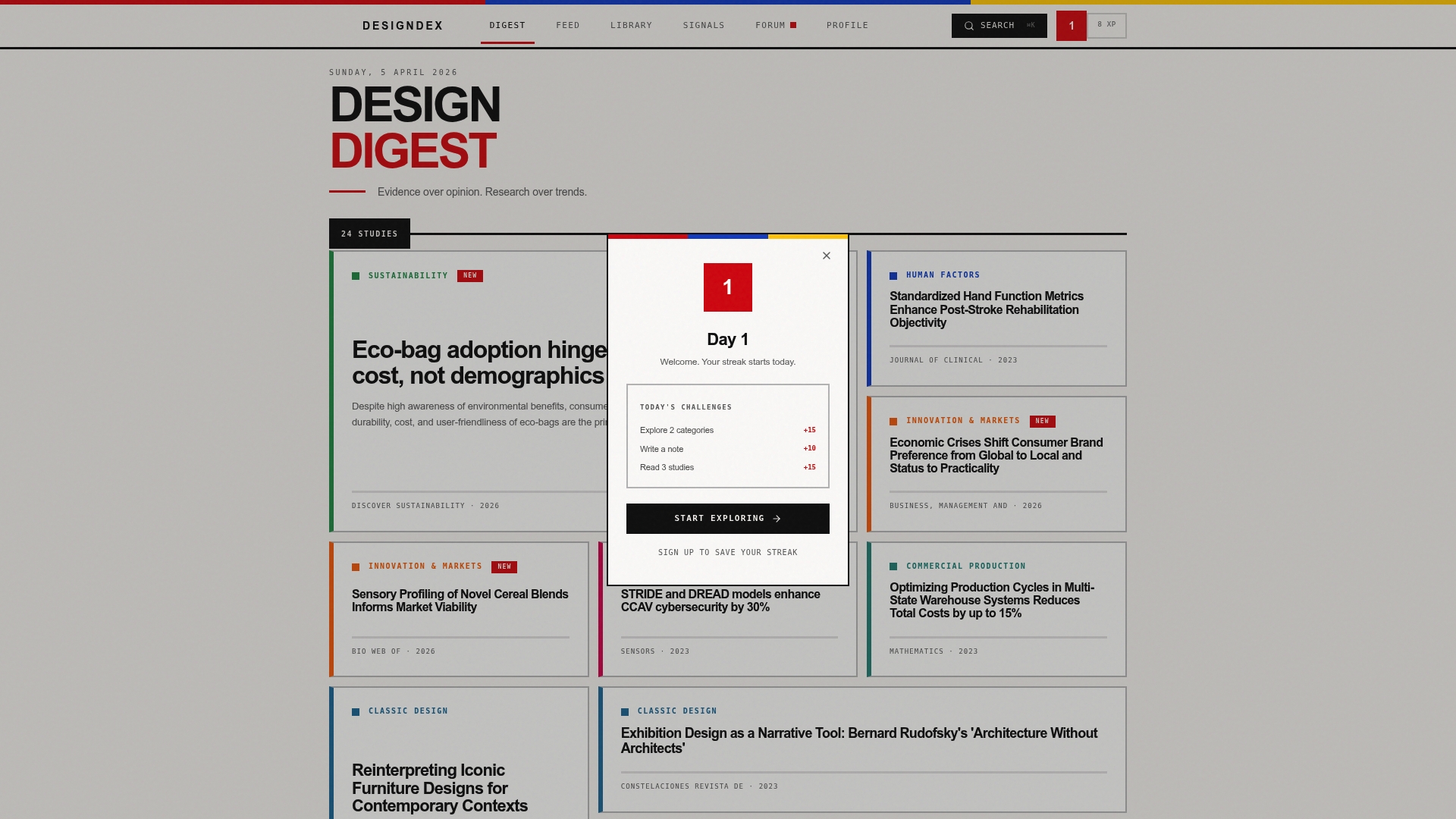
DesignDex distills peer-reviewed studies into structured breakdowns covering aims, methods, findings, and real-world applications, updated daily so that your research toolkit reflects current standards rather than legacy assumptions. Explore how VR-driven empathy research is reshaping user understanding methodologies, or examine findings from usability testing for interfaces to validate your current evaluation protocols against the latest empirical standards. Visit DesignDex for citation-ready insights that support every phase of evidence-based design decision-making.
Frequently asked questions
What are the main validity types in design research?
Instrument, technical, design, purpose, and generalization are the five primary validity types, each addressing a distinct dimension of research rigor from measurement accuracy to contextual transferability.
Why is continuous research important in design?
Continuous research prevents research debt and invalid assumptions by ensuring that findings remain aligned with evolving user contexts, technologies, and organizational decision-making needs rather than reflecting conditions that no longer exist.
How does AI impact modern design research?
AI integration in UX research enables scaled qualitative analysis, rapid edge-case detection, and continuous insight cycles that significantly expand the scope and speed of evidence generation in design projects.
How can I ensure my design research methods stay relevant?
Updating methods against current validity types through structured audits, mixed-method adoption, and continuous professional development ensures that research instruments, designs, and analytical processes remain fit for purpose across changing project contexts.