

TL;DR:
- Systematic evaluation identifies usability flaws early, reducing costly rework later.
- Diverse expert teams and proper preparation ensure reliable, impactful design assessments.
- Prioritize issues by severity and frequency to focus on high-impact improvements.
Design projects fail for reasons that rarely appear in creative briefs. A concept can be visually compelling, technically sound, and strategically aligned, yet still fall short when it reaches real users. The gap between intent and outcome often traces back to one missed step: systematic evaluation. Structured evaluation translates raw feedback into targeted, evidence-based improvements that teams can actually act on. This guide walks through every stage of an effective design evaluation process, from preparation through prioritization, covering both UX and industrial design contexts with methodological rigor and practical clarity.
Table of Contents
- Why every design project needs systematic evaluation
- Essential tools and preparations for design evaluation
- Step-by-step process for conducting design evaluations
- Analyzing results and prioritizing design improvements
- The truth about design evaluation that professionals don't discuss
- Take your design evaluation further with DesignDex insights
- Frequently asked questions
Key Takeaways
| Point | Details |
|---|---|
| Systematic evaluation is vital | Structured processes reveal critical design flaws and improve quality cost-effectively. |
| Preparation sets the stage | A well-chosen team and clear tools checklist ensure productive, targeted evaluations. |
| Hybrid methods deliver depth | Blending heuristics with domain-specific Kansei uncovers needs beyond the obvious. |
| Prioritization drives results | Translating findings into prioritized, actionable changes maximizes design impact. |
| Tools & mindsets matter | The best outcomes come from combining structured frameworks with a reflective, human-first perspective. |
Why every design project needs systematic evaluation
Design evaluation is not a quality-control afterthought. It is a structured diagnostic process that surfaces usability flaws, emotional mismatches, and lifecycle shortcomings before a product reaches production or deployment. Without it, teams operate on assumptions that accumulate cost at every stage of development. The benefits of design analysis benefits are well documented: earlier issue detection reduces downstream rework, accelerates iteration cycles, and strengthens the evidentiary basis for design decisions.
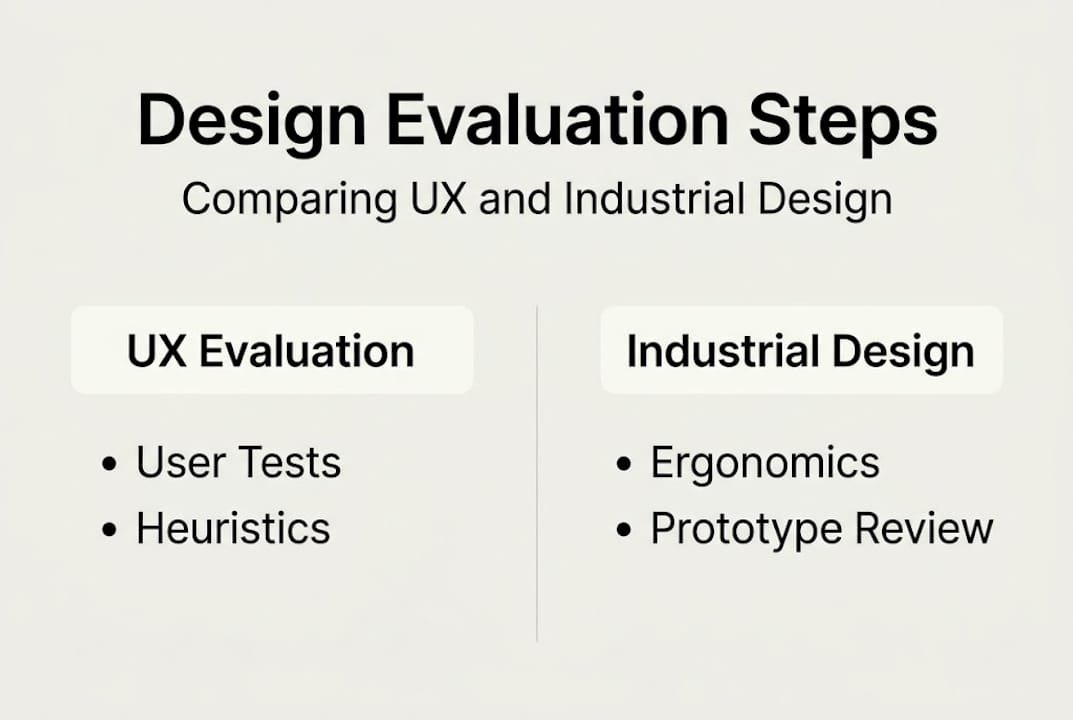
UX and industrial design share foundational principles, including user-centricity, iterative refinement, and stakeholder alignment, yet each domain carries distinct evaluation demands. UX evaluation typically focuses on interaction quality, task completion rates, and cognitive load. Industrial design evaluation must additionally account for ergonomics, material lifecycle, manufacturing constraints, and tactile emotional response. Applying UX-only frameworks to physical products, or vice versa, produces incomplete findings.
Structured evaluation reduces wasted resources with measurable consistency. When teams log issues by severity and frequency, they direct effort toward high-impact problems rather than cosmetic fixes. Research on human-centered design tips reinforces that teams embedding user feedback systematically into every cycle achieve superior outcomes compared to those relying on intuitive judgment alone.
The evidence base for evaluation maturity is sobering. Low UX maturity in sectors like the Swiss machinery industry reveals that barriers including insufficient skills and restricted user access remain widespread, even as professionals acknowledge quality and cost-reduction benefits. This gap between awareness and practice is exactly where structured processes make the most difference.
| Evaluation domain | Primary focus areas | Common methods |
|---|---|---|
| UX design | Interaction, cognition, task flow | Heuristic review, usability testing |
| Industrial design | Ergonomics, material, emotion | Weighted scoring, Kansei Engineering |
| Hybrid / complex products | Cross-domain experience | Kansei + heuristic, lifecycle analysis |
Key outcomes of systematic evaluation include:
- Earlier identification of usability and ergonomic defects
- Reduced iteration cost through targeted, evidence-based revisions
- Stronger stakeholder alignment via shared scoring criteria
- Improved lifecycle planning for physical product teams
"Mature evaluation processes consistently improve quality outcomes and cost-effectiveness, yet adoption remains limited where skills and user access are scarce."
Essential tools and preparations for design evaluation
Successful evaluation depends less on the sophistication of available tools and more on deliberate preparation. The selection of evaluators is the single most consequential pre-evaluation decision. Teams benefit from assembling three to five specialists with complementary expertise: UX researchers, interaction designers, domain engineers, and ergonomics specialists bring different analytical lenses to the same artifact. Diversity in perspective reduces blind spots and increases the reliability of findings.

Heuristic evaluation follows a two-phase independent review structure: evaluators first explore freely, then conduct a systematic pass against defined principles. Independence during initial review is critical; group review before individual assessment introduces anchoring bias that can suppress valid findings.
Before any session begins, the following resources should be confirmed and distributed:
- Evaluation brief: Scope definition, product context, and session objectives
- Scoring sheets: Standardized rubrics for severity, frequency, and domain-specific criteria
- Screen recording or eye-tracking setup: Essential for interaction tracing in UX; valuable for physical prototypes in industrial contexts
- Heuristic or criteria checklist: Pre-mapped to evaluation domain (UX principles vs. ergonomic and lifecycle criteria)
- Consensus protocol: Agreed method for aggregating individual findings post-session
Organizations pursuing design research methods that integrate both quantitative and qualitative measures should prepare separate scoring instruments for functional and emotional dimensions. Conflating these produces ambiguous data.
| Preparation element | UX evaluation | Industrial design evaluation |
|---|---|---|
| Evaluator profile | UX researchers, interaction designers | Engineers, ergonomists, product designers |
| Primary tools | Screen recording, think-aloud protocol | Physical prototype, eye-tracking, tactile scoring |
| Criteria framework | Nielsen's heuristics or similar | Weighted criteria matrix, lifecycle checklist |
| Output format | Issue log with severity ratings | Scored matrix with weighted priority ranking |
A well-executed design validation workflow pre-aligns team members on terminology and scoring logic, minimizing the variance that undermines inter-rater reliability.
Pro Tip: Draft a master evaluation checklist segmented by domain (UX flow, ergonomics, emotional response, and lifecycle impact) before the project begins. Revisiting this checklist at each evaluation cycle ensures consistent coverage and prevents category drift over time.
Step-by-step process for conducting design evaluations
With evaluators selected, tools prepared, and criteria defined, the evaluation proceeds in four structured phases:
- Exploratory review: Each evaluator interacts with the artifact freely, documenting first impressions, functional surprises, and initial friction points without reference to the formal criteria list. This phase surfaces the unanticipated.
- Criteria-based assessment: Evaluators re-engage with the artifact systematically, rating each criterion on the agreed scoring scale. For UX contexts, heuristics govern this pass. For industrial products, weighted domain criteria (ergonomics, material quality, aesthetic coherence, lifecycle fit) drive the review.
- Issue logging: Every identified problem receives a severity rating (critical, major, minor) and a frequency note (observed once, repeatedly, or consistently). Quantitative scoring for industrial artifacts uses a weighted matrix to calculate aggregate product scores.
- Cross-evaluator synthesis: Evaluators compare findings independently before convening. Discrepancies highlight ambiguity in criteria or genuine complexity in the artifact, both of which inform design revision priorities.
Industrial design evaluation employs several specialized frameworks not commonly used in UX. Hybrid Kansei Engineering combines emotional response modeling with analytical hierarchy processes (AHP) and fuzzy comprehensive evaluation (FCE) to handle complex products where unarticulated user feelings determine perceived quality. When applied alongside heuristic review, this hybrid approach captures what neither method surfaces alone.
| Method | Best application | Key output |
|---|---|---|
| Heuristic evaluation | Digital interfaces, service flows | Severity-rated issue log |
| Weighted scoring | Physical product assessment | Prioritized criteria matrix |
| Kansei Engineering | Emotional/aesthetic products | Affective response mapping |
| Hybrid Kansei + heuristic | Complex, cross-domain products | Integrated functional-emotional report |
For design intelligence teams working on embedded systems or multi-modal interfaces, contrasting evaluation frameworks highlight where UX heuristics and industrial methods diverge most sharply, informing which hybrid approach to deploy.
Pro Tip: Use eye-tracking data during industrial prototype reviews to identify fixation gaps, specifically the zones users avoid or overlook entirely. These "cold zones" often correspond to misaligned affordances that scoring alone would miss.
Analyzing results and prioritizing design improvements
Raw evaluation data does not produce design improvements. Structured aggregation and prioritization do. Once all evaluators have submitted independent findings, the synthesis process begins with frequency mapping: issues reported by three or more evaluators carry stronger evidential weight than single observations, regardless of how severe one evaluator rated them.
The following steps systematize the translation from data to action:
- Aggregate by category: Group issues into UX, ergonomic, emotional, and lifecycle clusters before assigning priorities across the full issue set
- Apply weighted severity scoring: Multiply severity rating by frequency count to generate a composite priority score for each issue
- Identify systemic patterns: Issues appearing across multiple categories often indicate a foundational design assumption that requires structural revision, not surface correction
- Define measurable revision targets: Each prioritized issue should map to a specific, testable design change with defined success criteria
- Schedule re-evaluation: High-priority revisions warrant a targeted re-evaluation cycle before full production or release
Severity and frequency prioritization is especially important in industrial edge cases, where unarticulated user needs often only emerge through Kansei-based feedback or eye-tracking patterns. Standard severity ratings alone can underweight these findings.
Well-prioritized revisions can reduce development costs significantly by concentrating effort on high-impact issues before manufacturing commitments are finalized. The cost multiplier of fixing a problem post-production versus during evaluation is well established across product development literature.
"Severity and frequency-based prioritization transforms evaluation findings into real design impact, directing resources toward changes with the highest return on quality investment."
Findings documented in the design analysis framework reinforce that teams integrating quantitative scoring with qualitative insight consistently produce more actionable revision plans than those relying on consensus-based discussion alone.
The truth about design evaluation that professionals don't discuss
There is a persistent professional assumption that rigorous methodology guarantees rigorous outcomes. It does not. The best evaluation processes in practice are distinguished not by the sophistication of their scoring instruments but by the quality of synthesis that follows them. Heuristic checklists and Kansei matrices provide structure; they do not provide interpretation.
The most transformative design improvements observed across peer-reviewed evaluation research emerge when evaluators step outside their frameworks and ask what the data cannot explain. An issue that scores low on severity but generates consistent emotional friction among users may carry more strategic importance than a high-severity interaction flaw. Contrasting evaluation frameworks confirm that UX heuristics transfer imperfectly to industrial contexts precisely because they were not designed to capture domain-specific ergonomic or lifecycle dimensions.
Most teams miss transformative improvement by not re-examining the assumptions embedded in their evaluation criteria themselves. Criteria designed for one product generation often persist unchanged through several iterations, gradually diverging from actual user context. Applying human-centered perspective means auditing evaluation criteria with the same rigor applied to the designs they assess. Methodology serves the outcome; it does not replace judgment.
Take your design evaluation further with DesignDex insights
The evidence-driven approach outlined in this guide reflects exactly what DesignDex is built to support: structured access to peer-reviewed research, distilled into findings you can apply directly to evaluation workflows.
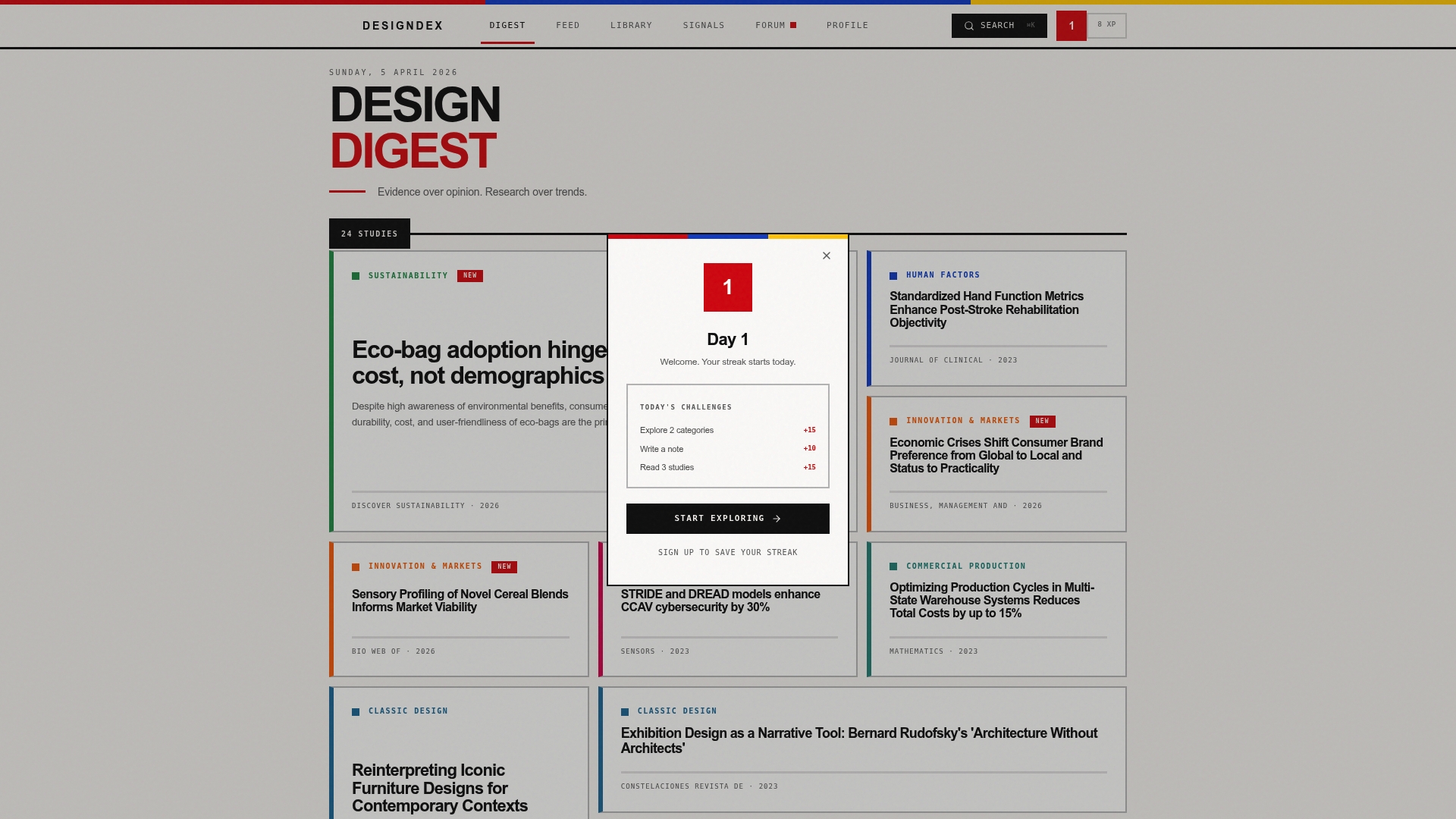
DesignDex aggregates studies on usability testing research and emerging methods like VR user empathy insights, giving professionals and students structured breakdowns of aims, methods, and real-world applications without reading full papers. Whether you are refining a heuristic checklist, selecting an industrial evaluation framework, or justifying a design decision to stakeholders, DesignDex Design Digest delivers the evidence base you need, updated daily with citation-ready content built for design practice.
Frequently asked questions
What's the key difference between UX and industrial design evaluation?
UX evaluation primarily uses heuristic reviews and usability scoring focused on interaction quality, while industrial design methods such as Kansei Engineering and lifecycle analysis address physical, emotional, and material dimensions not captured by interaction-focused frameworks.
How many evaluators are ideal for a heuristic evaluation?
Research recommends three to five evaluators for a heuristic review, as this range balances coverage and consistency while limiting redundancy in findings.
Why do many teams struggle with effective design evaluation?
Common barriers include lack of skills and user access, as documented in industrial sectors, alongside a failure to triage feedback systematically by severity and frequency before attempting revision.
How can I ensure my evaluation process leads to actionable improvements?
Prioritize issues using composite severity-frequency scoring, and supplement objective ratings with hybrid emotional methods such as Kansei Engineering to capture the unarticulated needs that numerical rubrics alone cannot surface.