

TL;DR:
- Deep understanding of users through research methods ensures evidence-based design decisions.
- Iterative testing with prototypes refines usability and validates design choices empirically.
- Incorporating empathy and inclusivity leads to more accessible and socially responsible products.
Human-centered design sits at the intersection of user advocacy and organizational reality, requiring practitioners to reconcile competing demands while maintaining rigorous focus on genuine user needs. The challenge is not simply empathizing with users; it is translating that empathy into scalable, feasible, and measurable outcomes that satisfy both the people who use a product and the stakeholders who fund it. This structured listicle presents four evidence-backed, actionable tips drawn from peer-reviewed research, offering design professionals and UX students a practical framework for elevating project outcomes through principled, user-centered methodology.
Table of Contents
- Understand your users deeply
- Apply iterative testing and feedback
- Design with empathy and inclusivity
- Bridge business goals and user needs
- Beyond the basics: What most designers miss about human-centered design
- Explore innovative solutions for human-centered design
- Frequently asked questions
Key Takeaways
| Point | Details |
|---|---|
| Know your users | Conduct research and participatory design to truly understand user needs and contexts. |
| Test and improve | Iterative usability testing leads to higher quality interfaces and better user satisfaction. |
| Empathy matters | Empathic, inclusive design broadens accessibility and deepens user engagement. |
| Balance goals | Successful designs harmonize user insights with business objectives for sustainable impact. |
Understand your users deeply
The foundation of any human-centered design process is a rigorous, systematic understanding of who your users are, what they need, and the contexts in which they operate. Without this foundation, design decisions rest on assumption rather than evidence, increasing the risk of costly rework and user dissatisfaction. Adopting a structured suite of design research methods ensures that user insights are captured accurately and translated into actionable design criteria.
Several established techniques support deep user understanding:
- Contextual interviews: Conduct semi-structured interviews in users' natural environments to surface latent needs and behavioral patterns that laboratory settings often obscure.
- Observational research (ethnography): Systematically observe users performing tasks to identify workarounds, friction points, and unarticulated requirements.
- Participatory design workshops: Involve users directly in ideation and concept development, treating them as co-designers rather than passive research subjects.
- User personas: Synthesize qualitative and quantitative data into representative archetypes that anchor design decisions to real behavioral profiles.
- Journey mapping: Visualize the end-to-end user experience across touchpoints, identifying moments of friction, delight, and unmet need.
Participatory design, in particular, yields measurable benefits beyond standard research approaches. Participatory design increases user satisfaction with learning environments, as demonstrated in research conducted across New Zealand primary schools, where co-design processes produced environments that users rated more favorably than those designed without their direct involvement. This finding underscores a critical principle: users who contribute to design decisions develop stronger ownership of outcomes, which amplifies satisfaction and adoption rates.
Involving users early and often also reduces the cost of iteration. Errors identified during research phases are significantly less expensive to correct than those discovered post-launch. Refining your research methodology tips and selecting methods appropriate to your project's scale and timeline will determine the quality of insights you generate.
Pro Tip: Leverage participatory design sessions not only to gather requirements but to stress-test early concepts. Users who co-create solutions identify feasibility constraints that internal teams routinely overlook, providing both validation and risk mitigation in a single research activity.
Apply iterative testing and feedback
After establishing the importance of understanding your users, it's crucial to test designs early and often. Iterative testing transforms abstract user insights into refined, functional design solutions by creating structured feedback loops between prototypes and real users. Each cycle of prototype, test, and refine reduces uncertainty and progressively aligns the design with validated user needs.
A structured iterative process typically follows these stages:
- Define testable hypotheses: Articulate specific assumptions about user behavior or interface performance that each testing round will validate or refute.
- Build low-fidelity prototypes: Construct paper sketches, wireframes, or clickable mockups that represent core interactions without investing in full visual design.
- Recruit representative users: Select participants who reflect the actual target audience, ensuring feedback is contextually relevant rather than generalized.
- Conduct moderated or unmoderated sessions: Observe users interacting with prototypes, capturing behavioral data, verbal feedback, and task completion rates.
- Synthesize and prioritize findings: Categorize issues by severity and frequency, then prioritize revisions that address the highest-impact pain points.
- Refine and retest: Implement targeted changes and run subsequent testing rounds until performance benchmarks are met.
Research confirms that this approach produces measurable improvements in interface quality. Usability testing enhances interface quality, with structured testing protocols consistently identifying critical usability deficiencies that heuristic evaluation alone fails to surface.
Iterative usability testing is not a quality assurance step appended to the design process; it is the mechanism through which design decisions acquire empirical validity and user legitimacy.
Integrating a robust validation workflow into your project timeline ensures that testing is treated as a core deliverable rather than an optional activity subject to budget cuts. Teams that formalize testing cadences report fewer post-launch defects and higher user retention metrics.
Pro Tip: Use quick, low-fidelity prototypes in early rounds to gather actionable feedback on information architecture and task flow before committing resources to high-fidelity visual design. This sequencing preserves budget for refinements where they generate the greatest user impact.

Design with empathy and inclusivity
Once feedback has been incorporated, empathy and inclusion are key pillars for comprehensive design. Empathic design requires practitioners to move beyond statistical user data and develop genuine experiential understanding of user challenges, particularly those experienced by populations with disabilities, limited digital literacy, or constrained device access.
Inclusive design techniques that operationalize empathy include:
- Accessibility audits: Evaluate interfaces against WCAG (Web Content Accessibility Guidelines) standards to identify barriers for users with visual, auditory, motor, or cognitive impairments.
- Multi-device testing: Validate design performance across low-bandwidth connections, older hardware, and diverse screen sizes to ensure equitable access.
- Language and literacy considerations: Design content hierarchies and microcopy that accommodate users with varying levels of domain expertise and language proficiency.
- Simulation exercises: Use tools that replicate visual impairments, motor limitations, or cognitive load to build designer empathy through direct experiential exposure.
Emerging technology is expanding the toolkit for empathy-building. VR immersion enhances user empathy in design contexts, enabling practitioners to experience simulated user perspectives with a fidelity that traditional role-playing exercises cannot replicate. VR-based empathy tools are particularly effective for designing environments and products for aging populations or users with mobility limitations.
| Dimension | Empathy-driven design | Standard design approach |
|---|---|---|
| User research depth | Contextual, observational, participatory | Survey-based, demographic |
| Accessibility integration | Embedded from project inception | Retrofitted post-development |
| Iteration frequency | Continuous, multi-round | Single or dual review cycle |
| Stakeholder alignment | User evidence informs decisions | Stakeholder preference dominates |
| Outcome measurement | Task success, satisfaction, retention | Feature delivery, timeline adherence |
Consulting a design intelligence guide provides structured frameworks for embedding empathy and inclusivity into project governance, ensuring these principles are maintained under schedule and budget pressure.
Bridge business goals and user needs
Now that you've prioritized empathy and inclusivity, it's time to integrate business imperatives. Human-centered design does not exist in isolation from commercial reality; sustainable design practice requires explicit alignment between user-centered insights and organizational objectives, including revenue targets, brand positioning, and operational scalability.
Strategies for achieving this alignment include:
- Translate user insights into business metrics: Frame usability improvements in terms of conversion rate optimization, customer lifetime value, and support cost reduction to communicate their financial relevance to non-design stakeholders.
- Involve stakeholders in user research: Expose product managers, engineers, and executives to direct user feedback sessions to build organizational empathy and reduce resistance to user-centered recommendations.
- Prioritize features using impact-effort matrices: Align user-valued features with business feasibility assessments to identify high-return design investments.
- Document design rationale with evidence: Maintain citation-ready records of research findings that justify design decisions, enabling confident stakeholder communication.
Aesthetic considerations play a measurable role in this alignment. Aesthetic elements drive product brand success, with visual design quality directly influencing brand perception, purchase intent, and customer loyalty. This finding reinforces that investment in user-centered aesthetic refinement is not a discretionary expense but a quantifiable driver of commercial performance.
| Design investment area | User satisfaction impact | Estimated ROI indicator |
|---|---|---|
| Usability testing integration | High: reduces task failure rates | Reduced support costs, higher retention |
| Inclusive design compliance | Moderate to high: expands addressable market | Regulatory risk reduction, market growth |
| Aesthetic and brand coherence | High: elevates perceived quality | Increased conversion, brand premium |
| Participatory co-design | High: increases ownership and adoption | Lower change management costs |
Referencing design analysis in UX equips practitioners with analytical frameworks for quantifying design value, enabling more persuasive business cases and more informed prioritization decisions.
Beyond the basics: What most designers miss about human-centered design
The prevailing narrative around human-centered design tends to position user empathy as both the starting point and the destination. This framing, while valuable, obscures a more demanding truth: empathy without feasibility analysis produces designs that users love but organizations cannot sustain or scale.
Over-reliance on user feedback introduces a specific risk. Users articulate preferences based on existing mental models and current experiences; they rarely anticipate transformative solutions that fall outside their frame of reference. Treating every user statement as a design directive can constrain innovation and anchor teams to incremental improvements rather than substantive advances.
The most consequential design failures are not those that ignored users; they are those that listened too literally, optimizing for stated preferences rather than underlying needs.
Practitioners who integrate advanced UX analysis alongside user research develop the capacity to distinguish between what users say, what they do, and what they actually require. This triangulation, combining behavioral observation, quantitative performance data, and organizational feasibility assessment, produces design solutions that are simultaneously user-validated and strategically viable. Organizational context, including team capability, technical infrastructure, and governance constraints, must be treated as a design variable, not an external limitation.
Explore innovative solutions for human-centered design
DesignDex provides design professionals and UX students with direct access to distilled, peer-reviewed research that supports evidence-based decision-making across every phase of the human-centered design process.
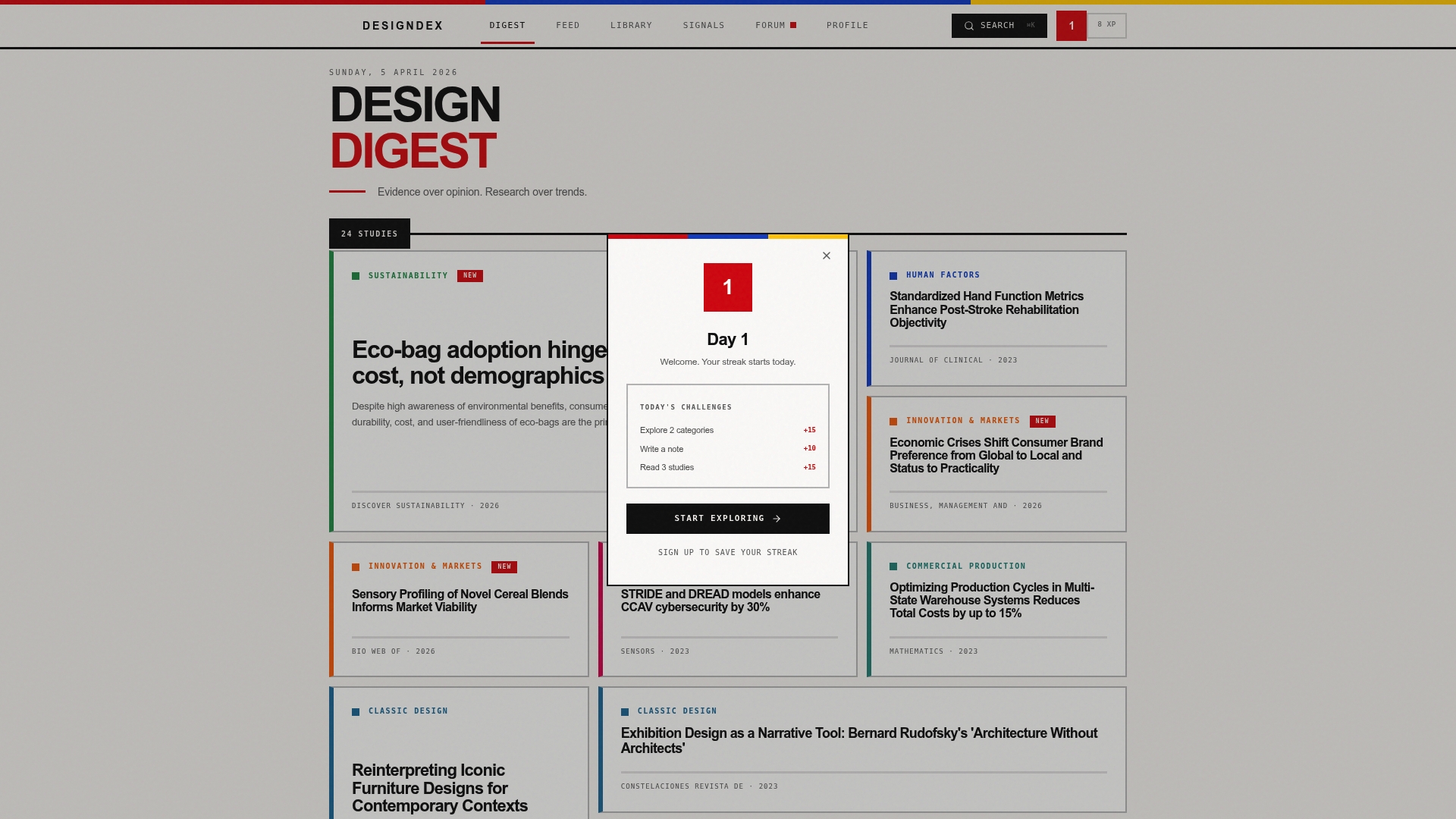
From usability testing insights that clarify how structured testing protocols improve interface quality, to VR empathy research demonstrating how immersive technology deepens designer empathy, DesignDex translates complex academic findings into structured, actionable summaries. Each study breakdown includes aims, methods, findings, and real-world applications, enabling you to justify design choices with citation-ready evidence. Explore the full suite of DesignDex resources to access daily-updated research intelligence that keeps your practice at the leading edge of human-centered design methodology.
Frequently asked questions
What is human-centered design?
Human-centered design is a framework that prioritizes the needs, behaviors, and experiences of real users throughout the design process, using methods such as participatory co-design to increase satisfaction. Participatory design increases user satisfaction with designed environments, confirming the measurable value of direct user involvement.
How does usability testing improve human-centered design?
Usability testing identifies specific interaction failures and interface deficiencies that heuristic reviews miss, enabling targeted refinements that produce measurably more effective products. Usability testing enhances interface quality by surfacing real user pain points that internal teams cannot reliably self-diagnose.
What tools can help foster empathy in design?
VR technology and immersive simulation tools allow designers to experience user challenges firsthand, building empathy that informs more inclusive and contextually appropriate design decisions. Research confirms that VR immersion enhances empathy beyond what conventional role-playing or persona exercises can achieve.
How can I align user-centered design with business goals?
By framing usability improvements as drivers of conversion, retention, and brand equity, and by documenting design rationale with peer-reviewed evidence, designers can satisfy both user and stakeholder demands. Aesthetic elements drive brand success, demonstrating that user-centered visual investment generates quantifiable commercial returns.