

TL;DR:
- Integrating systematic design analysis from the start improves user satisfaction and reduces rework.
- Structured evaluation methods like usability testing and participatory design produce measurable benefits.
- Continuous, evidence-based analysis directs creative work and lowers project risks across all scales.
Many designers treat design analysis as a final-stage checkpoint, a review that happens only after the work is nearly done. This assumption is costly. Evidence from peer-reviewed research consistently shows that systematic design analysis, when integrated from ideation through execution, reduces rework, surfaces hidden usability issues, and produces measurably better outcomes for users and organizations alike. This article covers the foundational concepts behind design analysis, its proven impact on user satisfaction and business performance, the most effective frameworks for applying it, and real-world case examples from both UX and industrial design contexts.
Table of Contents
- What is design analysis and why is it essential?
- How design analysis improves outcomes for users and businesses
- Critical frameworks and methods for effective design analysis
- Applying design analysis: case examples from UX and industrial design
- The uncomfortable truth most experts miss about design analysis
- Boost your design impact with evidence-based analysis
- Frequently asked questions
Key Takeaways
| Point | Details |
|---|---|
| Design analysis defined | Design analysis is a structured process to ensure user and business goals are met in UX and product design. |
| Delivers real results | Evidence shows design analysis improves usability, satisfaction, and business performance. |
| Use proven frameworks | Applying methods like crits and usability testing boosts the quality and impact of design work. |
| Critical at all project stages | Analysis should be an ongoing process from concept through final execution, not a late-stage add-on. |
What is design analysis and why is it essential?
Design analysis is the structured, evidence-informed process of evaluating design decisions against user needs, functional requirements, and business objectives. It is not the same as a design review, which typically focuses on approvals and compliance, nor is it identical to a design critique, which emphasizes qualitative feedback on creative choices. Design analysis is broader: it integrates quantitative data, user behavior observations, ergonomic assessments, and stakeholder input to identify gaps between intended and actual performance.
In UX, design analysis might involve evaluating information architecture against task completion rates, or assessing visual hierarchy through eye-tracking data. In industrial design, it could mean applying load analysis to structural components or reviewing ergonomic fit against anthropometric data. Both disciplines share a core purpose: identifying hidden issues before they become embedded in a final product.
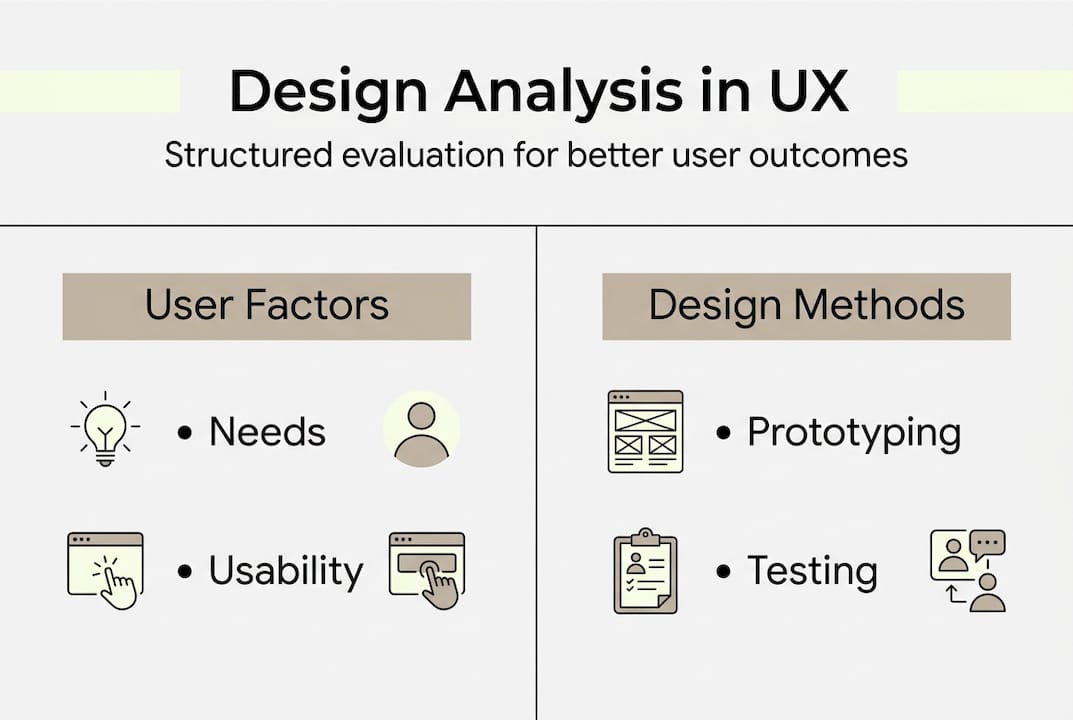
The distinction matters because conflating analysis with critique or review often leads to superficial evaluations. Structured design analysis approaches go beyond aesthetic preferences to interrogate whether a design actually solves the problem it was built to address. This is where significant value is generated.
Consider what happens when feedback processes lack structure. Teams frequently waste time debating low-priority visual details (a phenomenon known as bikeshedding) or defer to the most senior voice in the room regardless of evidence (the HiPPO effect, short for Highest Paid Person's Opinion). Research confirms that design critiques structured around user needs and business objectives actively prevent these pitfalls, keeping teams focused on decisions that move the work forward.
Key characteristics that distinguish rigorous design analysis:
- Evidence-based evaluation: Decisions are assessed against user data, not personal preference.
- Multi-dimensional scope: Analysis covers usability, functionality, aesthetics, ergonomics, and business alignment simultaneously.
- Iterative application: Analysis is not a one-time event; it recurs at each project phase.
- Stakeholder alignment: Findings are structured to communicate clearly across disciplines.
"Design critiques, when structured correctly, align feedback with user needs and business objectives, avoiding pitfalls like bikeshedding or HiPPO-driven decisions that derail project momentum." — Jakob Nielsen
For those working across graphic design analysis contexts, the same principles apply: systematic evaluation of how visual choices serve communicative and functional goals produces stronger, more defensible outcomes than intuition alone.
How design analysis improves outcomes for users and businesses
The practical impact of design analysis is well-documented across multiple research domains. When teams invest in structured evaluation methods, they consistently report improvements in usability, user satisfaction, and downstream business metrics including reduced support costs and increased user retention.

Usability testing, one of the most widely applied design analysis methods, directly improves the quality of interactive interfaces. Studies confirm that usability testing benefits extend beyond identifying surface-level errors; they reveal systemic interaction failures that would otherwise persist into production. The result is a measurably higher-quality interface that reduces friction for end users.
Participatory design, a method that involves end users directly in the design process, produces similarly strong results. Research from New Zealand primary schools demonstrates that participatory design impact on user satisfaction is significant even in non-digital contexts, reinforcing the universality of user-centered analysis across design disciplines.
| Outcome metric | Without formal analysis | With formal analysis |
|---|---|---|
| Usability issue detection rate | Low (post-launch) | High (pre-launch) |
| User satisfaction scores | Variable | Consistently higher |
| Rework and revision cycles | Frequent | Reduced |
| Support and error costs | Elevated | Measurably lower |
| Stakeholder alignment | Inconsistent | Structured and documented |
Beyond usability, design analysis generates measurable business value. Teams that embed analysis early in the design process report fewer late-stage revisions, faster stakeholder sign-off, and stronger alignment between product performance and market expectations. These outcomes translate directly into reduced time-to-market and lower development costs.
Pro Tip: Involve users at the earliest possible stage, even with rough prototypes or sketches. Research consistently shows that early user input changes project direction in ways that prevent costly late-stage corrections. A five-minute hallway test in week one is worth more than a formal usability study in week ten.
The business case is clear: design analysis is not an overhead cost. It is a risk-reduction mechanism that protects investment in development and increases the probability of market success.
Critical frameworks and methods for effective design analysis
With the impact of design analysis established, the next challenge is selecting and applying the right method for each project context. Three frameworks dominate professional practice: structured design critiques, usability testing, and participatory design. Each serves a distinct purpose and fits different project phases.
| Framework | Best context | Core strength | Key limitation |
|---|---|---|---|
| Structured design critique | Mid-project, team reviews | Aligns feedback with objectives | Requires skilled facilitation |
| Usability testing | Prototype and post-launch | Reveals real interaction failures | Resource-intensive at scale |
| Participatory design | Early ideation, community projects | Embeds user voice in decisions | Slower iteration cycles |
Structured design critiques, when facilitated correctly, align feedback with objectives rather than devolving into subjective debate. The facilitator's role is to keep discussion anchored to user needs and measurable goals. Without this structure, critiques frequently become forums for personal preference, producing feedback that is neither actionable nor evidence-based.
The structured analysis process also prevents two of the most damaging group dynamics in design: bikeshedding (debating trivial details at the expense of substantive issues) and HiPPO dominance (allowing seniority to override evidence). Both phenomena are well-documented in design team research and both are preventable with the right facilitation protocol.
Implementing a productive design analysis session requires a clear sequence:
- Define the evaluation criteria before the session begins, grounded in user research and project objectives.
- Separate observation from interpretation: Document what you see in the design before drawing conclusions about why it works or fails.
- Prioritize findings by impact: Not all issues are equal; rank by user impact and business risk.
- Assign ownership and timelines to each finding to ensure analysis translates into action.
- Document and share outputs in a format accessible to all stakeholders, including non-designers.
Pro Tip: When facilitating a design critique, distribute a one-page brief in advance that outlines the design's objectives, target users, and key constraints. This single step dramatically reduces off-topic feedback and keeps the session focused on daily design intelligence that actually moves the project forward.
For those working in spatial or exhibition design analysis contexts, the same structured approach applies: define the visitor experience objectives first, then evaluate the design against those criteria systematically.
Applying design analysis: case examples from UX and industrial design
Theory gains credibility through application. The following case examples illustrate how design analysis methods produce measurable results across both digital and physical design contexts.
In UX research, virtual reality (VR) has emerged as a powerful tool for enhancing the empathy component of user-centered analysis. Studies confirm that VR and empathy are directly linked: immersive VR experiences increase a designer's capacity to understand and internalize user perspectives, leading to more empathetic and functionally appropriate design decisions. This finding has direct implications for teams working on accessibility, healthcare interfaces, and any context where the designer's lived experience differs significantly from the end user's.
In industrial design, the application of Quality Function Deployment (QFD), a structured method for translating user needs into engineering specifications, demonstrates how systematic analysis reduces physical risk. Research shows that safer process design through QFD integration proactively reduces work-related musculoskeletal disorders by identifying ergonomic risks during the design phase rather than after deployment.
Key outcomes observed across these and related case studies:
- Empathy increase: VR-based analysis tools measurably improve designer understanding of user context and need.
- Risk reduction: QFD-integrated analysis identifies ergonomic and safety risks before physical prototyping begins.
- Engagement boosts: Participatory design methods increase user engagement with final products by embedding user input throughout the process.
- Iteration efficiency: Teams using structured analysis frameworks complete fewer revision cycles while producing higher-quality outputs.
- Stakeholder confidence: Evidence-backed analysis findings are easier to communicate and defend to clients and leadership.
The common thread across all these examples is that analysis is not passive observation. It is an active, structured intervention that changes the trajectory of a project. Teams that treat it as optional consistently produce weaker outcomes than those that treat it as foundational.
Actionable insight: when starting a new project, map your intended analysis methods to each project phase explicitly. Identify which method serves ideation, which serves prototyping, and which serves pre-launch validation. This mapping prevents the most common failure mode: saving all analysis for the end.
The uncomfortable truth most experts miss about design analysis
The dominant narrative positions design analysis as a tool for large organizations with dedicated research teams and generous timelines. This framing is both inaccurate and damaging. The evidence does not support the idea that rigorous analysis requires scale. It requires discipline.
Small teams and independent designers who skip structured analysis rarely do so because they lack time. They do so because they conflate speed with progress. Projects that bypass systematic evaluation in early phases consistently accumulate what engineers call technical debt: deferred problems that compound in cost and complexity over time. The same principle applies in design.
The harder truth is that analysis does not slow creative work. It directs it. Without structured evaluation, creative energy is frequently spent solving the wrong problem with precision. The most original design solutions in documented case studies almost always emerge from a thorough understanding of constraints, and that understanding comes from analysis.
Integrating design news and insights from peer-reviewed research into your practice is not about adding bureaucratic process. It is about replacing guesswork with evidence, at any scale.
Boost your design impact with evidence-based analysis
Every design decision you make carries risk. The question is whether that risk is informed or assumed. DesignDex exists to close that gap, aggregating peer-reviewed research into structured, citation-ready summaries that support faster, more defensible design decisions.
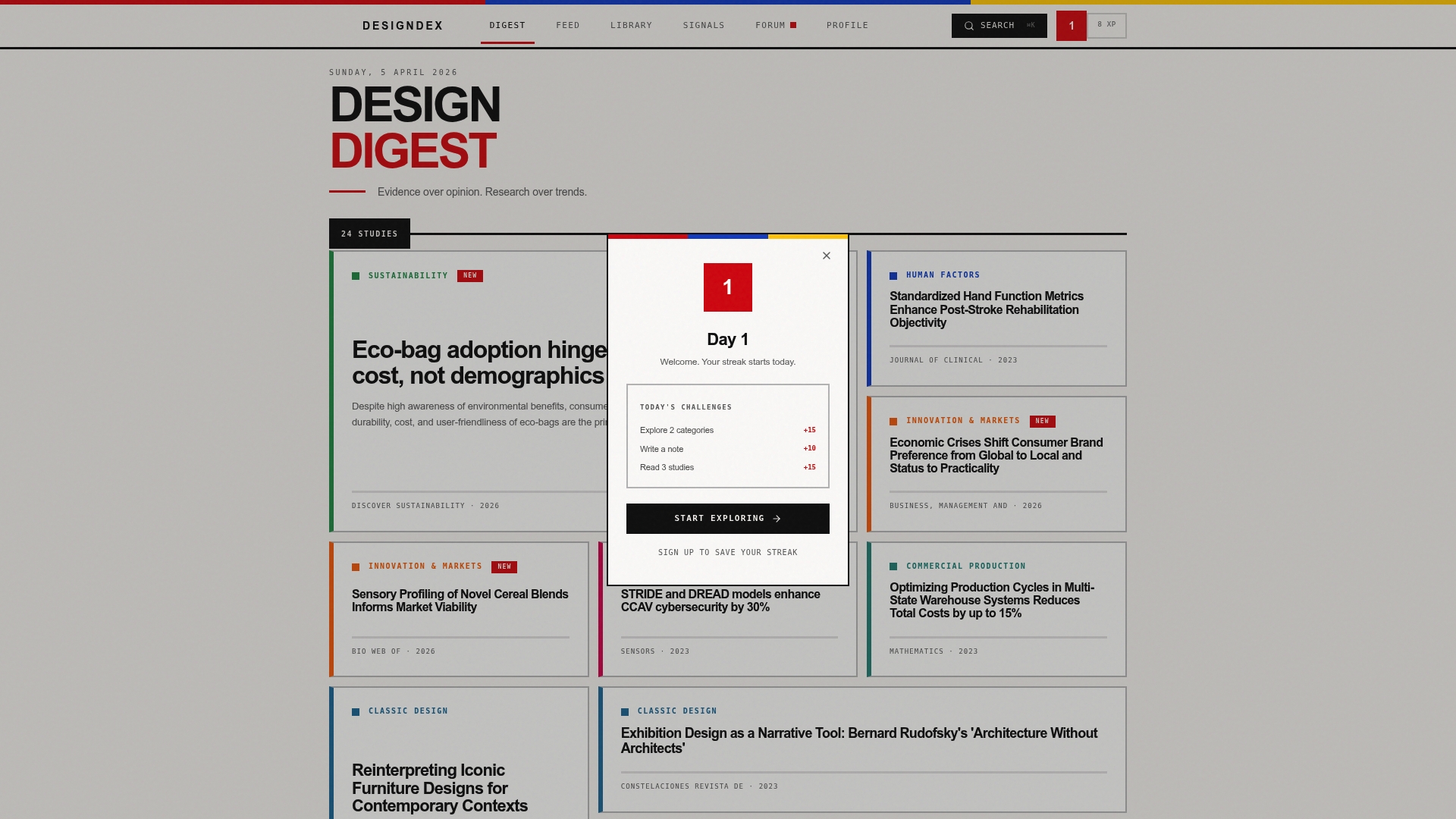
Explore the VR user empathy study to see how immersive analysis tools are reshaping UX practice, or review the latest usability testing research to strengthen your next interface evaluation. DesignDex design research summaries are updated daily, giving you continuous access to the evidence your projects need. Ground your next design decision in research, not intuition.
Frequently asked questions
What is design analysis in UX and industrial design?
Design analysis is the systematic evaluation of design concepts and decisions against user needs, functional requirements, and business objectives; it goes beyond critique by integrating quantitative data and structured feedback processes. Research confirms that feedback structured around user needs produces more actionable and defensible outcomes than unstructured review.
How does design analysis benefit a project?
Effective design analysis uncovers usability issues early, improves user satisfaction, and reduces costly late-stage revisions. Studies show that interface quality improvements are directly attributable to structured usability testing integrated throughout the design process.
When should design analysis be performed in a project?
Design analysis should be embedded at every project phase, from early ideation through final execution, rather than reserved for end-stage review. Structured critique applied early prevents project misdirection and reduces the compounding cost of deferred design problems.
What are common design analysis methods?
The most widely applied methods include structured design critiques, usability testing, participatory design, and comparative framework analysis, each suited to different project phases and contexts. Research confirms that participatory design methods directly and measurably increase user satisfaction across both digital and physical design contexts.
Recommended
- Usability Testing Enhances Interactive Interface Quality — Design Research Summary | DesignDex
- Visual Communication Design Enhances Animated Film Aesthetics and Audience Engagement — Design Research Summary | DesignDex
- Contemporary Art's Influence Elevates Graphic Design Beyond Pure Functionality — Design Research Summary | DesignDex
- Aesthetic Elements Drive Product Brand Success — Design Research Summary | DesignDex