

TL;DR:
- Design research is a structured, empirical discipline that informs human-centered design decisions.
- Combining qualitative and quantitative methods through iterative sequencing provides robust insights.
- Genuine curiosity and interpretive judgment are essential to effective, impactful design research.
Design research is frequently reduced to a single activity: asking users what they want. This misconception leads to shallow insights, misaligned solutions, and wasted project cycles. In reality, design research methodology is a structured, empirical discipline that generates the evidence base designers need to make defensible, human-centered decisions. Whether you are a UX practitioner mapping digital touchpoints or an industrial designer evaluating ergonomic constraints, the methodology you apply determines the quality of your outcomes. This article covers the core pillars, primary methods, and practical integration strategies that translate rigorous research into actionable design.
Table of Contents
- What is design research methodology?
- Qualitative vs. quantitative: Methods and when to use them
- Integrating research into the design process
- Practical application and real-world tips
- The uncomfortable truth about design research most miss
- Start applying design research with DesignDex
- Frequently asked questions
Key Takeaways
| Point | Details |
|---|---|
| Empirical insight drives design | Design research uses structured, evidence-based methods to inform impactful design solutions. |
| Mix methods for clarity | Combining qualitative and quantitative research avoids blind spots and delivers actionable answers. |
| Iterate throughout projects | Incorporate research findings at each project stage for better results and fewer costly mistakes. |
| Context shapes research | Different design challenges require tailored research approaches, not rigid formulas. |
What is design research methodology?
With the context set, let's establish exactly what design research methodology means and why it's essential for impactful design.
Design research methodology is a structured approach to gathering user insights through empirical investigation to inform human-centered design decisions in UX and industrial design. This definition distinguishes it sharply from generic market research, which typically prioritizes preference data and purchase intent over behavioral understanding and contextual need.
"Design research methodology operates at the intersection of social science rigor and creative practice, producing evidence that neither discipline could generate alone."
Three core pillars define the discipline:
- Empirical grounding: Findings derive from observable, measurable user behavior rather than assumption or convention.
- User-driven inquiry: Research questions center on real human needs, goals, and constraints within authentic contexts.
- Iterative validation: Insights are tested, refined, and re-tested across project phases rather than collected once and archived.
In UX design, methodology governs how teams conduct contextual inquiries, usability evaluations, and longitudinal diary studies. In industrial design, it shapes ergonomic assessments, material interaction studies, and field observations of product use in natural environments. The scope differs; the epistemological commitment to evidence does not.
A persistent misconception frames design research as data collection for its own sake, producing reports that inform no decision. Effective methodology is purposive: every method selected maps to a specific research question, and every finding connects to a design implication. You can explore the full spectrum of design research methods to see how method selection aligns with project objectives.
Understanding what is UX research at its foundation reveals that the discipline is not about confirming existing ideas. It is about surfacing what designers do not yet know, including latent needs users cannot articulate directly. This distinction separates methodology from opinion-gathering and positions design research as a rigorous investigative practice.
Qualitative vs. quantitative: Methods and when to use them
Now that we understand what design research methodology is, let's compare its main categories: qualitative and quantitative research.
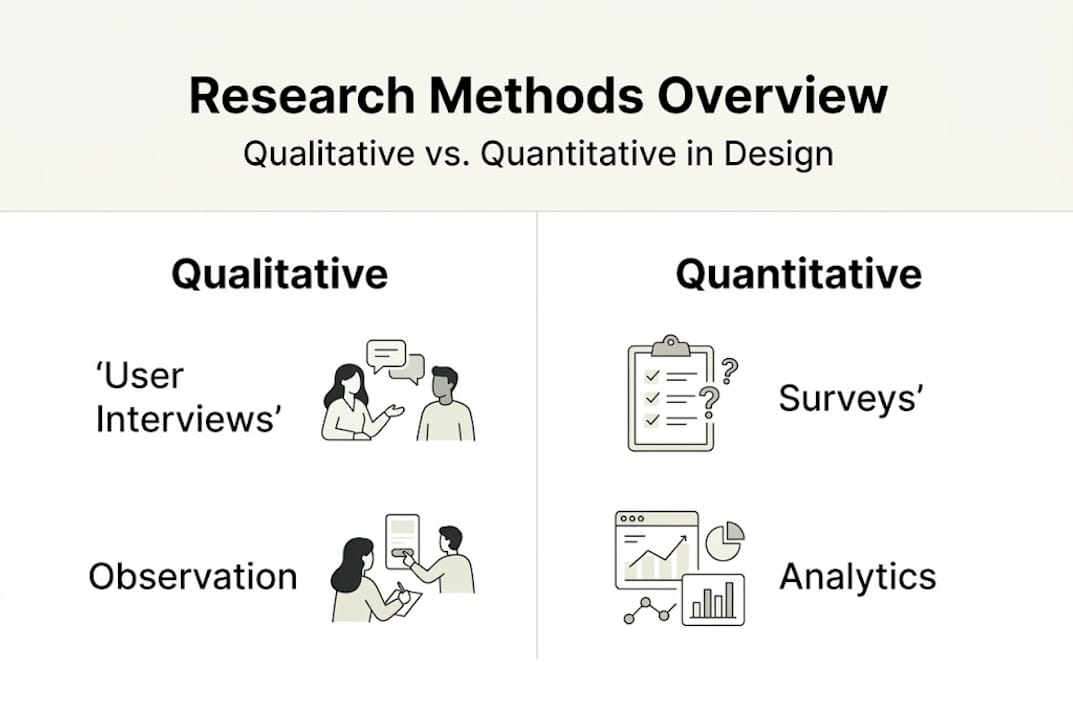
Core mechanics divide into qualitative, which explores "why" via interviews, usability testing, and observations, and quantitative, which measures "what" and "how many" via surveys, A/B tests, and analytics. Each category serves distinct research objectives and operates within different constraints of sample size, time, and analytical rigor.
| Dimension | Qualitative | Quantitative |
|---|---|---|
| Primary question | Why / How | What / How many |
| Typical methods | Interviews, ethnography, usability testing | Surveys, A/B tests, analytics |
| Sample size | 5 to 12 participants | Hundreds or more |
| Output | Themes, patterns, narratives | Statistics, metrics, conversion rates |
| Best project stage | Early discovery, concept evaluation | Late validation, performance measurement |
| Limitation | Not generalizable | Lacks contextual depth |
Mixed-method sequencing produces the most robust, actionable insights. A validated sequence for most design projects follows this structure:
- Conduct semi-structured interviews to surface behavioral patterns and unmet needs (qualitative discovery).
- Synthesize themes into hypotheses that can be tested at scale.
- Deploy a structured survey to measure prevalence of identified patterns across a larger population.
- Run usability tests on prototypes to observe task completion and error rates.
- Execute A/B or multivariate tests on live interfaces to quantify the impact of design changes.
This sequence prevents single-method bias, a common error where teams over-rely on interviews and miss statistically significant patterns, or over-rely on analytics and miss the contextual reasons behind behavioral anomalies. Reviewing design analysis in UX demonstrates how synthesis bridges both data types into coherent design direction.
Pro Tip: Before selecting a method, write the research question in one sentence. If the question contains "why" or "how does it feel," start qualitative. If it contains "how many" or "which performs better," start quantitative. This discipline prevents method selection driven by convenience rather than rigor.
A usability testing case study illustrates how iterative usability evaluation, combined with quantitative performance metrics, produces measurable interface quality improvements that neither method achieves independently. Reviewing UX research methods in their full range reinforces why method pluralism is the professional standard.

Integrating research into the design process
Having explored the main research methods, let's see how insights are integrated directly into the design process.
Within Design Thinking frameworks from IDEO and d.school, research occurs in the Empathize stage through user observation and interviews, and in the Define stage through synthesis of insights into personas and problem statements. These two stages establish the evidence foundation that all subsequent ideation, prototyping, and testing activities build upon.
Research activities shift in character as projects advance through phases:
- Early phase (Empathize): Exploratory methods dominate; contextual inquiry, ethnographic observation, and open-ended interviews generate rich, unstructured data about user contexts and motivations.
- Mid phase (Define and Ideate): Synthesis activities translate raw data into structured artifacts; affinity mapping, persona construction, and journey mapping organize findings into actionable design direction.
- Late phase (Prototype and Test): Evaluative methods take precedence; usability testing, heuristic evaluation, and A/B testing measure whether design solutions address the problems identified in earlier phases.
| Phase | Research inputs | Core activities | Key deliverables |
|---|---|---|---|
| Empathize | Field observations, interview transcripts | Contextual inquiry, diary studies | Raw behavioral data, video recordings |
| Define | Affinity clusters, behavioral patterns | Persona development, journey mapping | Personas, problem statements, HMW questions |
| Prototype | Wireframes, prototypes | Cognitive walkthroughs, expert reviews | Annotated prototypes, heuristic reports |
| Test | Task scenarios, metrics | Usability testing, A/B testing | SUS scores, task completion rates, error logs |
Key questions answered at each stage include:
- Empathize: What are users actually doing, and what contexts shape their behavior?
- Define: What is the core problem worth solving, and for whom?
- Prototype: Does this solution address the defined problem without introducing new friction?
- Test: Does the refined solution perform measurably better than the baseline?
Exploring design thinking in practice and reviewing a structured design validation workflow clarifies how research outputs translate into specific design decisions at each stage. Understanding design thinking explained provides the broader framework within which these research integrations operate.
Practical application and real-world tips
With research woven into the design process, how is all this actually applied in real-world student and professional projects?
The build-test-learn loop is the operational core of applied design research. Begin with qualitative discovery to understand the problem space, then validate findings quantitatively before committing to a design direction. Empirical benchmarks such as System Usability Scale scores and A/B test conversion lifts, including documented improvements exceeding 30% in controlled case studies, provide objective criteria against which design iterations are measured.
A practical application sequence for student and professional projects:
- Define research objectives before selecting any method; ambiguous objectives produce ambiguous findings.
- Conduct 5 to 8 user interviews to identify behavioral patterns and surface latent needs in the problem domain.
- Synthesize findings into a prioritized list of design requirements grounded in observed behavior.
- Prototype at appropriate fidelity and conduct task-based usability tests with 5 participants to identify critical failure points.
- Instrument the live or high-fidelity prototype with analytics and run A/B tests to quantify the impact of specific design changes.
- Document SUS scores and task completion rates as objective evidence of design performance for portfolio and stakeholder reporting.
Common pitfalls to avoid in project research include recruiting participants who are too familiar with the product domain, writing leading interview questions that confirm existing assumptions, stopping research after a single round of usability testing, and failing to connect research findings explicitly to design decisions in project documentation.
Pro Tip: Digital and physical design problems require different method adaptations. UX projects benefit from remote moderated testing and clickstream analytics; industrial design projects require in-situ observation and physical prototype interaction studies. Applying digital-only methods to physical product research, or vice versa, systematically underrepresents critical contextual factors.
Reviewing design research in action and examining ethnographic research in industrial design demonstrates how contextual sensitivity in method selection produces richer, more transferable insights. For a broader view of design research in practice, cross-disciplinary case studies reinforce the value of methodological rigor across product categories.
The uncomfortable truth about design research most miss
Now that you have the tools to apply design research, here's an honest perspective on what's often overlooked in this field.
The most significant failure mode in design research is not methodological incompetence. It is methodological compliance without genuine curiosity. Many practitioners execute research as a procedural requirement, completing interview guides, generating persona templates, and filing usability reports without ever asking whether the findings are actually changing their understanding of the problem.
Checklists and standardized templates create the appearance of rigor while suppressing the interpretive judgment that distinguishes strong research from weak research. The designers who produce the most defensible, impactful work treat research as a lens through which they continuously re-examine their assumptions, not as a task to be completed before ideation begins.
Over-reliance on quantitative data compounds this problem. Metrics confirm what is happening; they rarely explain why. Synthesis, the act of sitting with messy qualitative data and identifying non-obvious patterns, is where genuine insight originates. Reviewing design analysis lessons reinforces that analytical depth, not data volume, determines the quality of design decisions. Prioritize understanding people over accumulating data points.
Start applying design research with DesignDex
To make the leap from theory to action, here's where to find expert-vetted design research insight and tools.
DesignDex distills peer-reviewed UX and industrial design studies into structured, citation-ready summaries that map directly to your project needs. Instead of navigating full academic papers, you access concise breakdowns of research aims, methods, findings, and real-world applications, updated daily.
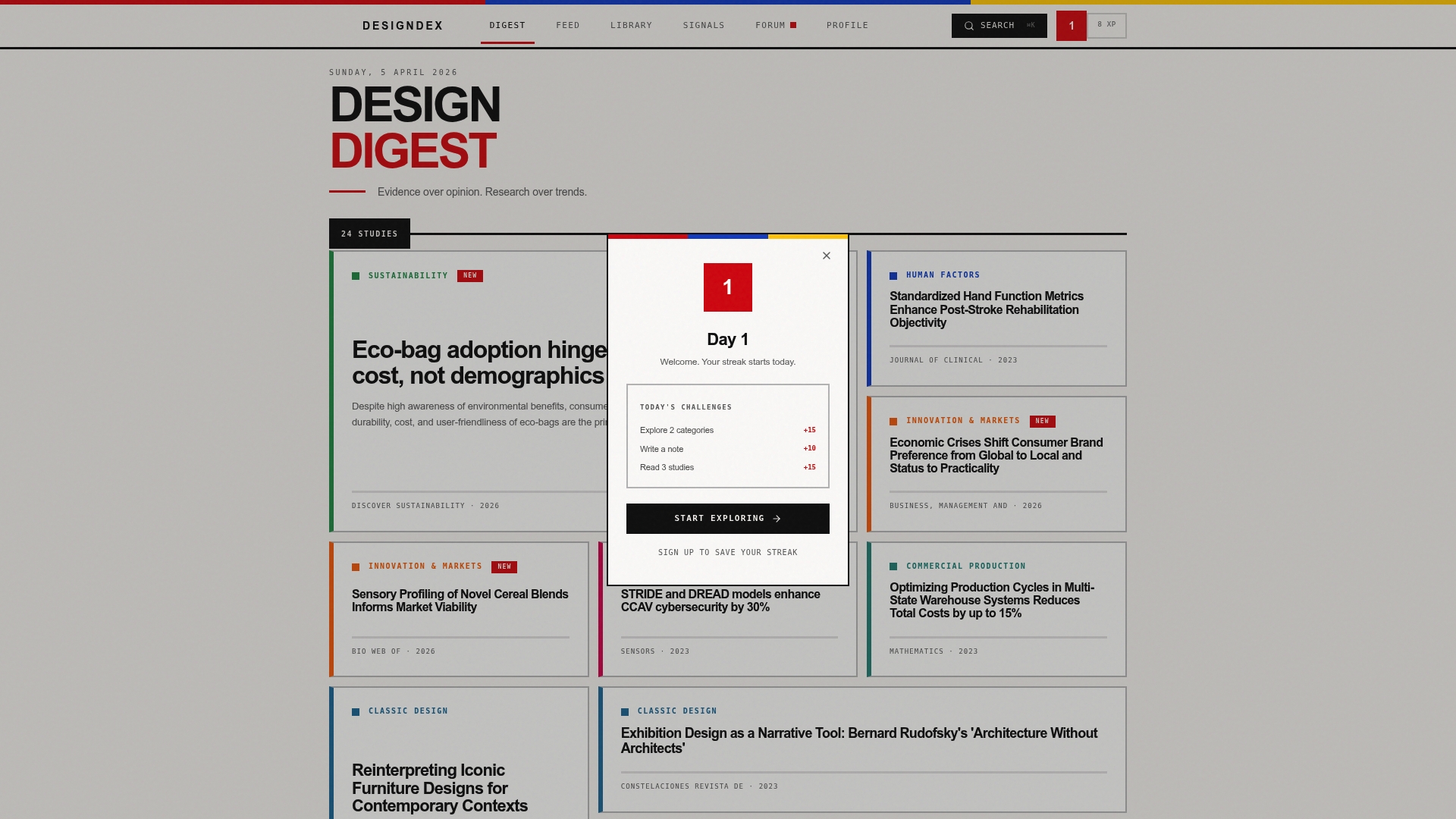
Whether you are validating a design decision with a stakeholder or building a research plan for a student project, DesignDex insights provide the evidence base you need. Explore peer-reviewed usability testing research and VR empathy research to see how emerging methodologies are shaping the discipline. DesignDex transforms research from a time-consuming obligation into a practical, decision-support asset for every stage of your design process.
Frequently asked questions
What is the main goal of design research methodology?
Its primary goal is to gather and analyze user data through empirical investigation to guide informed, human-centered design decisions in both UX and industrial design contexts.
When should you use qualitative vs. quantitative research in design?
Apply qualitative methods in early project stages to explore user needs and motivations; shift to quantitative methods when statistically validated results or measurement of design change impact are required.
How many users do you need for design research?
Small qualitative studies achieve saturation with 5 to 12 users; quantitative research requires hundreds of participants to produce statistically reliable results.
What are common mistakes in applying design research?
Relying on a single method, ignoring contextual factors, and failing to connect research findings to specific design decisions are the most frequently documented errors in both student and professional practice.