

TL;DR:
- Selecting the appropriate research method is critical to ensure relevant, effective design insights.
- Combining qualitative and quantitative methods enhances understanding and reduces bias in findings.
- Method choice should align with project goals, user access, timeline, and ethical considerations.
Selecting the right research method at the outset of a design project is one of the most consequential decisions a designer or researcher can make. A misaligned method produces data that fails to answer the core design question, wastes resources, and can steer a project toward solutions that miss user needs entirely. Whether you are validating an early-stage concept, mapping user journeys for a complex interface, or conducting field research for an industrial product, the method you choose shapes every insight that follows. This article presents a structured list of core design research methods, evaluation criteria, a comparative framework, and situational guidance to support more informed, evidence-based method selection.
Table of Contents
- How to approach selecting design research methods
- Top design research methods explained
- Comparison of design research methods
- Situational guidance: Which methods fit your project?
- Why your design research should mix methods for real impact
- Explore leading design research in action
- Frequently asked questions
Key Takeaways
| Point | Details |
|---|---|
| Selection matters | The right research method can transform your project outcomes. |
| Method variety | Using multiple methods provides deeper, more reliable insights. |
| Situational fit | Tailor research methods to your project's unique constraints and goals. |
| Evidence-based advice | Recent studies confirm the practical value of usability and participatory design methods. |
How to approach selecting design research methods
Method selection is not a neutral administrative step; it is a research design decision with direct consequences for the quality and applicability of findings. Design analysis improves project outcomes by ensuring that relevant methods are chosen relative to the specific research question, user population, and project constraints. Selecting a survey when you need to understand nuanced user motivations, for instance, produces superficial data that cannot support meaningful design decisions.
Several criteria should govern method selection:
- User type and access: Are participants expert users, general consumers, or vulnerable populations? Access constraints shape feasibility.
- Project goals: Exploratory research calls for qualitative methods; validation research typically requires quantitative approaches.
- Timeline and budget: Some methods, such as longitudinal diary studies, demand weeks of data collection; others, like guerrilla usability tests, can be executed in a single afternoon.
- Existing knowledge base: When prior research exists, methods can build on established findings rather than starting from scratch.
- Regulatory or ethical requirements: Certain user groups and contexts require IRB approval or specific consent protocols.
The qualitative versus quantitative distinction is foundational. Qualitative methods, including interviews, observations, and ethnographic studies, generate rich, contextual data about motivations and behaviors. Quantitative methods, such as surveys and analytics, produce statistically generalizable findings. Design validation methods often combine both to triangulate findings and reduce the risk of systematic bias. Adopting user-friendly research practices from the outset reduces participant burden and improves data quality.
Pro Tip: Map your chosen methods to specific project stages: discovery, definition, ideation, and testing. This prevents the common error of applying evaluative methods too early, before a design concept is sufficiently developed to generate meaningful feedback.
Top design research methods explained
With a framework for evaluation in place, the following core methods constitute the essential toolkit for UX and industrial design research. Each carries distinct strengths, limitations, and optimal deployment contexts.
- User interviews: Semi-structured conversations that elicit motivations, mental models, and pain points. Best deployed during discovery phases. Interviews generate rich qualitative data but are time-intensive to analyze and subject to social desirability bias.
- Contextual observation: Researchers observe users in their natural environment without intervention. This method surfaces behaviors that participants cannot or do not articulate in interviews. It is particularly effective for industrial product research and workplace tool design.
- Usability testing: Participants complete defined tasks using a prototype or live product while researchers observe and record errors, hesitations, and completion rates. Usability testing directly improves interface quality, making it the most direct method for evaluating interactive systems.
- Surveys: Structured questionnaires distributed to large samples. Surveys excel at quantifying attitudes and measuring satisfaction at scale, but they cannot capture behavioral nuance or uncover unknown variables.
- Field studies: Extended immersive research in a user's environment, often combining observation, interviews, and artifact analysis. An ethnographic research case study illustrates how field studies can surface culturally embedded design values that laboratory methods miss entirely.
- Diary studies: Participants self-report experiences, behaviors, or emotions over an extended period using structured logs. Diary studies are uniquely suited to capturing longitudinal behavioral change and episodic use patterns.
The role of UX/UI in shaping user perception further underscores why method choice must align with the artifact being studied. Research on design in graphic contexts demonstrates that aesthetic and functional dimensions require different methodological lenses.

Pro Tip: Combining at least two methods, one qualitative and one quantitative, increases insight depth and reduces the risk that findings reflect method artifacts rather than genuine user behavior.
Comparison of design research methods
With each technique examined individually, a side-by-side comparison enables more precise decision-making under real project constraints.
| Method | Time required | Relative cost | Best for | Key limitation |
|---|---|---|---|---|
| User interviews | Medium | Low to medium | Discovery, motivation mapping | Social desirability bias |
| Contextual observation | High | Medium | Behavioral research, industrial design | Observer effect |
| Usability testing | Low to medium | Low | Interface evaluation, iteration | Limited sample size |
| Surveys | Low | Low | Attitudinal measurement at scale | No behavioral depth |
| Field studies | Very high | High | Cultural and environmental context | Resource intensive |
| Diary studies | High | Medium | Longitudinal behavior, episodic use | Participant dropout |
The design validation workflow benefits most from methods that produce both behavioral and attitudinal data, particularly when iterating on complex systems. Emerging approaches are also reshaping the comparison landscape: VR immersion enhances user empathy in design, suggesting that immersive simulation may serve as a viable complement to traditional observation in contexts where physical access to real environments is constrained.
"The value of a research method is not intrinsic; it is entirely contingent on how well it aligns with the research question, the user population, and the stage of the design process." This principle should anchor every method selection decision, regardless of team size or project budget.
For UX projects operating under tight timelines, usability testing and surveys offer the most favorable cost-to-insight ratio. For industrial design projects requiring deep contextual understanding, field studies and contextual observation remain the gold standard despite their resource demands.
Situational guidance: Which methods fit your project?
A summary comparison is helpful, but real projects introduce unique challenges. Here is how to adapt your method selection to specific scenarios.
Common project scenarios and recommended methods:
- Startup MVP validation: Guerrilla usability testing and brief user interviews provide rapid, actionable feedback without requiring large participant pools or extended timelines.
- Accessibility research: Contextual observation combined with interviews with users who have disabilities surfaces barriers that standard usability tests frequently miss.
- International market study: Diary studies and field research conducted by local research partners mitigate cultural interpretation errors that remote methods introduce.
- Educational environment design: Participatory design increases user satisfaction in learning environments, demonstrating that co-design methods are particularly effective when end users are children or community stakeholders.
- Hybrid and remote teams: Remote moderated usability testing and asynchronous diary studies via digital platforms maintain research quality when in-person access is unavailable.
| Scenario | Recommended method | Secondary method |
|---|---|---|
| Tight timeline (under 2 weeks) | Guerrilla usability testing | Remote survey |
| Deep behavioral insight needed | Field study | Diary study |
| Large-scale attitudinal data | Survey | Analytics review |
| Early concept exploration | User interviews | Participatory design |
| Accessibility evaluation | Contextual observation | Expert heuristic review |
For projects at the intersection of ecology and design, biomimicry-driven design research demonstrates how specialized research frameworks can generate innovation by drawing on natural systems, a reminder that method selection should remain open to non-conventional approaches when the design problem demands it.
Why your design research should mix methods for real impact
A persistent pattern in design practice is the overreliance on a single method, most often user interviews or usability testing, as though one instrument can capture the full complexity of human behavior and context. This is a structural error, not a resource limitation. Even small teams with constrained budgets can execute a two-method approach: a short round of interviews followed by a targeted usability test, or a survey paired with contextual observation of a small sample.
Projects that rely exclusively on interviews frequently miss behavioral data that contradicts what participants report. Users consistently describe their behavior inaccurately, not from deception, but because self-report is an imperfect instrument. Conversely, teams that rely only on usability testing generate task-completion data without understanding the motivational context that drives those tasks in the first place.
Why design analysis matters is precisely this: structured multi-method research produces findings that are both richer and more defensible. Mixed-method designs are not a luxury reserved for large research teams. They are the standard that separates design decisions grounded in evidence from those grounded in assumption. Adopt a minimum two-method protocol on every project, regardless of scope, and treat single-method findings as preliminary rather than conclusive.
Explore leading design research in action
Ready to put these methods into practice and see them applied in real research contexts?
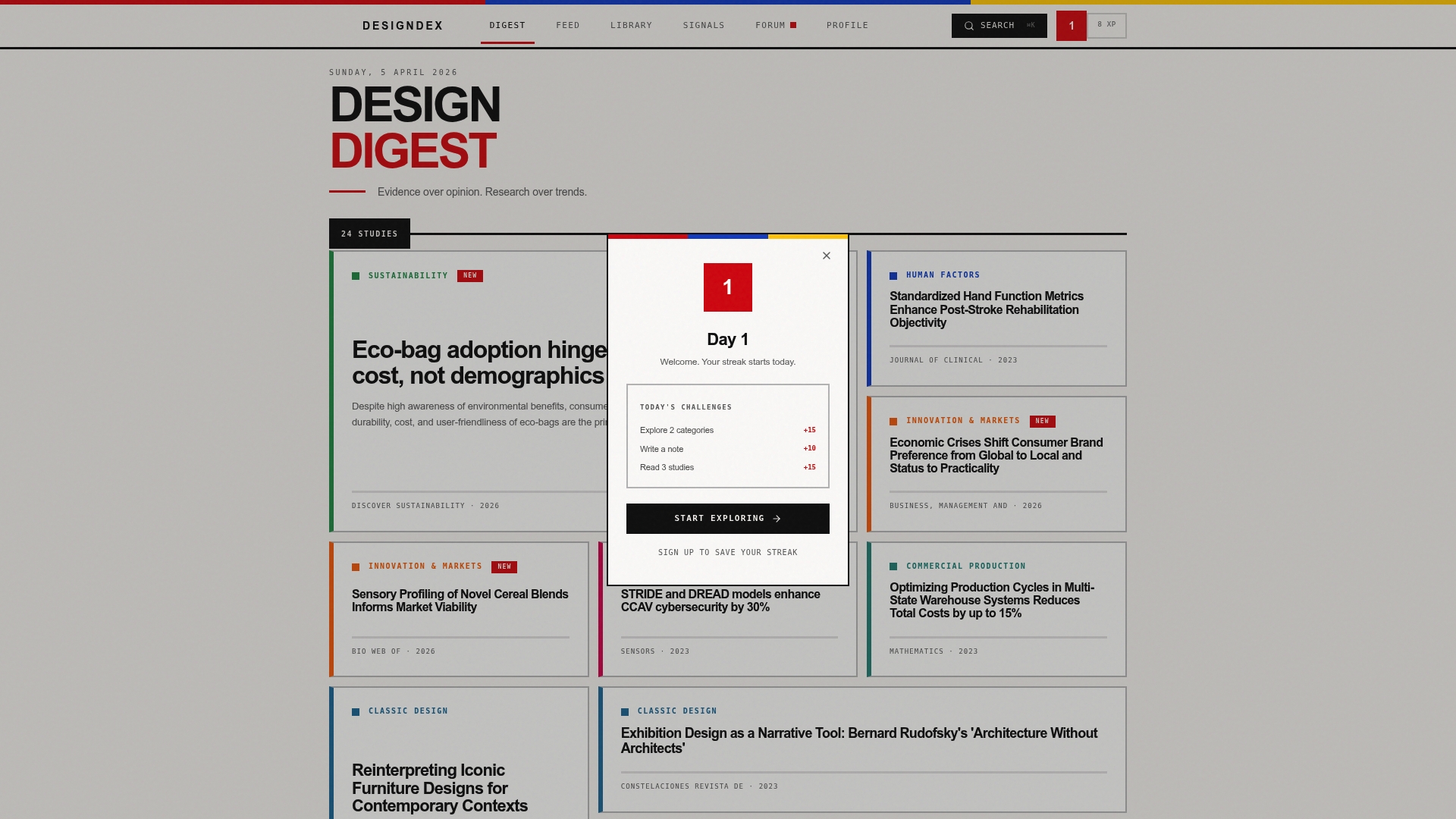
DesignDex aggregates and distills peer-reviewed design research into structured, citation-ready summaries that map directly to the methods covered in this article. Explore how the VR empathy study applies immersive simulation to user research, or examine the usability testing case study to see how evaluative methods translate into interface improvements. DesignDex surfaces the studies most relevant to your current project stage, enabling faster, more defensible design decisions without requiring you to parse full academic papers.
Frequently asked questions
What is the difference between qualitative and quantitative design research methods?
Qualitative methods explore motivations, behaviors, and contextual meaning through observation and conversation; quantitative methods use measurable, statistically analyzable data to validate patterns across larger populations.
Which design research method is best for testing interface usability?
Usability testing is the most direct and reliable method for evaluating interactive interface quality, as it directly improves interface outcomes by surfacing task-level failures and friction points in real time.
How do I choose the right design research method for a limited budget?
Prioritize high-impact, low-overhead methods such as user interviews and remote moderated usability tests, which require minimal equipment and can be executed with small participant samples without sacrificing insight quality.
Can design research methods be combined in a single project?
Yes, and combining methods is strongly recommended; blending qualitative and quantitative approaches uncovers behavioral and attitudinal blind spots that no single method can address alone.
Recommended
- Better design results: why design analysis matters in UX
- Streamline your design validation workflow: proven methods
- Indigenous Craftsmanship Shapes Enduring Design Narratives — Design Research Summary | DesignDex
- Traditional architectural features enhance modernist designs through sustainable principles. — Design Research Summary | DesignDex
- Top audience research methods to boost campaign performance | POPJAM.IO Blog
- Design-localization integration: A 2026 guide for product teams - Gleef