

TL;DR:
- Industrial design integrates user needs, manufacturing, and brand strategy for scalable product solutions.
- It differs from product design by focusing on systems, costs, and sustainability across the entire product lifecycle.
- Success relies on research, iterative prototyping, and measurable impacts like cost savings and sustainability improvements.
Industrial design is frequently reduced to surface-level aesthetics, a field concerned primarily with how products look on a shelf. That perception misses the deeper discipline entirely. Industrial design integrates user behavior, engineering constraints, manufacturing scalability, and brand strategy into cohesive, repeatable solutions built for real-world production. It is a practice that shapes how billions of people interact with everyday objects, from medical devices to kitchen appliances to public transit systems. This guide establishes what industrial design actually is, how professionals practice it, and what metrics signal genuine design success, giving you a structured foundation to apply these principles in your own work.
Table of Contents
- Defining industrial design: principles and scope
- Industrial design versus product design: similarities and key differences
- Industrial design in action: methods, processes, and best practices
- Evaluating success: metrics, impacts, and sustainability considerations
- A fresh perspective: The real value of industrial design (and what most people miss)
- Take your industrial design skills further
- Frequently asked questions
Key Takeaways
| Point | Details |
|---|---|
| Beyond aesthetics | Industrial design shapes how products are made, experienced, and sustainably brought to market. |
| Process is power | Effective industrial design relies on research, prototyping, and iterative refinement. |
| Measure real impact | Project success is judged by user adoption, manufacturing efficiency, and sustainability. |
| Success through collaboration | Great industrial design happens when user needs, manufacturing, and business goals align. |
Defining industrial design: principles and scope
Industrial design occupies a distinct position among creative disciplines because it operates at the intersection of human factors, manufacturing systems, and commercial viability. It is not craft, and it is not fine art. Designing for mass production distinguishes it from one-off or artisanal approaches, demanding that every decision be reproducible, cost-effective, and scalable across thousands or millions of units.
A working definition clarifies the scope: industrial design is the professional practice of designing products, devices, systems, and services for mass production that optimize usability, ergonomics, aesthetics, and manufacturability. Each of those four dimensions carries equal weight. Prioritizing aesthetics over ergonomics produces beautiful products that people stop using. Prioritizing manufacturability over usability produces cheap products that fail in the market. The discipline demands balance.
Core principles that govern professional industrial design practice include:
- User-centric problem framing: Design decisions originate from observed and validated user needs, not assumptions or stylistic preferences.
- Manufacturable scalability: Every form, material choice, and assembly sequence must be executable at production volume without prohibitive cost increases.
- Holistic systems thinking: A product exists within a supply chain, a retail environment, a use context, and an end-of-life pathway; industrial designers account for all of these.
- Iterative validation: Designs are tested, refined, and retested before committing to tooling or production investment.
Industrial designers operate at the convergence of three stakeholder groups: users who need functional, intuitive, and satisfying products; manufacturers who require producible, cost-controlled designs; and brand teams who demand coherent visual and experiential identity. Understanding design intelligence in practice means recognizing that these three sets of requirements are rarely aligned by default, and the designer's role is to resolve those tensions systematically.
"The discipline is not about making things look good. It is about making things work well, at scale, for real people, within real constraints."
The importance of design analysis becomes evident when you consider that a single poor decision, such as specifying a material that warps under heat, can invalidate an entire production run. Rigorous analytical thinking is as fundamental to industrial design as sketching or modeling. Professionals who study industrial photography techniques also gain an appreciation for how manufactured objects communicate quality through form, finish, and proportion, reinforcing the connection between visual output and production intent.
Industrial design versus product design: similarities and key differences
A persistent source of confusion among students entering the field is the relationship between industrial design and product design. The two disciplines share significant overlap, particularly in their emphasis on user research, prototyping, and iterative development. However, their scope, priorities, and success metrics diverge in meaningful ways.
System-level manufacturability and scale define industrial design's primary orientation, whereas product design typically focuses on individual feature sets, user interface specifics, and the experience of a single product in isolation. Industrial design also carries broader accountability: sustainability considerations, brand ecosystem coherence, and supply chain implications fall within its purview in ways that narrower product design engagements may not address.
| Dimension | Industrial design | Product design |
|---|---|---|
| Primary scope | Systems, manufacturing, scale | Individual product features and UX |
| Key metrics | Cost per unit, material efficiency, time-to-market | Usability scores, feature adoption, NPS |
| Sustainability role | Integrated from concept stage | Often addressed post-concept |
| Brand ecosystem | Holistic identity across product lines | Single product visual identity |
| Stakeholder breadth | Users, manufacturers, supply chain, regulators | Users, product managers, developers |
Consider a real-world application: when a consumer electronics company redesigns a product line, industrial designers determine wall thicknesses, material grades, assembly tolerances, and packaging efficiency across every variant. Product designers working on the same project may focus on button placement, screen interaction logic, and the tactile feedback of a single control surface. Both contributions are essential; they operate at different levels of abstraction.
Key distinctions worth internalizing:
- Industrial design decisions affect manufacturing economics directly; a 0.5mm change in wall thickness can alter tooling costs by thousands of dollars.
- Industrial design encompasses the full product lifecycle, including disassembly, recyclability, and remanufacturing potential.
- Visual communication design principles inform how industrial designers communicate design intent to engineers, manufacturers, and stakeholders across disciplines.
Studying product photography in design also reveals how industrial design decisions, particularly surface finish, form language, and material choice, translate into perceived quality at the point of sale, reinforcing the commercial dimension of the discipline.
Industrial design in action: methods, processes, and best practices
Understanding how industrial designers actually work clarifies why the discipline produces outcomes that other creative fields cannot replicate at scale. The process is structured, iterative, and evidence-driven, not linear or purely intuitive.
A typical industrial design process follows this sequence:
- Research and discovery: Ethnographic observation, user interviews, competitive benchmarking, and manufacturing capability audits establish the problem space and constraints.
- Ideation and concept generation: Sketching, digital modeling, and scenario mapping generate multiple solution directions without premature commitment to any single approach.
- Concept refinement: Promising directions are evaluated against user needs, manufacturing requirements, and cost targets; weak concepts are eliminated through structured analysis.
- Prototyping: Physical and digital prototypes are built to test form, fit, function, and user interaction under realistic conditions.
- Validation and testing: Prototypes are evaluated with real users and manufacturing partners; findings drive further refinement.
- Production handoff: Final specifications, tolerances, material callouts, and assembly instructions are documented for manufacturing partners.
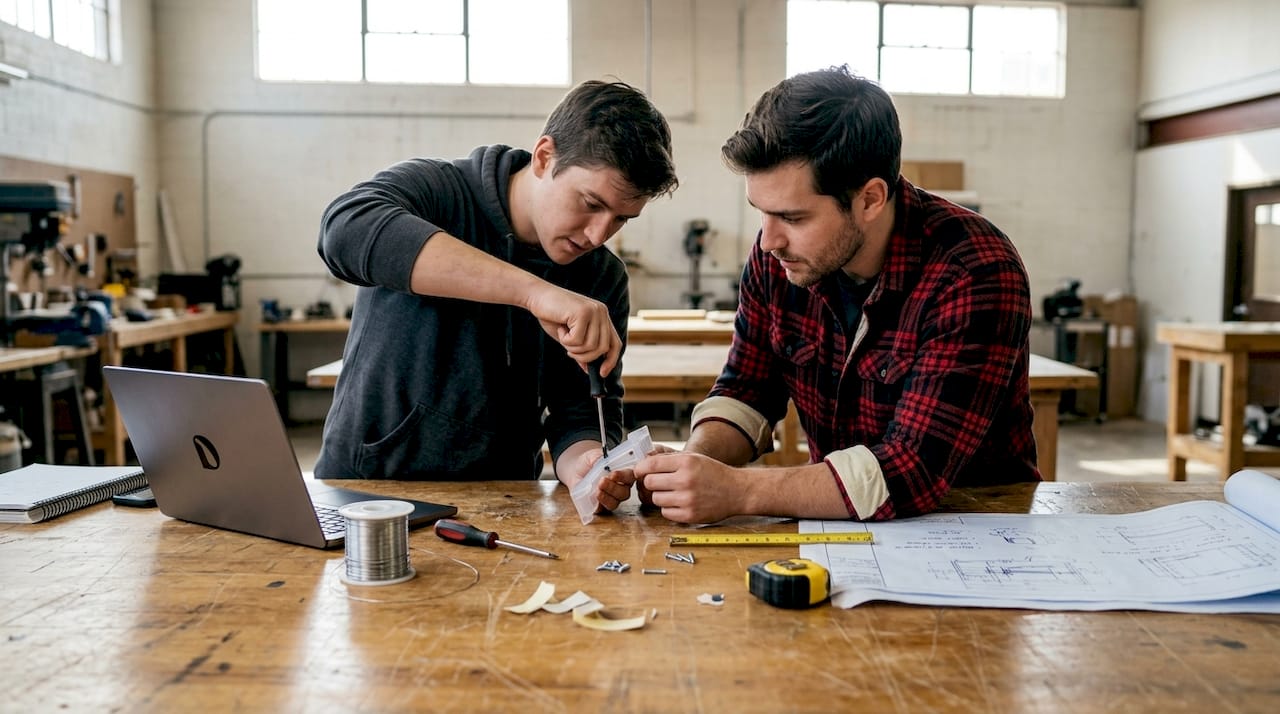
Design for Manufacturing (DFM) is not a late-stage consideration; it is integrated from the first concept review. Prioritizing DFM early, for example by specifying constant wall thickness to avoid sink marks in injection-molded parts, prevents costly tooling revisions and production defects that compound at scale. Prototyping extensively throughout the process, rather than only at the end, enables teams to surface and resolve problems before they become expensive commitments.
"Measure success not by how the prototype looks, but by user adoption rates, manufacturing cost savings, and documented sustainability impacts."
Pro Tip: When reviewing your own concepts, apply a DFM lens at every stage. Ask whether each geometry, joint, or material transition can be produced consistently at volume. If you cannot answer that question, the concept is not ready for refinement.
Practical design strategies published through industry research consistently show that teams integrating rapid prototyping with structured iteration cycles reduce downstream engineering changes significantly. Research into QFD safer design processes further demonstrates that systematic quality function deployment methods, applied proactively, reduce ergonomic risk in manufactured products. For deeper context on foundational concepts, more on industrial design provides useful supplementary frameworks.
Evaluating success: metrics, impacts, and sustainability considerations
Design value must be measured, not assumed. Industrial designers who cannot quantify their contributions struggle to justify decisions to stakeholders, secure resources for iteration, or build credibility within cross-functional teams. Establishing clear metrics before a project begins is as important as the design work itself.
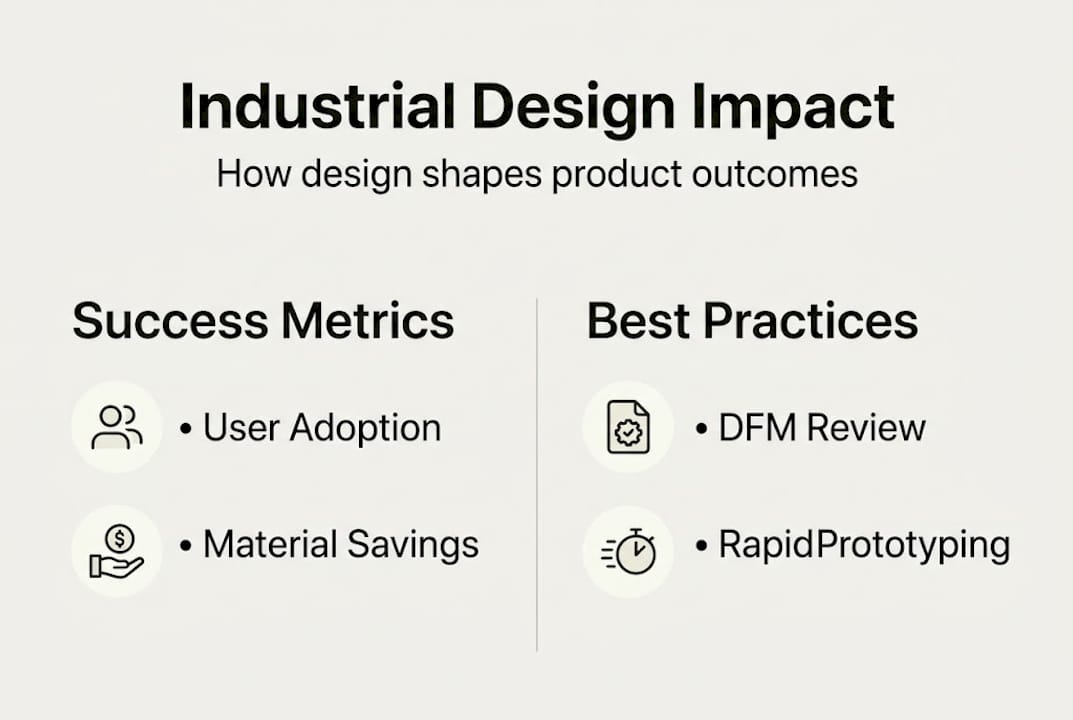
Key performance indicators in industrial design practice include:
| Metric | What it measures | Why it matters |
|---|---|---|
| User adoption rate | Percentage of target users actively using the product | Validates that design solves a real need |
| Manufacturing cost savings | Reduction in per-unit production cost | Demonstrates commercial impact |
| Time-to-market | Duration from concept to production launch | Measures process efficiency |
| Material savings (kg/year) | Reduction in raw material consumption at production volume | Quantifies sustainability contribution |
| Recyclability index | Percentage of product materials recoverable at end of life | Tracks circular economy alignment |
Empirical evidence underscores the scale of impact achievable through rigorous industrial design. A 55% weight reduction in one documented redesign translated to 16.6 tonnes of material savings per year at 100,000 units of production volume. A separate case recorded a 50% reduction in time-to-market through backend-first design systems that streamlined handoff and validation cycles.
Pro Tip: When presenting a design to stakeholders, lead with quantified impact. Frame material savings in annual tonnes, cost savings in per-unit dollars, and usability improvements in adoption rate percentages. Numbers communicate value more effectively than visual presentations alone.
Sustainability is no longer a supplementary consideration in industrial design; it is a core performance dimension. Life Cycle Assessment (LCA) methodology enables designers to evaluate environmental burden across extraction, manufacturing, use, and end-of-life phases. Understanding project research metrics equips you to select and apply the right measurement frameworks for each project phase. Research on student satisfaction measures also demonstrates that structured, evidence-based learning frameworks improve design competency outcomes significantly. For students building sustainability fluency, research on sustainable design innovation through biomimicry offers one of the most compelling frameworks for integrating ecological principles into manufacturable solutions.
A fresh perspective: The real value of industrial design (and what most people miss)
Most early-career designers arrive with a portfolio built around aesthetics and a mental model shaped by consumer product admiration. That orientation is understandable, but it consistently produces the same blind spot: an underestimation of system-level thinking as the actual engine of design impact.
The products that endure, that achieve commercial success and genuine user loyalty, rarely succeed because of a single brilliant visual decision. They succeed because someone resolved the tension between what users need, what manufacturers can produce, and what the market will sustain. That resolution happens through research, structured iteration, and manufacturing literacy, not through sketching alone.
Students who invest equally in understanding production constraints and user behavior as they do in rendering skills will find themselves capable of contributing to decisions that actually reach production. Design intelligence insights consistently show that evidence-based decision-making separates designers who influence outcomes from those who produce presentations. Strategy, research, and iteration are not supporting activities. They are the discipline itself.
Take your industrial design skills further
For students and early-career designers ready to move beyond foundational knowledge, structured access to peer-reviewed research is one of the highest-leverage investments you can make. Understanding what the evidence actually says about user behavior, manufacturing outcomes, and sustainability performance gives you the ability to justify design decisions with rigor rather than intuition.
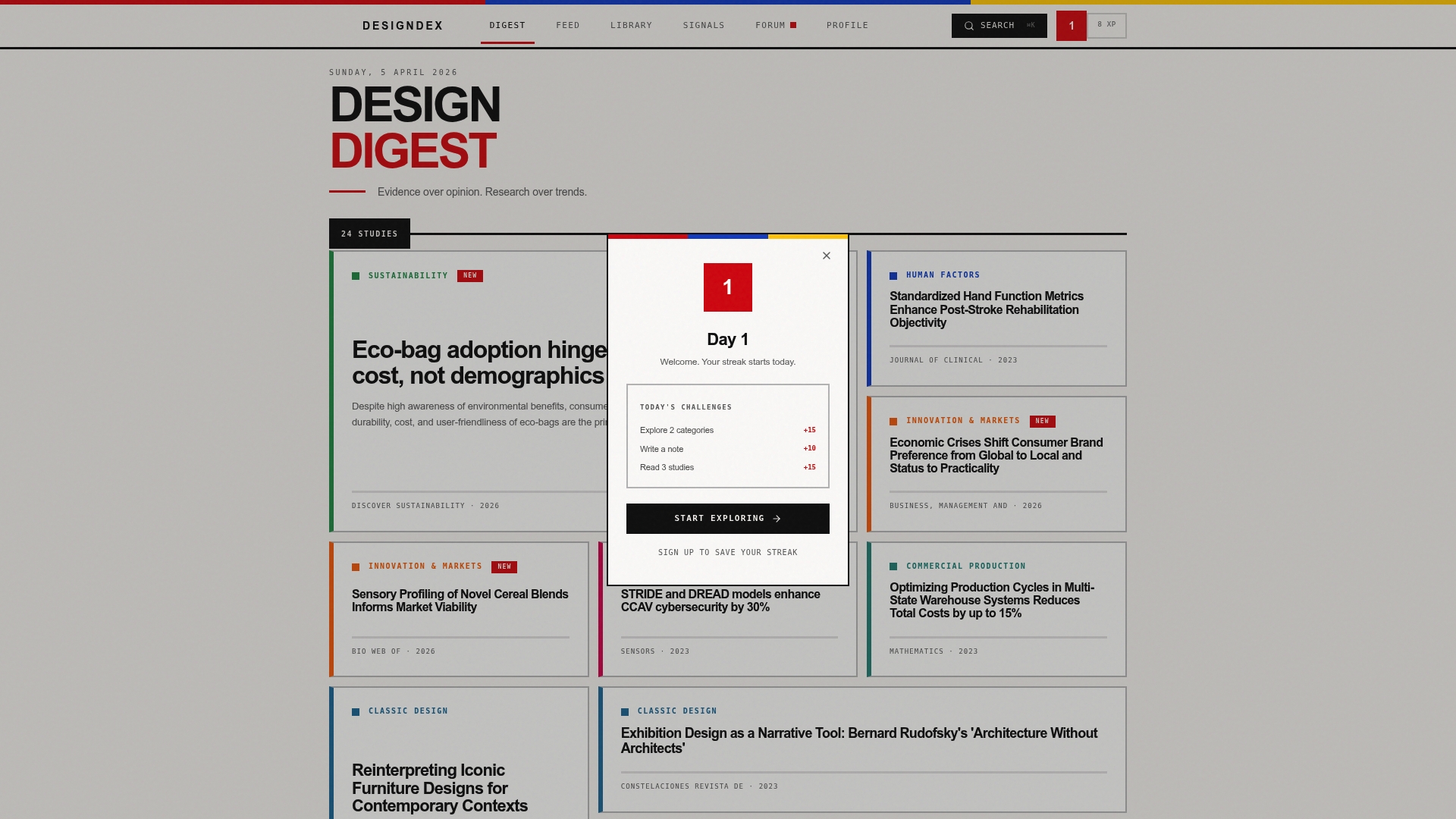
DesignDex aggregates and distills peer-reviewed studies in UX and industrial design into structured, citation-ready insights updated daily. Instead of searching through full academic papers, you access concise breakdowns of aims, methods, findings, and real-world applications. Research on usability testing research is one example of the evidence base available to inform your practice from day one.
Frequently asked questions
What are the four main principles of industrial design?
The core principles are user-centricity, manufacturability, ergonomics, and aesthetics. Each principle must be balanced against the others; optimizing all four dimensions simultaneously is what distinguishes professional industrial design from general product development.
How is industrial design different from engineering design?
Industrial design focuses on user experience, production at scale, and aesthetic coherence, while engineering design centers on technical function and structural performance. Industrial design's broader scope includes sustainability, brand ecosystem alignment, and human factors that engineering specifications alone do not address.
Why is prototyping important in industrial design?
Prototyping enables rapid testing, iteration, and problem resolution before manufacturing commitments are made. Extensive prototyping for iteration reduces downstream engineering changes and validates both user experience and production feasibility at lower cost than post-tooling revisions.
How do industrial designers measure sustainability?
They track material consumption, energy footprint, recyclability rates, and long-term lifecycle impacts as primary sustainability benchmarks. Documented cases show that rigorous redesign can achieve a 55% weight reduction, translating directly into measurable annual material savings at production volume.
Recommended
- Design intelligence: a practical guide for better outcomes
- Better design results: why design analysis matters in UX
- Essential design research methods for effective projects
- Design research methodology: principles, methods, tips
- Industrial component machining: methods, precision, value | Machining Technologies