

TL;DR:
- Effective trend identification combines multiple data sources and systematic workflows to stay ahead.
- Distinguishing between fads and genuine trends relies on adoption patterns, problem-solving value, and cross-industry validation.
- Applying validated trends requires context awareness, user testing, and continuous monitoring to ensure relevance and longevity.
Designers who replicate trends six months after their peak risk producing work that reads as derivative rather than current, a professional liability that compounds with each project cycle. The gap between early adopters and late followers is not simply aesthetic; it reflects a structural difference in how designers gather, interpret, and act on market signals. Proactive trend identification, grounded in empirical data and systematic methodology, is the mechanism that separates forward-looking practitioners from reactive ones. This guide outlines a rigorous, repeatable process for sourcing, analyzing, validating, and applying design trends, equipping both students and professionals with the decision-support framework needed to keep their work contextually relevant and evidence-backed.
Table of Contents
- Gathering the right resources and data
- Step-by-step process for identifying trends
- Distinguishing genuine trends from fleeting fads
- Validating and applying trends to your work
- Our perspective: Authenticity in the AI era of design trends
- Turn insights into action with DesignDex
- Frequently asked questions
Key Takeaways
| Point | Details |
|---|---|
| Use diverse sources | Rely on community platforms, formal reports, and AI-driven analysis for verified trend data. |
| Validate before applying | Cross-check trends with multiple methods and pilot them before full-scale adoption. |
| Balance tech with intuition | Mix data-driven insights with human expertise to avoid generic or inauthentic results. |
| Beware of fads | Distinguish real trends from short-lived visual fads to protect project outcomes. |
Gathering the right resources and data
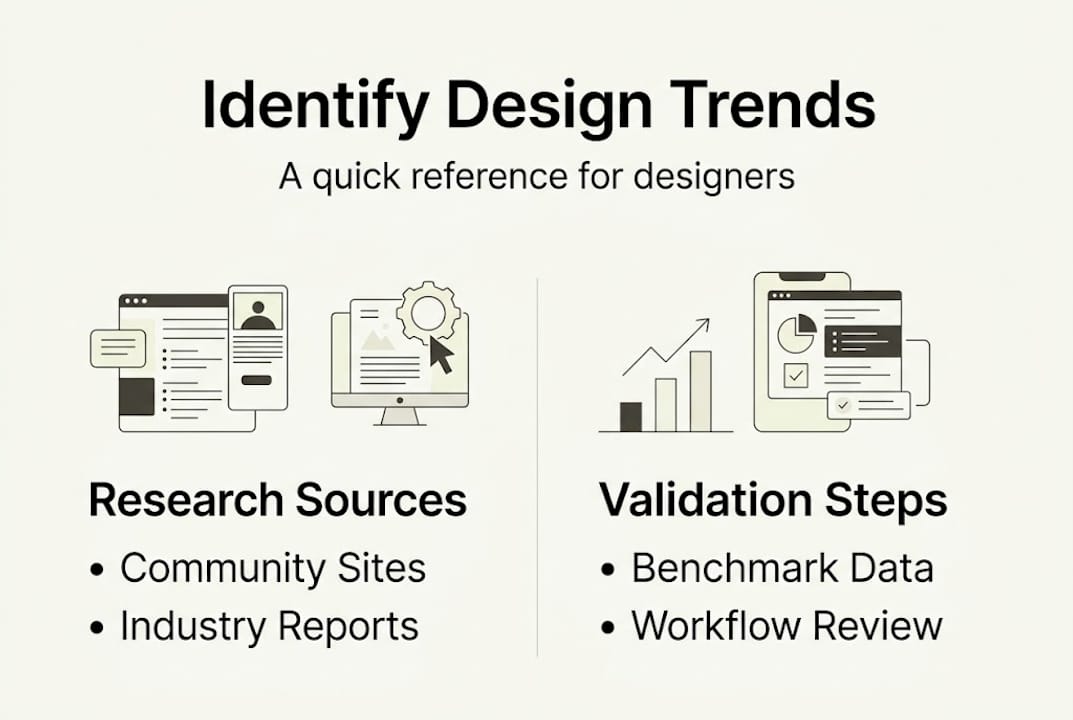
Effective trend research begins with source selection, and not all data streams carry equal signal quality. A mixed-methods approach, combining quantitative platform analytics with qualitative cultural observation, produces the most reliable picture of where design is heading. Relying on a single feed, whether that is a social media algorithm or a single annual report, introduces selection bias that skews interpretation.
Design research methods that integrate multiple data types consistently outperform single-source approaches in accuracy and contextual relevance. The core categories of reliable sources include:
- Platform analytics: Behance engagement metrics, Adobe trend reports, and Dribbble save rates surface aggregate designer behavior at scale.
- AI-powered visual analysis: Tools that parse millions of live websites extract structural and stylistic patterns invisible to manual review.
- User-generated design repositories: Community uploads and open-source design systems reflect grassroots adoption before institutional recognition.
- Horizon scanning: Academic journals, patent filings, and cross-industry innovation reports signal emerging directions 12 to 36 months ahead of mainstream adoption.
- Social listening: Keyword frequency, hashtag velocity, and comment sentiment on platforms like Instagram and Pinterest provide real-time cultural temperature readings.
Key methodologies for trend identification include analyzing platform data from Behance and Adobe, AI-powered visual analysis, user-generated design repositories, and structured horizon scanning, each contributing a distinct layer of evidence.
| Source type | Data format | Update frequency | Best for |
|---|---|---|---|
| Behance / Adobe reports | Quantitative + qualitative | Quarterly / annual | Macro trend validation |
| AI web analysis tools | Structured JSON, visual clusters | Continuous | Pattern detection at scale |
| Social listening platforms | Sentiment, frequency | Real-time | Early signal detection |
| Academic / patent databases | Peer-reviewed, citations | Variable | Long-horizon forecasting |
For AI trend analysis specifically, tools capable of extracting structured data from live web environments offer a reproducible, scalable complement to human curation.
Pro Tip: Build a dedicated research folder or Notion workspace segmented by source type. Review each category on a fixed cadence (daily for social, monthly for reports) to prevent data overload while maintaining coverage.
Step-by-step process for identifying trends
Once credible sources are assembled, the next requirement is a systematic workflow that converts raw data into actionable trend intelligence. Ad hoc browsing produces inconsistent results; a structured process ensures reproducibility and reduces confirmation bias.
- Scan primary platforms weekly. Review Behance, Dribbble, and Awwwards for recurring visual patterns: typography choices, layout structures, color palettes, and interaction paradigms.
- Collect and log quantitative metrics. Record engagement rates, save counts, and share volumes for specific design styles. Frequency and growth rate are both relevant indicators.
- Apply social listening filters. Monitor keyword clusters related to emerging styles (e.g., "bento grid," "neo-brutalism") across Instagram, Pinterest, and X to measure velocity and geographic spread.
- Cross-reference with AI-powered tools. Use platforms capable of AI-powered design analysis to validate whether patterns observed manually are statistically significant across larger datasets.
- Conduct horizon scanning. Review design-adjacent fields (architecture, fashion, material science) for upstream signals that historically migrate into digital and product design.
- Document and date all findings. Timestamped logs allow retrospective analysis of adoption curves, which improves future forecasting accuracy.
Data-driven benchmarks are essential calibration tools in this process. Empirical indicators such as 86% sans-serif usage across top-ranked websites, 68% blue color dominance in SaaS interfaces, and 5x to 20x content growth rates in specific visual categories function as validation flags confirming that a pattern has crossed from niche to normative.
| Approach | Speed | Scale | Context sensitivity | Risk of bias |
|---|---|---|---|---|
| Traditional manual review | Slow | Low | High | Moderate |
| AI-powered analysis | Fast | Very high | Low | Low (sampling) |
| Hybrid (manual + AI) | Moderate | High | High | Minimal |
Integrating design analysis in UX and design intelligence frameworks into this workflow ensures that findings are interpreted within functional and strategic contexts, not treated as purely aesthetic observations.
Pro Tip: Automate data collection where possible (RSS feeds, API alerts, saved searches) but reserve final interpretation for human review. Automation handles volume; judgment handles nuance.
Distinguishing genuine trends from fleeting fads
Not every visual motif that gains rapid traction constitutes a trend. The distinction between a fad and a sustainable trend carries significant professional consequences: designing around a fad produces work that ages poorly and erodes client trust, while aligning with a genuine trend positions deliverables for longevity.

Fads are characterized by fast rise and fall cycles and homogeneous replication without contextual adaptation, whereas genuine trends build gradually, solve identifiable user problems, and demonstrate adoption across diverse platforms and industries. High volatility in a pattern's engagement metrics is itself a signal of fad behavior, often prompting experienced practitioners toward conservatism.
Indicators of a fad:
- Viral spread concentrated within 4 to 8 weeks with no sustained plateau
- Adoption limited to a single platform or demographic cohort
- Replication without variation: copies appear identical rather than adapted
- No identifiable functional or user experience rationale
- Rapid decline in search volume and engagement within one quarter
Indicators of a sustainable trend:
- Gradual adoption curve spanning 6 to 24 months
- Cross-platform and cross-industry validation
- Solves a documented user need (accessibility, cognitive load, navigability)
- Generates derivative innovations rather than direct copies
- Maintains relevance across multiple design contexts
"A fad is temporary; a trend solves a problem for real people across real contexts." This distinction, grounded in adoption pattern analysis and functional validation, is the most operationally useful filter available to practicing designers.
For long-term verification, consult 2026 trend predictions from authoritative industry sources and cross-reference against your own longitudinal data logs. Patterns that appear consistently across 12 months of your own records carry substantially more evidential weight than single-point observations.
A structured design validation workflow provides the procedural scaffolding needed to make this distinction repeatable and defensible, particularly when presenting recommendations to clients or stakeholders.
Pro Tip: Maintain a "trend graveyard" document logging patterns you identified as fads and their actual lifecycle. Reviewing it quarterly sharpens your calibration over time.
Validating and applying trends to your work
Identifying a trend is necessary but insufficient. The professional value is realized only when trends are translated into contextually appropriate, validated design decisions that improve project outcomes.
Stepwise validation process:
- Test context fit. Assess whether the trend aligns with the project's audience demographics, brand positioning, and functional requirements. A trend dominant in consumer fintech may be inappropriate for a healthcare information system.
- Gather user feedback. Prototype trend-informed design elements and test them with representative users. Preference data and task completion rates provide empirical grounding.
- Conduct a multi-source check. Confirm the trend's presence across at least three independent, high-quality sources before committing to full implementation.
- Evaluate accessibility and ethics. Trends that compromise readability, introduce cognitive overload, or exclude users with disabilities fail the functional threshold regardless of aesthetic appeal.
- Iterate and document. Apply the trend incrementally, measure outcomes, and maintain records for future reference and client reporting.
Multi-source validation combined with mixed methods is the most reliable approach: AI tools provide scale and pattern detection, while expert judgment supplies the contextual interpretation that algorithmic systems cannot replicate.
When applying validated trends in practice, consider the following:
- Client work: Frame trend adoption in terms of user benefit and business objective, not aesthetic novelty. Evidence-backed rationale strengthens client confidence.
- Portfolio projects: Use trend-informed work to demonstrate forward awareness, but pair it with explanatory context showing your analytical process.
- Local vs. global context: A trend validated globally may require adaptation for regional cultural norms, language structures, or regulatory environments.
- Longevity planning: Build designs with modular components that can be updated as trends evolve, reducing future rework costs.
Further trend research techniques from practitioner-focused sources can supplement the validation framework with discipline-specific methods. Integrating design research methods ensures your application process remains grounded in evidence rather than assumption.
Pro Tip: Treat trend adoption as a hypothesis, not a conclusion. Define success metrics before implementation and review them post-launch to build an evidence base that informs future decisions.
Our perspective: Authenticity in the AI era of design trends
The industrialization of trend analysis through AI creates a paradox: the more efficiently designers identify and replicate dominant patterns, the faster those patterns become saturated and contextually meaningless. Algorithmic systems are optimized for pattern detection at scale, but they are structurally blind to the cultural specificity, historical resonance, and human nuance that give design work lasting relevance.
In 2026, leading designers are actively prioritizing authenticity and tactile, imperfect aesthetics as a deliberate counter to the homogeneity produced by AI-driven convergence. This is not a rejection of data; it is a recalibration of its role. Data identifies what exists; human judgment determines what matters and why.
The most defensible position for a design professional is to use design intelligence tools as a first-pass filter and then apply cultural, contextual, and ethical reasoning to determine genuine applicability. Trend literacy, properly understood, is not the ability to follow signals but the capacity to evaluate them critically and apply them with intentionality.
Turn insights into action with DesignDex
Staying current on design trends requires more than periodic research sessions; it demands a continuous intelligence infrastructure that surfaces relevant signals, validates findings against peer-reviewed evidence, and connects observations to actionable frameworks.
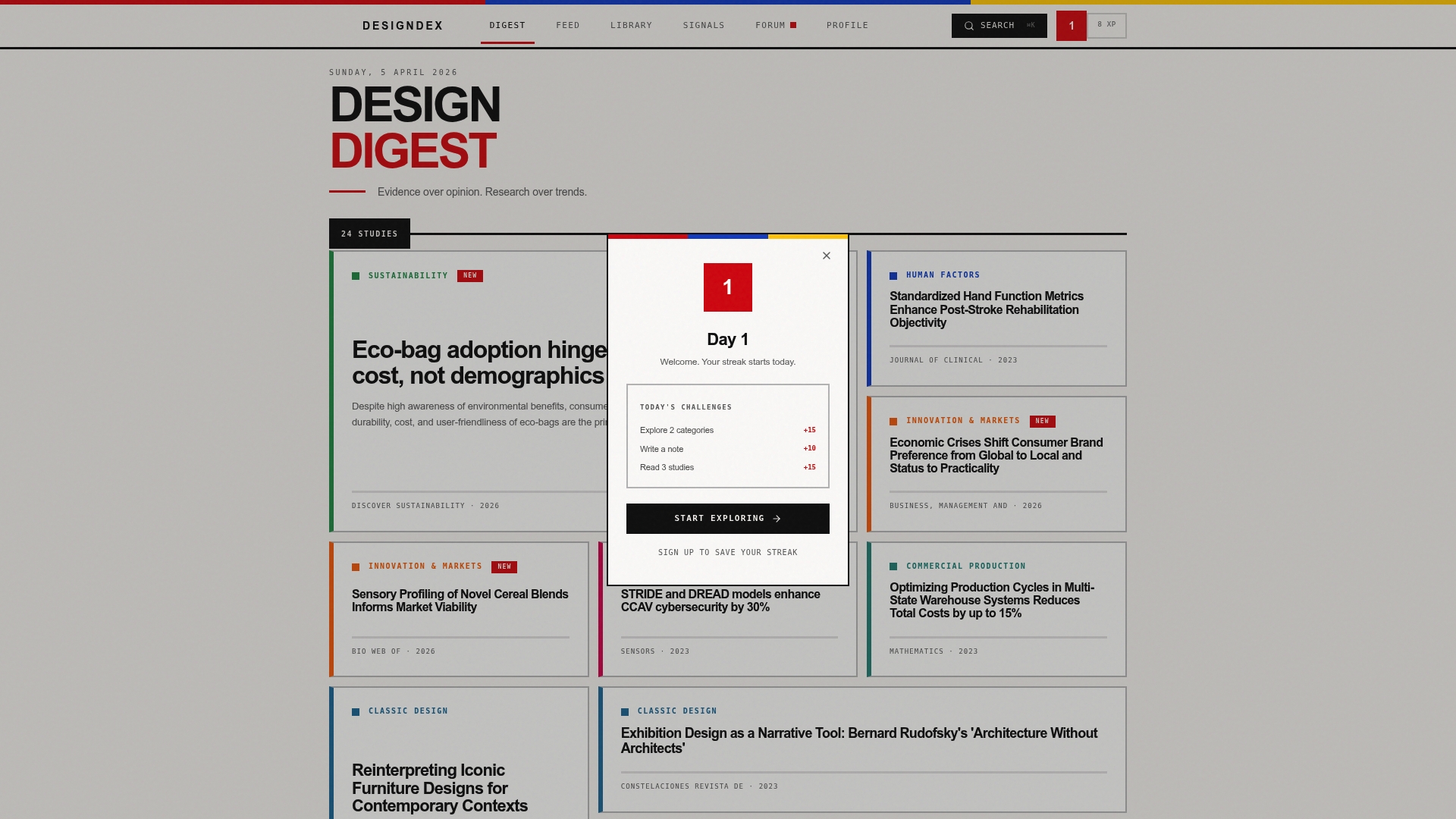
DesignDex is built precisely for this workflow. The platform aggregates and distills peer-reviewed UX and industrial design research daily, providing structured breakdowns of study aims, methods, and real-world applications. Explore design trend signals updated in real time, review studies such as the VR empathy study for cross-disciplinary insight, and access citation-ready content through the DesignDex digest. When your trend decisions are backed by evidence, they are easier to defend, implement, and iterate on.
Frequently asked questions
What are the best sources for spotting new design trends quickly?
Behance, Adobe, and AI-powered visual analysis tools are among the most reliable sources, as they aggregate large-scale behavioral and visual data into structured, actionable insights for design professionals.
How can I tell if a trend is a fad or has long-term potential?
A sustainable trend solves a real user problem and is adopted gradually across multiple platforms and industries, while fads are characterized by rapid, homogeneous replication followed by equally rapid decline.
Is AI reliable for forecasting design trends?
AI offers high accuracy at scale for pattern detection, but expert judgment remains essential for interpreting context, cultural nuance, and avoiding the systematic biases that algorithmic models can introduce.
How often should I update my trend research?
Ongoing horizon scanning and platform analysis indicate that monthly structured reviews, supplemented by daily monitoring of curated design feeds, represent the minimum cadence for maintaining current awareness in a fast-moving field.