

TL;DR:
- A structured design process aligns stakeholders, reduces revisions, and ensures user needs are met.
- Essential tools include Figma, Miro, documentation platforms, and stakeholder involvement at key stages.
- Empathize, Define, Ideate, Prototype, and Test form an iterative framework to create user-centered, innovative designs.
Most design projects fail not because of a lack of talent, but because of a lack of sequence. When teams jump from brief to execution without a structured framework, the result is predictable: misaligned stakeholders, redundant revision cycles, and deliverables that miss user needs entirely. A methodical design process resolves these inefficiencies by providing a shared language, clear decision gates, and measurable checkpoints at every stage. This guide walks you through the tools, frameworks, creative methods, and critical pitfalls that define a professional-grade design workflow, equipping you to make evidence-based decisions from project initiation to final validation.
Table of Contents
- Requirements and tools for an effective design process
- The 5-step design thinking framework explained
- Boosting creativity and novelty: Comparing design approaches
- Common pitfalls and critiques of the design process
- What most guides miss: Real-world lessons on design process success
- Leverage structured design with DesignDex research and tools
- Frequently asked questions
Key Takeaways
| Point | Details |
|---|---|
| Start with empathy | User research is the foundation for meaningful design decisions and outcomes. |
| Iterate and test often | Prototyping and user testing reveal real-world issues and refine solutions efficiently. |
| Choose creative methods | Storyboarding, Synectics, and TRIZ drive innovation and help overcome project stagnation. |
| Avoid common pitfalls | Respect process integrity, involve stakeholders, and anchor actions to strategy for lasting results. |
| Measure what matters | Use metrics like time saved and creativity delivered to track genuine project success. |
Requirements and tools for an effective design process
Building on the need for structure, let's address what you need to get started. Executing a disciplined design process requires the right infrastructure: software platforms, stakeholder alignment mechanisms, and a pre-project preparation checklist that reduces ambiguity before a single pixel is placed.
Essential tools and platforms
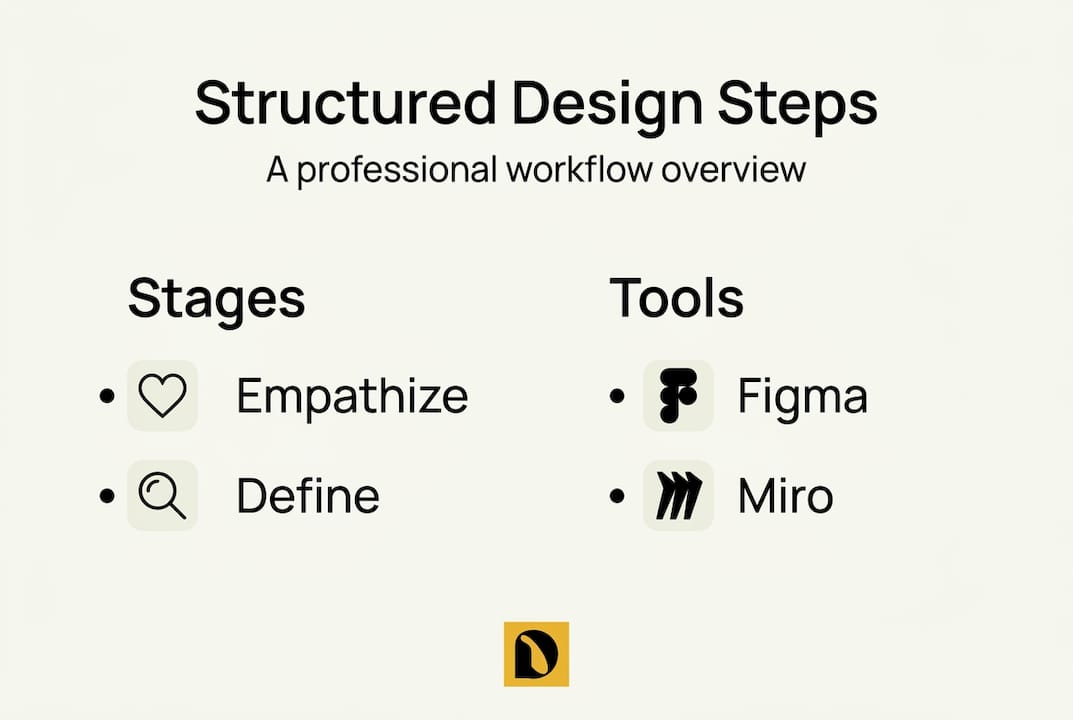
The contemporary design toolkit centers on two platforms that have become industry standards:
- Figma for interface design, component libraries, and collaborative prototyping in real time
- Miro for visual collaboration, affinity mapping, journey mapping, and workshop facilitation
- Notion or Confluence for documentation, design briefs, and decision logs
- Jira or Linear for task tracking and sprint management when working in agile environments
- Maze or Lookback for remote usability testing and participant session recording
Each tool serves a distinct phase of the process. Figma dominates the Prototype and Test stages; Miro is particularly valuable during Empathize and Ideate phases where spatial thinking and rapid visualization matter.
Stakeholder roles and involvement
A common failure point is treating design as a solo discipline. In practice, the process requires structured involvement from product managers, engineers, researchers, marketers, and end users at defined intervals. Stakeholders should participate in kick-off workshops, design critiques, and usability review sessions. This structured touchpoint model prevents scope drift and ensures decisions are traceable back to validated user or business needs. Applying design intelligence principles at the outset, such as defining success metrics and identifying key constraints before ideation, accelerates stakeholder alignment significantly.
The case for design systems
Design systems represent one of the highest-leverage investments a design team can make. A Figma study demonstrates that design systems save 34% of design time, equivalent to adding 3.5 designers per week to a seven-person team. That is not a marginal gain; it is a structural advantage that compounds over the lifecycle of a product.

| Preparation area | Key action | Outcome |
|---|---|---|
| Tooling setup | Configure Figma + Miro + documentation platform | Reduced tool-switching friction |
| Stakeholder mapping | Identify roles, responsibilities, and review cadence | Fewer revision cycles |
| Design system readiness | Audit existing components or initiate new library | Faster prototyping and consistency |
| Research planning | Define methods using design research methods | Validated user insights before ideation |
Pro Tip: Before starting any project, create a one-page design brief that captures the problem statement, target user, success criteria, and timeline. Teams that use structured briefs spend less time in ambiguous revision loops and more time in productive iteration.
The 5-step design thinking framework explained
Once you have the tools in place, it's time to use them within a proven framework. The design thinking framework consists of five core stages that are iterative by design, not linear by default: Empathize, Define, Ideate, Prototype, and Test. Each stage serves a distinct cognitive and operational purpose, and skipping any one of them introduces measurable risk.
The five stages in detail
-
Empathize: Conduct user interviews, contextual observation, and secondary research to build a factual understanding of user behavior, goals, and pain points. This stage relies heavily on design research methodology including ethnographic studies, diary studies, and stakeholder interviews. The objective is not to confirm assumptions but to surface unexpected realities.
-
Define: Synthesize research findings into a clear, actionable problem statement, often expressed as a "How Might We" (HMW) question or a Jobs-to-Be-Done (JTBD) framing. A well-formed problem statement guides ideation without prematurely narrowing solution space.
-
Ideate: Generate a broad range of solutions using structured creativity methods (covered in the next section). Quantity precedes quality at this stage; teams that skip divergent thinking in favor of the "obvious" solution consistently produce less innovative outcomes.
-
Prototype: Build low-fidelity to medium-fidelity representations of the most promising ideas. Prototypes should be just detailed enough to elicit meaningful user feedback. Over-investing in prototype fidelity before validation is a well-documented source of wasted effort. Applying a structured design validation workflow at this stage ensures prototypes are tested against pre-defined criteria.
-
Test: Conduct structured usability sessions with representative users, collect both qualitative and quantitative data, and use findings to either iterate or pivot. Testing is not the end of the process; it feeds back into Empathize or Define as new insights emerge.
Comparison: Design thinking vs. alternative methodologies
| Dimension | Design thinking | Agile UX | Lean UX |
|---|---|---|---|
| Primary focus | User empathy and ideation | Iterative delivery | Validated learning |
| Iteration speed | Moderate | High | Very high |
| Research depth | Deep qualitative | Continuous lightweight | Minimum viable research |
| Best suited for | Complex, ambiguous problems | Fast-paced product teams | Startup and MVP contexts |
Research-backed design analysis in UX consistently shows that teams combining design thinking's empathy-driven research with agile's rapid iteration cycles outperform teams using either methodology in isolation, particularly in projects with high user complexity. For curated research summaries on process methodologies, Design Digest provides daily-updated breakdowns sourced from peer-reviewed literature.
Pro Tip: Treat stage transitions as explicit decisions, not automatic progressions. Before moving from Define to Ideate, verify that your problem statement has been reviewed and approved by at least one stakeholder outside the design team. This single checkpoint prevents misaligned ideation.
Boosting creativity and novelty: Comparing design approaches
While process drives consistency, creativity methods inject innovation. A structured process ensures you arrive at the right destination; creativity methods determine how original and differentiated your solution is when you get there.
Top creativity frameworks
Three methods stand out for their empirically measured impact on design novelty, as noted in research comparing creativity methods:
- Storyboarding: A narrative visualization technique that maps user journeys through sequential illustrated panels, surfacing emotional and contextual dimensions that abstract wireframes miss entirely.
- Synectics: A structured analogical reasoning method that forces connection-making between unrelated domains. For example, applying principles from biomimicry in design to solve human-centered problems can yield genuinely novel structural or functional approaches.
- TRIZ (Theory of Inventive Problem Solving): An engineering-originated systematic innovation methodology that identifies and resolves design contradictions using a database of proven inventive principles. TRIZ is particularly effective when functional requirements appear to be mutually exclusive.
Situational use and impact comparison
| Method | Best stage | Key strength | Limitation |
|---|---|---|---|
| Storyboarding | Empathize, Define | User context clarity | Time-intensive to produce |
| Synectics | Ideate | Cross-domain novelty | Requires facilitation expertise |
| TRIZ | Ideate, Prototype | Contradiction resolution | Steep learning curve |
The selection of creativity method should be informed by project type and team composition. Essential research methods literature suggests that teams with mixed disciplinary backgrounds benefit most from Synectics, while engineering-heavy teams consistently extract more value from TRIZ due to their familiarity with systematic problem framing.
Exposure to diverse creative inputs, including contemporary art influence in graphic design, has also been shown to expand the conceptual range of design teams, particularly when working on brand identity or visual communication projects.
"The most impactful innovations in design rarely emerge from incremental refinement. They emerge when designers deliberately displace themselves from the familiar and engage with domains that appear unrelated to their problem space." — Design research practitioner consensus on cross-domain creativity
To maximize creative output in your ideation sessions, structure them as time-boxed sprints with a defined diverge-then-converge rhythm: 20 minutes of unconstrained generation followed by 10 minutes of structured evaluation against user and business criteria.
Common pitfalls and critiques of the design process
Even the best frameworks have weaknesses. Understanding where design processes break down is as important as understanding how to execute them correctly.
Frequent execution mistakes
- Skipping the Empathize stage due to timeline pressure, resulting in solutions built on assumptions rather than validated user insights
- Treating the process as a linear checklist rather than an iterative loop, which prevents the kind of recursive learning that produces genuinely user-centered outputs
- Low stakeholder involvement during Testing, which leads to validated designs being overruled by executive preference in final review stages
- Poor documentation of decisions, making it impossible to trace why a design direction was chosen, which becomes critical during handoff to engineering
- Premature high-fidelity prototyping before problem definition is complete, investing visual design effort in solutions that later fail usability validation
Design research methodology literature consistently identifies these patterns as root causes of project failure, particularly in organizations where design is not yet integrated into the product development lifecycle at a strategic level.
Critiques of design thinking as a framework
The design thinking model is not without its critics. A design thinking critique from organizational practice perspectives argues that the framework is frequently adopted superficially, functioning more as "design theater" than as a genuine problem-solving mechanism. Specific critiques include:
- The framework tends to ignore systemic power dynamics, organizational constraints, and resource limitations that determine whether any designed solution can actually be implemented
- Design thinking is strong for ideation but structurally weak at the execution and scaling stages, creating a gap between validated prototypes and deployed products
- Expertise and domain knowledge are sometimes undervalued in favor of user empathy processes, which can produce naive solutions when applied to technically complex problems
- Poor implementation follow-through remains endemic: organizations run workshops, generate ideas, and then fail to create the operational conditions necessary to move those ideas forward
"Design thinking, as commonly practiced, often prioritizes the experience of doing design over the outcomes of design. The process becomes the product, and the actual user need goes unaddressed at scale." — Jack Martin Leith, organizational design critic
Solutions and mitigation strategies
The antidote to these pitfalls is intentional integration: linking each design stage explicitly to strategic business outcomes, assigning clear ownership for implementation, and maintaining active stakeholder participation beyond the ideation phase. Teams that regularly monitor identifying design trends also maintain a more accurate picture of what the broader market is validating, reducing the risk of producing solutions that are internally celebrated but externally irrelevant.
Pro Tip: At the end of every design phase, schedule a 30-minute retrospective with the full team. Document three things that worked, two that need adjustment, and one decision that should be revisited. This structured reflection loop prevents process degradation over long project cycles.
What most guides miss: Real-world lessons on design process success
Most process guides present a clean, sequential model that rarely survives contact with organizational reality. The actual differentiator between teams that use a design process effectively and those that merely follow it is outcome-driven thinking. Following each step correctly is necessary but insufficient; what determines success is whether each stage is connected to a measurable project outcome that stakeholders have agreed to in advance.
Rigid adherence to a framework without adaptation to organizational context tends to produce bureaucratic process overhead rather than innovative outputs. The design intelligence guide framework argues persuasively that the most effective design teams treat the process as a decision architecture, not a workflow checklist. Every stage should answer a specific question and produce an artifact that feeds the next stage.
Stakeholder buy-in is not a soft consideration. It is a structural requirement. Teams that invest time upfront in aligning stakeholders on success metrics, user definitions, and evaluation criteria consistently deliver projects with fewer late-stage revisions and higher user satisfaction scores. Measurement itself matters: track time-to-prototype, usability test pass rates, and post-launch user satisfaction alongside velocity metrics to build an evidence base that justifies continued investment in structured process adoption.
Leverage structured design with DesignDex research and tools
Ready to put these ideas to work? DesignDex delivers research-backed support for every stage of the design process, from Empathize through Test, with structured study breakdowns that are immediately applicable to real projects.
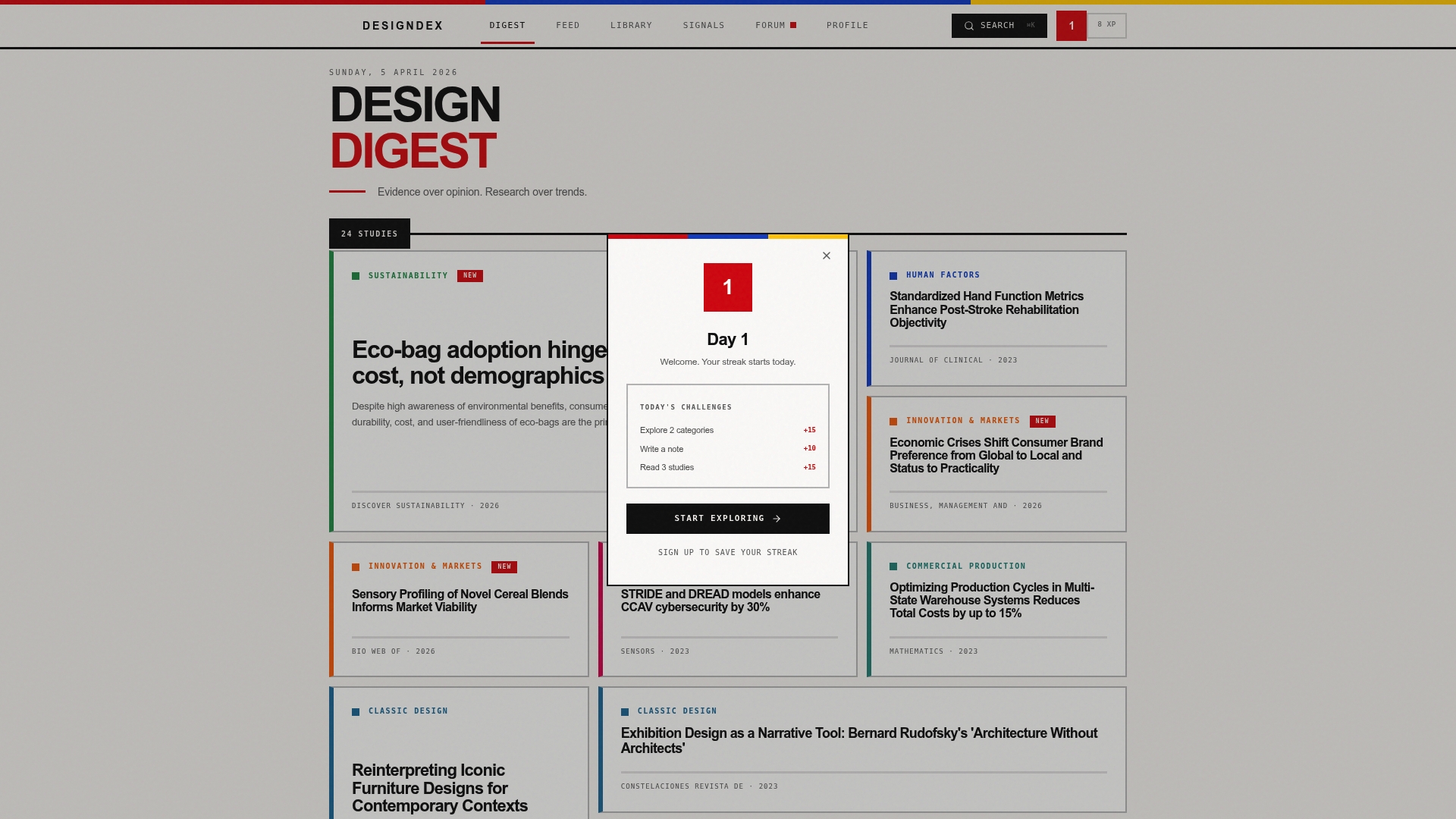
For the Empathize stage, explore peer-reviewed findings on VR-enhanced empathy in design, which documents how immersive technology changes the quality of user insight gathering. For the Test stage, access validated protocols in usability testing research that demonstrate how structured testing improves interface quality measurably. DesignDex aggregates hundreds of studies across UX and industrial design, distilled into citation-ready insights so you can justify every design decision with evidence rather than intuition.
Frequently asked questions
What is the most important step in the design process?
The Empathize stage is widely considered the most critical because it grounds all subsequent decisions in validated user reality rather than assumption; the design thinking process explicitly frames it as the foundation for defining the right problem before generating solutions.
How do design systems speed up project development?
Design systems eliminate redundant component creation and enforce visual consistency, enabling faster prototyping and testing; a Figma study quantifies this as a 34% reduction in design time across teams that implement them systematically.
What methods increase creativity in design projects?
Storyboarding, Synectics, and TRIZ are empirically validated approaches that consistently yield higher novelty in design outputs by forcing structured divergent thinking rather than relying on conventional ideation techniques.
Why is design thinking criticized?
Design thinking is frequently criticized for enabling superficial adoption that produces ideation theater without implementation follow-through, and for underweighting systemic constraints, organizational power dynamics, and domain expertise in favor of user empathy exercises.
How do I measure the success of a design project?
Success measurement should combine user satisfaction scores, usability test pass rates, time-to-prototype efficiency, and post-launch behavioral metrics to provide a multidimensional view of both process quality and solution effectiveness across the full project lifecycle.