

TL;DR:
- Structured ideation improves idea diversity, novelty, and feasibility compared to unstructured brainstorming.
- Preparation, effective facilitation, and clear challenge framing are essential for high-impact ideation sessions.
- Evaluating ideas through clustering, voting, and measuring diversity and novelty enhances overall creative outcomes.
Even the most experienced design teams hit walls during ideation: sessions spiral into the same five ideas, silence settles over the whiteboard, or every concept feels like a variation of last quarter's work. Structured ideation is not about constraining creativity; it is about channeling it toward solutions with measurable impact. Research from leading institutions confirms that applying deliberate frameworks to the ideation phase significantly improves both the novelty and feasibility of design outcomes. This guide walks design professionals and students through every stage of the process, from foundational definitions to step-by-step facilitation, evaluation, and verification of results.
Table of Contents
- What is the design ideation process?
- Preparation: tools, templates, and mindsets for effective ideation
- Step-by-step: running a high-impact ideation session
- From ideas to action: evaluating and selecting the best solutions
- Verification: measuring the impact and diversity of ideation outcomes
- Why process is only half the battle: rethinking ideation in practice
- Turn ideas into impact with DesignDex
- Frequently asked questions
Key Takeaways
| Point | Details |
|---|---|
| Structure boosts creativity | Applying a clear ideation workflow leads to stronger, more original solutions for design challenges. |
| Preparation matters | Effective tools, templates, mindsets, and constraints are essential to foster productive ideation sessions. |
| Beyond quantity | Focus on the diversity and novelty of ideas instead of just aiming for high numbers. |
| Balance process with critique | Frameworks guide brainstorming, but real breakthroughs require ongoing evaluation and adaptation. |
What is the design ideation process?
Ideation is the generative phase of design thinking in which teams produce, develop, and communicate new ideas in response to a defined problem. It sits between the empathize/define stages and the prototype stage, functioning as the creative engine of the broader process. Unlike brainstorming in its informal sense, structured ideation is goal-directed: it targets specific challenge statements and uses repeatable methods to unlock a wider range of solutions than intuition alone would yield.
Understanding design intelligence helps clarify why ideation is not simply "coming up with ideas." The phase produces tangible outputs including idea lists, concept clusters, annotated sketches, and low-fidelity prototypes, each of which feeds directly into downstream validation and testing workflows.
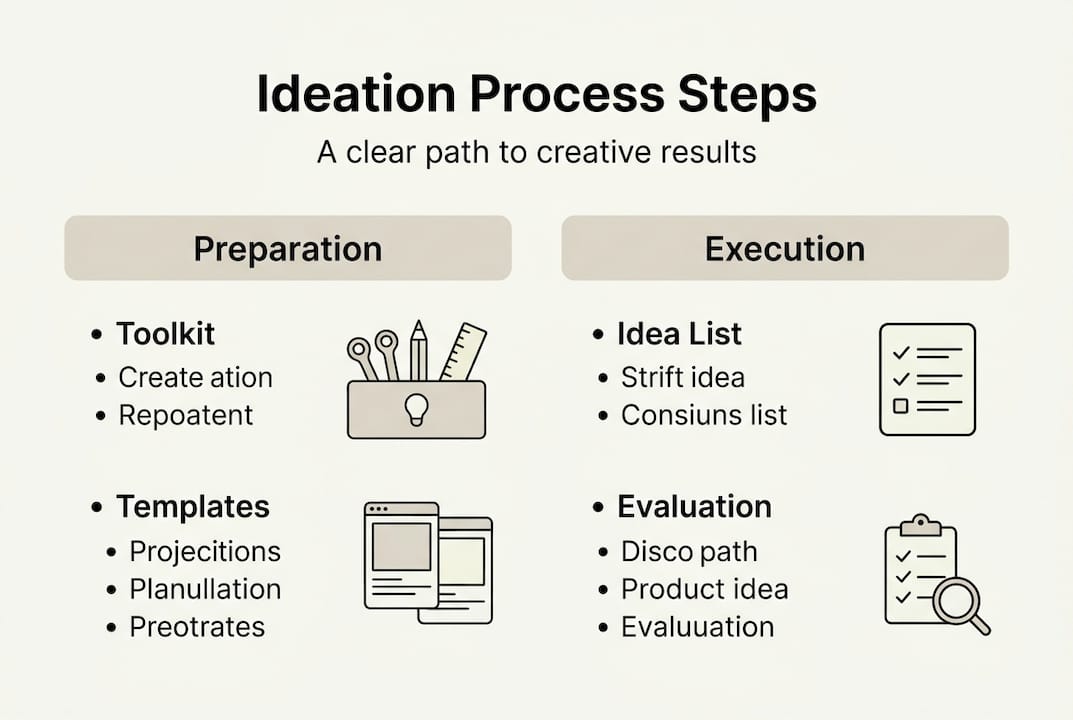
Structured methods, including those developed by Stanford d.school and IDEO, consistently outperform unstructured sessions in producing diverse and novel concepts. Stanford d.school innovation tools such as Idea Expedition, Liberatory Design, and Design Thinking Bootleg provide tested scaffolding for structured creative thinking.
One frequently overlooked driver of ideation quality is the role of constraints. Research confirms that well-defined constraints in ideation, particularly "How Might We" (HMW) questions, focus creative energy rather than limit it. The HMW format reframes problems as opportunities, giving teams a productive direction without prescribing solutions.
Key outputs from a structured ideation session:
- Idea lists (volume-focused, unfiltered)
- Concept clusters (grouped by theme or function)
- Annotated sketches or storyboards
- Prioritized shortlists for prototyping
"Ideation is not the act of having one great idea. It is the systematic pursuit of many ideas, from which the most viable ones emerge through structured selection."
| Ideation phase output | Primary purpose |
|---|---|
| Idea list | Volume generation, cognitive breadth |
| Concept cluster | Pattern recognition, theme identification |
| Concept poster | Communication, team alignment |
| Low-fidelity prototype | Rapid validation, feasibility testing |
Preparation: tools, templates, and mindsets for effective ideation
With an understanding of the ideation phase, you will need to prepare the right resources and mindset to get the most from your sessions. Preparation is not a formality; it directly determines the ceiling of your ideation output.

The toolkit for effective ideation spans both analog and digital domains. Physical tools such as Post-it notes, large whiteboards, and printed brief cards remain highly effective for in-person workshops. Digital equivalents including Miro, FigJam, and emerging AI ideation platforms extend these capabilities for distributed teams, while also introducing functionality that combats cognitive fixation by surfacing unexpected prompts and connections.
Template selection matters significantly. Stanford ideation templates such as the Design Thinking Bootleg and IDEO Method Cards provide structured prompts that guide divergent thinking without over-specifying outcomes. Pairing these with thorough design research methods ensures that ideation is grounded in validated user insights rather than assumption.
Research confirms that ideation quality improves when sessions are anchored to HMW constraints rather than open-ended prompts. Integrating digital and AI tools in early experimentation further amplifies novelty and reduces the fixation effect, where teams unconsciously default to familiar solutions.
Pre-session preparation checklist:
- Define the HMW challenge statement from validated research findings
- Select two to three complementary ideation methods
- Prepare physical or digital workspace with accessible templates
- Brief participants on ground rules (no evaluation during generation)
- Set time boxes for each activity phase
| Tool type | Example | Best suited for |
|---|---|---|
| Analog | Post-its, whiteboards | Co-located teams, rapid iteration |
| Digital | Miro, FigJam | Distributed or hybrid teams |
| AI-assisted | Ideation prompts, clustering bots | Overcoming fixation, volume scaling |
| Template-based | d.school Bootleg, IDEO cards | Structured facilitation, beginners |
Pro Tip: Practice facilitation in low-stakes environments, such as internal team exercises or student workshops, before leading high-pressure client sessions. Facilitation skill compounds with repetition and directly improves group output quality.
Step-by-step: running a high-impact ideation session
Once you have the right tools and a clear mindset, it is time to run your ideation session using a proven, sequential approach. The following steps synthesize established methods from design thinking practice.
- Frame the challenge. Open with a precise HMW question or focused brief. Ambiguity at this stage compounds downstream.
- Explain process and set ground rules. Establish timeboxing parameters (typically 10 to 20 minutes per activity), a volume target, and a strict no-evaluation policy during idea generation.
- Execute divergent methods in sequence. Begin with individual Brainwriting (participants write ideas silently before sharing) to ensure all voices contribute, then transition to group rapid ideation or round-robin sharing. Rotating methods balances participation across introverted and extroverted team members.
- Capture ideas visually. Record every concept, regardless of apparent quality. Sketch-based capture is preferable to text-only lists, as visual representation accelerates pattern recognition.
- Cluster and prioritize. Group related ideas by theme or function, then apply dot voting to surface team-aligned priorities. Dot voting is fast, democratic, and reduces facilitator bias.
- Define next steps. Identify two to four concepts for further development, concept poster creation, or rapid prototyping.
Experts recommend targeting 30 to 100+ ideas per session to push teams beyond obvious solutions; clustering and dot voting then provide a structured path to prioritization.
Pro Tip: Rotate the facilitation role across sessions rather than assigning it permanently. Different facilitators naturally emphasize different methods, which expands team exposure to varied ideation approaches and balances group dynamics over time.
The design validation workflow that follows ideation depends heavily on the quality of concepts produced in this phase. Similarly, human-centered design principles should inform how challenge framing reflects actual user needs, not assumed ones.
From ideas to action: evaluating and selecting the best solutions
When the generation phase concludes, the real analytical work begins: filtering, clustering, and selecting which solutions merit further investment. This transition from divergent to convergent thinking is where many teams introduce bias or discard high-potential concepts prematurely.
Established evaluation methods include concept clustering, dot voting, and concept posters, each of which serves a distinct function. Concept posters formalize individual ideas into a shareable format that includes a title, sketch, and rationale, making comparative evaluation more systematic. Empathy mapping and quick user-feedback sessions provide early validation signals before significant prototyping resources are committed.
A critical finding from academic critique challenges the popular assumption that volume guarantees quality. Research shows that few original propositions often outperform bulk generation; the "quantity breeds quality" heuristic is contested, with common critiques noting process rigidity, lack of measurability, and overemphasis on empathy without validation.
Applying design analysis frameworks at the evaluation stage helps teams assess ideas against feasibility, desirability, and viability criteria simultaneously. Pairing this with a robust design research methodology ensures that selection decisions are evidence-driven rather than instinctive.
Common evaluation pitfalls to avoid:
- Groupthink during dot voting (anchor on bold, visible ideas)
- Selection bias toward familiar or low-risk concepts
- Novelty fixation (prioritizing originality over feasibility)
- Premature convergence before sufficient divergent exploration
"Rigorous idea evaluation is not the enemy of creativity; it is the mechanism through which the most promising concepts receive the attention they deserve."
| Evaluation method | Primary function | Risk if misapplied |
|---|---|---|
| Dot voting | Democratic prioritization | Groupthink, anchoring bias |
| Concept poster | Structured comparison | Over-formalization of early ideas |
| Empathy mapping | User alignment check | Substituting validation for testing |
| Feasibility scoring | Resource and risk assessment | Eliminating bold but viable concepts |
Verification: measuring the impact and diversity of ideation outcomes
With ideas selected and moving toward execution, the final step is to verify the true impact and breadth of your ideation session. Verification is frequently skipped, yet it provides the data needed to improve future sessions and justify creative decisions to stakeholders.
Effective measurement focuses on idea diversity, novelty, feasibility, and speed to prototype rather than raw idea count. Diversity metrics assess whether the output spans multiple solution categories or clusters tightly around one approach. Novelty scoring evaluates departure from existing solutions in the domain. Both metrics are more informative than volume alone.
Research recommends that professionals and students begin with d.school and IDEO templates, practice in low-stakes settings, and measure session success by idea diversity and novelty rather than volume generated. Template-based comparison across sessions enables longitudinal tracking of ideation capability growth.
Session debriefs, structured user feedback loops, and retrospective journaling (particularly valuable for students) all contribute to a continuous improvement cycle. Tracking idea origin, whether an idea emerged individually or through group interaction, provides insight into which session structures produce the most generative outcomes.
For teams working to stay current on emerging design trends, verification data also surfaces signals about where team knowledge gaps may be limiting ideation breadth.
Pro Tip: Log the origin of each shortlisted idea (individual silent generation vs. group activity) after every session. Over time, this data reveals which methods your specific team responds to most productively, allowing you to optimize future session structures with evidence rather than assumption.
Verification metrics worth tracking:
- Idea diversity score (number of distinct solution categories)
- Novelty rating (departure from existing solutions, rated by peers)
- Feasibility distribution (spread across low, medium, high feasibility)
- Time to first prototype from session close
- Ratio of individual-to-group originated shortlisted ideas
Why process is only half the battle: rethinking ideation in practice
Structured frameworks are necessary, but treating them as fixed recipes produces predictable, incremental results rather than breakthrough innovations. The most significant ideation outcomes observed across professional practice emerge not from strict protocol adherence but from the willingness to deviate from process when evidence demands it.
Academic critique of mainstream frameworks is instructive here. Documented critiques cite process rigidity and lack of measurability as persistent weaknesses in conventional ideation models. These are not minor limitations; they represent structural blind spots that can systematically suppress the most original contributions in a session.
The more productive stance treats process as a safety net, not a cage. Use structured methods to prevent the session from collapsing into groupthink or repetition; then deliberately push beyond the framework's boundaries through creative risk-taking, cross-disciplinary provocation, and iterative critique. Examining how art influences design practice offers one productive example of how non-design domains can expand ideation range.
Continuous validation and course-correction should be embedded throughout the process, not reserved for a final review gate. Teams that integrate critique and testing at multiple points within ideation produce concepts that are both more original and more grounded in real-world constraints.
Turn ideas into impact with DesignDex
Strong ideation practice is built on access to validated research, and that is precisely where DesignDex delivers sustained value for design teams and students.
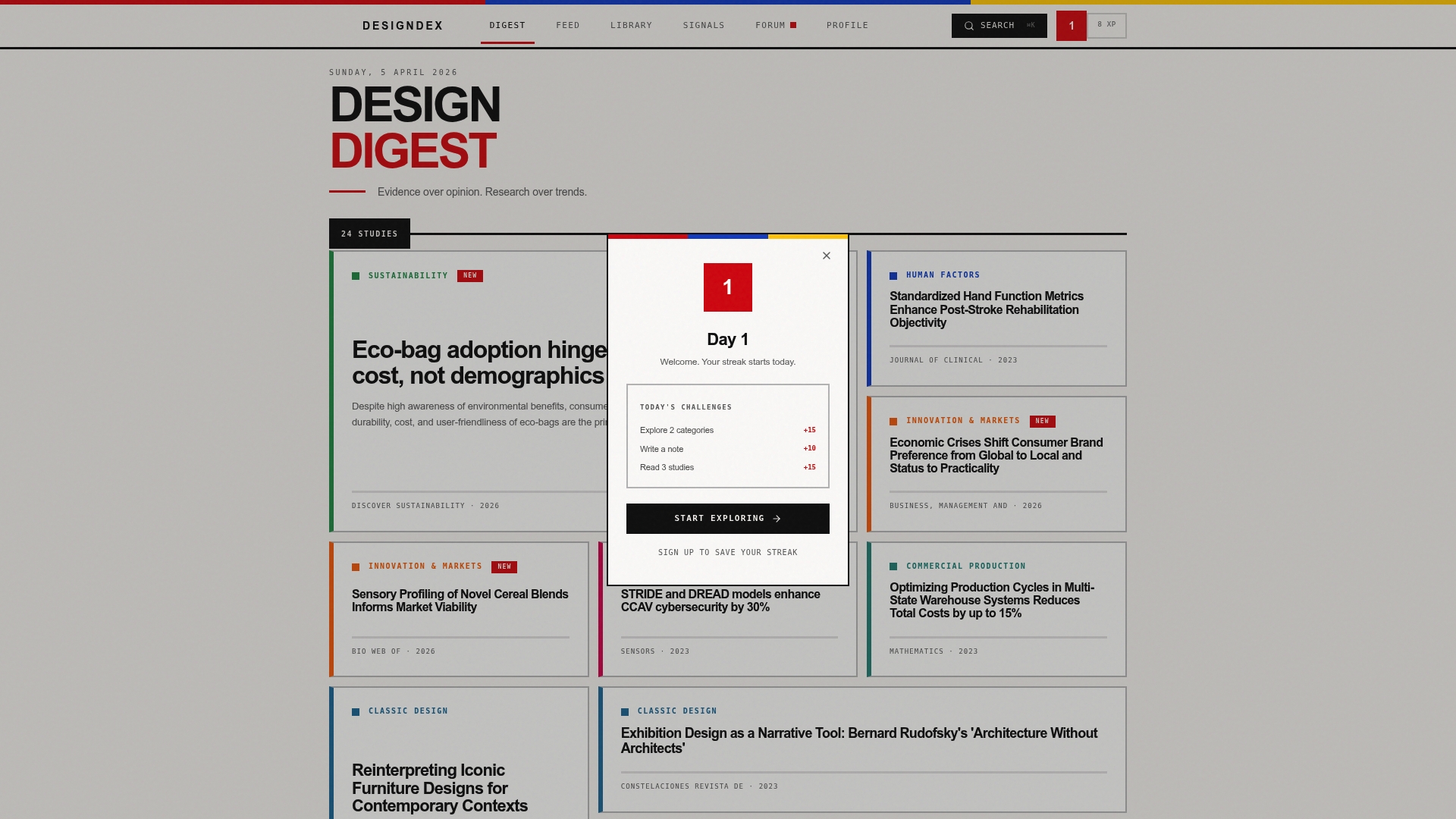
DesignDex aggregates and distills peer-reviewed UX and industrial design research into structured, citation-ready summaries, giving you the evidence base to justify ideation choices with precision. Explore how usability testing research and VR empathy research directly inform how design teams frame challenges and evaluate concepts. Whether you are a student building your first ideation toolkit or a professional optimizing team workflows, DesignDex provides the research intelligence to move from intuition-driven to evidence-driven creative practice.
Frequently asked questions
What is the main goal of the design ideation process?
The main goal is to generate diverse, novel ideas that solve the core design challenge using structured methods and collaborative creativity. Stanford d.school tools such as Idea Expedition and Design Thinking Bootleg provide the scaffolding to achieve this systematically.
How many ideas should be generated in a typical ideation session?
Aim for 30 to 100+ ideas per session to move beyond obvious solutions and surface high-potential, original concepts through clustering and prioritization.
Which tools or templates are best for beginners?
Stanford d.school and IDEO templates are the most accessible starting points; d.school structured tools such as Liberatory Design and Design Thinking Bootleg provide clear facilitation guidance for structured idea development.
How do I measure if my ideation session was successful?
Success is best measured by the diversity and novelty of ideas produced, not just total count; tracking these metrics by session enables longitudinal improvement of team ideation capability.
Can digital or AI tools improve ideation outcomes?
Yes: digital and AI tools help teams overcome cognitive fixation and introduce novel directions, particularly during early-stage experimentation when idea diversity matters most.