

TL;DR:
- Design validation confirms products perform effectively in real-world conditions, beyond just meeting specifications.
- Risk-based validation prioritizes testing scenarios with high severity and likelihood to prevent costly failures.
- Integrating validation throughout agile workflows with small user tests and documentation improves reliability and reduces post-launch issues.
Design validation is the process of confirming that a design meets user needs and intended use in real-world conditions, a discipline fundamentally distinct from verification, which checks whether technical specifications are satisfied. Many design teams treat validation as a final-stage formality, a box to check before launch. That misconception is costly: products that skip rigorous validation routinely fail in the field, generating rework cycles, regulatory setbacks, and reputational damage that can dwarf the original development budget. This guide presents evidence-backed strategies, structured frameworks, and practical methods to help UX and industrial design professionals build validation into their process at every stage, not just at the end.
Table of Contents
- Defining design validation: More than a checkbox
- Essential methods for validation in UX and industrial design
- Risk-based validation: Focusing on what matters most
- Integrating validation into modern agile workflows
- The uncomfortable truth: What most 'validation' misses
- Enhance your validation impact with research and tools
- Frequently asked questions
Key Takeaways
| Point | Details |
|---|---|
| Validation is user-focused | Design validation ensures real-world user needs and intended use are met, not just technical requirements. |
| Combine multiple methods | Mix usability testing, simulations, interviews, and heuristic reviews for broader validation coverage. |
| Prioritize risk and edge cases | Use risk assessment to target validation on high-impact failures, unusual situations, and boundary conditions. |
| Embed validation iteratively | Integrate checkpoints and re-testing throughout agile cycles, not just at the project's end. |
| Balance AI and human input | Supplement traditional methods with AI tools, but always validate critical insights with real users. |
Defining design validation: More than a checkbox
At its core, design validation ensures a design meets user needs in actual use, while verification checks that specs are met. The distinction is consequential. A product can pass every technical specification and still fail its users entirely, because specs describe intent, not outcome. Validation interrogates outcome: does this design perform as users actually need it to, in the real conditions they encounter?
This distinction matters acutely in both UX and industrial design. In UX, validation addresses market fit and usability: does the interface support the tasks users genuinely perform, in the contexts they inhabit? In industrial design, it addresses performance, safety, and regulatory compliance under real operating conditions. For high-stakes domains, validation for medical devices is a regulatory requirement, not an optional quality step, because the consequences of failure are measured in patient harm rather than user frustration.
The key elements of rigorous design validation include:
- User needs: Validation must be anchored to documented, researched user requirements, not assumed ones.
- Intended use: The design must be tested in the context for which it was designed, including foreseeable misuse.
- Real-world conditions: Lab-controlled testing alone is insufficient; environmental, ergonomic, and contextual variables must be represented.
- Outcome measurement: Success criteria must be defined before testing begins, not inferred after results arrive.
"Validation is not a gate at the end of the process. It is a continuous interrogation of whether the design is solving the right problem for the right people in the right context."
The costs of inadequate validation are well-documented. Defects discovered post-launch can cost 10 to 100 times more to correct than those caught during development. Reputational damage, regulatory penalties, and product recalls compound those direct costs. Incorporating design analysis in UX early and systematically reduces these risks by surfacing misalignments between design intent and user reality before they become expensive field failures.

With a clear understanding of why validation isn't just ticking boxes, let's explore how it unfolds in practice for UX and industrial design.
Essential methods for validation in UX and industrial design
Validation methods divide broadly into qualitative techniques, which reveal why problems occur, and quantitative techniques, which measure what is happening and at what frequency. Both categories are necessary; neither alone provides sufficient evidence for confident design decisions.
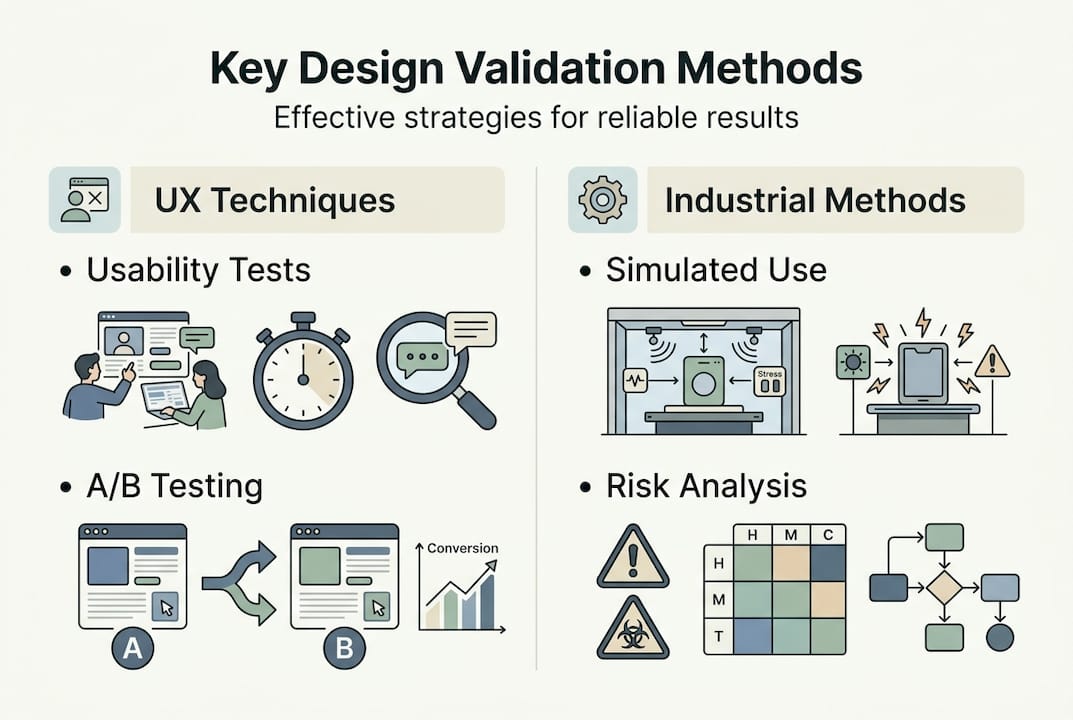
Validation in UX uses usability testing, A/B tests, and interviews; industrial validation uses simulated testing and real-world prototyping. The following table maps method type to primary output:
| Method | Domain | Output type |
|---|---|---|
| Moderated usability testing | UX | Qualitative behavioral insight |
| A/B testing | UX | Quantitative performance comparison |
| User interviews | UX | Qualitative attitudinal data |
| Heuristic evaluation (Nielsen) | UX | Expert-based issue identification |
| First-click and tree testing | UX | Quantitative navigation accuracy |
| Simulated use testing | Industrial | Quantitative performance under load |
| Environmental stress testing | Industrial | Quantitative failure threshold data |
| Production prototype validation | Industrial | Qualitative and quantitative combined |
A critical empirical benchmark: 3 to 5 users uncover approximately 80% of usability issues in moderated testing, making small-sample studies highly cost-effective for iterative cycles. AI-assisted heuristic tools now identify up to 77% of common usability issues, offering a rapid first-pass screen before human testing resources are deployed. Explore common UX validation methods for a practical reference on selecting the right approach for each project phase.
Key principles for method selection include:
- Combine qualitative and quantitative methods to capture both behavioral patterns and underlying motivations.
- Match method rigor to the risk level of the design decision being validated.
- Use AI-assisted heuristics for rapid screening, reserving moderated sessions for high-stakes or ambiguous findings.
- Validate with representative users, not internal proxies, to avoid confirmation bias.
Pro Tip: A usability testing case study from DesignDex illustrates how structured test protocols, even with small participant groups, consistently surface the critical issues that matter most. Review it before designing your next validation session.
Explore proven validation workflows and human-centered design tips to build a method stack suited to your project's risk profile and timeline.
Having mapped out key methods, it's vital to understand how to target validation efforts for maximum real-world reliability.
Risk-based validation: Focusing on what matters most
Not all design failures carry equal consequence. Risk-based validation applies structured prioritization frameworks to direct testing resources toward the scenarios most likely to produce severe or frequent failures. The most widely applied tool is Failure Mode and Effects Analysis (FMEA), a systematic method for identifying potential failure modes, assessing their severity and probability, and ranking them by risk priority number.
Risk-based validation uses FMEA and edge case prioritization to allocate resources effectively and ensure reliability under critical conditions. Edge cases, including boundary inputs, error states, atypical user behaviors, and environmental extremes, are disproportionately responsible for post-launch failures, yet they are consistently under-tested because teams focus on the happy path.
A practical risk ranking table for validation planning:
| Failure scenario | Severity (1-5) | Frequency (1-5) | Risk priority |
|---|---|---|---|
| Data loss on form submission | 5 | 3 | 15 |
| Navigation failure on mobile | 4 | 4 | 16 |
| Incorrect error message display | 3 | 3 | 9 |
| Accessibility failure (screen reader) | 5 | 2 | 10 |
| Environmental stress failure (heat) | 5 | 1 | 5 |
A structured process for risk-based validation prioritization:
- Enumerate all potential failure modes across user journeys and technical components.
- Assign severity scores (impact on user or system) and frequency scores (likelihood of occurrence).
- Calculate risk priority numbers and rank failure modes accordingly.
- Map each high-priority failure mode to a specific validation test or scenario.
- Establish explicit success criteria and pass/fail thresholds before testing begins.
- Document findings and residual risks for traceability and future reference.
Requirement traceability, linking each validation test to a specific user requirement or design specification, ensures that coverage is systematic rather than opportunistic. A risk-based QFD case study demonstrates how Quality Function Deployment integrated with risk analysis reduces musculoskeletal injury risks by proactively identifying high-severity design gaps. Consult the guide to design validation for additional FMEA templates and traceability frameworks.
Pro Tip: Document every risk finding and its resolution in a shared validation log. This record becomes a reusable knowledge asset for future projects, compressing risk identification time on subsequent design cycles.
Understanding how to prioritize risk leads directly into practical, actionable workflow improvements.
Integrating validation into modern agile workflows
Agile design and development cycles create both an opportunity and a challenge for validation. The opportunity: frequent iteration cycles provide natural checkpoints for lightweight validation. The challenge: sprint velocity pressures often push validation to the end of the cycle, where it functions as a gate rather than a learning mechanism.
Iterative validation checkpoints in agile cycles catch problems early and reduce rework. Embedding validation at each sprint or design phase, rather than reserving it for a final review, fundamentally changes the economics of defect correction. Issues caught in prototype stages cost a fraction of those discovered post-deployment.
Practical integration strategies include:
- Schedule lightweight, unmoderated testing sessions within each sprint to validate the highest-risk changes introduced in that cycle.
- Use AI-assisted validation tools for rapid heuristic screening between moderated sessions, maintaining continuous coverage without proportional resource investment.
- Maintain a living validation log that documents test objectives, participant profiles, findings, and design responses for each checkpoint.
- Track outcome metrics including defect escape rate (issues discovered post-release versus pre-release) and iteration cycle count to quantify validation effectiveness over time.
- Balance exploratory moderated sessions, which generate deep qualitative insight, with rapid unmoderated tests, which generate high-volume quantitative signal.
Documentation discipline is non-negotiable in agile validation. Without structured records, findings from early sprints are lost by the time later-stage decisions are made, and traceability to user requirements breaks down. A rigorous design research methodology provides the structural foundation for maintaining this discipline across fast-moving cycles.
Pro Tip: Re-test after every major design change, not just at milestone gates. A single significant modification to navigation, layout, or interaction logic can invalidate findings from prior sessions. Treat each major change as a new validation trigger.
The current generation of AI validation tools offers meaningful efficiency gains for pattern detection and heuristic analysis, but they do not replicate the contextual judgment, empathy, or behavioral nuance that human participants provide. The optimal approach layers AI screening with targeted human testing, using each where its comparative advantage is greatest.
The uncomfortable truth: What most 'validation' misses
The most pervasive failure in design validation is not a lack of testing. It is a systematic avoidance of the tests most likely to produce uncomfortable findings. Teams under-test edge cases, accessibility scenarios, and high-severity failure modes not because they lack the methodology, but because those tests surface problems that require difficult, time-consuming design revisions. The organizational incentive to ship frequently overwhelms the professional incentive to validate rigorously.
The psychological dimension is real: presenting evidence that a design is failing is professionally uncomfortable, particularly when timelines are tight and stakeholder expectations are fixed. Rigorous validation demands a culture in which negative findings are treated as valuable intelligence, not as project failures. That cultural shift is harder to achieve than any methodological improvement.
The evidence is clear that layering risk-based prioritization with iterative user testing and structured documentation produces outlier outcomes: lower defect escape rates, fewer post-launch iterations, and stronger user adoption metrics. A design intelligence guide provides frameworks for building the organizational conditions in which rigorous validation becomes the default, not the exception. The payoff is asymmetric: the cost of catching a critical failure before launch is always lower than the cost of managing it after.
Enhance your validation impact with research and tools
DesignDex aggregates and distills peer-reviewed research in UX and industrial design into structured, citation-ready insights that support evidence-based validation decisions. Rather than navigating full academic papers, you get direct access to methodology breakdowns, empirical findings, and real-world applications.
Explore the usability testing case study to see how structured protocols translate into measurable quality improvements, or review the VR empathy case study for emerging validation approaches in immersive design contexts. The DesignDex Digest delivers daily research signals and trend analysis, keeping your validation practice aligned with the latest empirical evidence. Use it as your ongoing decision-support resource for justifying design choices with rigor.
Frequently asked questions
What is the difference between design validation and verification?
Design validation confirms real-world effectiveness for users, while verification checks if technical specifications are met. Validation is outcome-focused; verification is specification-focused.
How many users do you need for usability validation?
Testing with 3 to 5 users uncovers approximately 80% of usability issues, making small-sample studies highly efficient for iterative validation cycles.
What are some standard methods for validating designs in practice?
Common methods include usability testing, A/B tests, heuristic evaluation, and simulated use testing with production prototypes, selected based on the design domain and risk level.
Why is risk-based validation important?
Risk-based validation focuses limited resources on high-severity and high-frequency failure modes, maximizing the impact of validation investment and reducing the probability of costly post-launch defects.
Can AI replace human validation in design?
AI heuristics identify up to 77% of common issues efficiently, but human validation remains essential for capturing the contextual, behavioral, and attitudinal depth that automated tools cannot replicate.