

TL;DR:
- Effective synthesis requires comprehensive data review, combining qualitative, quantitative, and behavioral evidence.
- Combining manual methods with AI assistance, underpinned by rigorous verification, ensures trustworthy insights.
- Well-structured synthesis enables confident, evidence-based design decisions and stakeholder alignment.
Product teams that invest in rigorous user research frequently encounter the same critical bottleneck: stacks of interview transcripts, usability recordings, survey exports, and analytics reports that resist translation into clear design direction. The gap between data collection and confident decision-making is where projects stall, stakeholders lose trust, and design quality suffers. This guide presents a structured, evidence-backed methodology for synthesizing design research effectively, drawing on proven manual techniques and emerging AI-assisted approaches, so your team can move from raw evidence to prioritized, defensible insights with precision and intellectual honesty.
Table of Contents
- What you need to start synthesizing design research
- Step-by-step process for synthesizing design research
- Common pitfalls and how to verify your synthesis
- How synthesized research drives design decisions
- Why most teams get synthesis wrong and what actually works
- Explore advanced tools and research summaries for better synthesis
- Frequently asked questions
Key Takeaways
| Point | Details |
|---|---|
| Prepare effectively | Gather all relevant data, select synthesis tools, and clarify team roles before you start. |
| Follow a structured workflow | Use step-by-step synthesis processes, whether manual or AI-accelerated, to maintain clarity and integrity. |
| Verify and triangulate insights | Always cross-check synthesized findings with raw data and involve team feedback to avoid bias. |
| Present actionable recommendations | Synthesized research should directly guide design decisions and stakeholder action. |
| Balance AI and manual methods | Combine AI speed with rigorous manual validation for trustworthy, empathetic outcomes. |
What you need to start synthesizing design research
Effective synthesis begins well before any clustering or theming occurs. Teams must audit the full landscape of available input data to ensure synthesis reflects the complete evidence base rather than the most convenient subset.
Types of data typically used in synthesis:
- Qualitative interviews: Verbatim transcripts and annotated recordings that capture participant language, emotion, and context
- Usability test sessions: Task completion data, error logs, think-aloud observations, and facilitator notes
- Survey responses: Closed-ended quantitative distributions alongside open-ended text fields requiring qualitative coding
- Analytics and behavioral data: Funnel drop-off rates, heatmaps, session recordings, and feature adoption metrics
Each data type carries distinct evidentiary weight. Quantitative analytics confirm the what at scale, while qualitative interviews illuminate the why at depth. A synthesis process that omits either type risks producing findings that are statistically significant but contextually hollow, or emotionally resonant but statistically unreliable. Grounding your approach in sound design research methodology from the outset significantly reduces these risks.
Synthesis tools comparison:
| Feature | Manual synthesis (sticky notes, spreadsheets) | AI-assisted synthesis platforms |
|---|---|---|
| Speed | Slow (days to weeks) | Fast (hours) |
| Team empathy building | High | Low |
| Contradiction detection | Strong (with good facilitation) | Variable |
| Auditability | High if documented | Requires verification layer |
| Cost | Low tool cost, high labor cost | Higher tool cost, lower labor cost |
| Risk of narrative forcing | Low | Moderate to high |
The table above reflects a well-documented tension in current practice: AI accelerates synthesis through auto-tagging and clustering but introduces guardrails requirements that manual methods do not. AI tools can group similar statements with impressive speed, yet they optimize for coherence over contradiction. A skilled human facilitator will notice the outlier participant who disrupts a tidy narrative; an algorithm may simply suppress it.
Team roles in synthesis sessions:
- Facilitator: Manages time, prevents groupthink, and enforces intellectual honesty
- Note takers: Ensure observations are captured verbatim during sessions, not paraphrased post-hoc
- Analysts: Apply coding schemes, identify pattern frequencies, and flag contradictions
The required mindset shift is equally important. Teams must approach synthesis with openness to contradiction: the finding that does not fit the emerging story is frequently the most informative. Intellectual honesty, expressed as a willingness to show your work, document how each insight was derived, and expose reasoning to peer scrutiny, distinguishes reliable synthesis from post-rationalized storytelling.
With preparation in place, you're ready to move into the structured synthesis process itself.
Step-by-step process for synthesizing design research
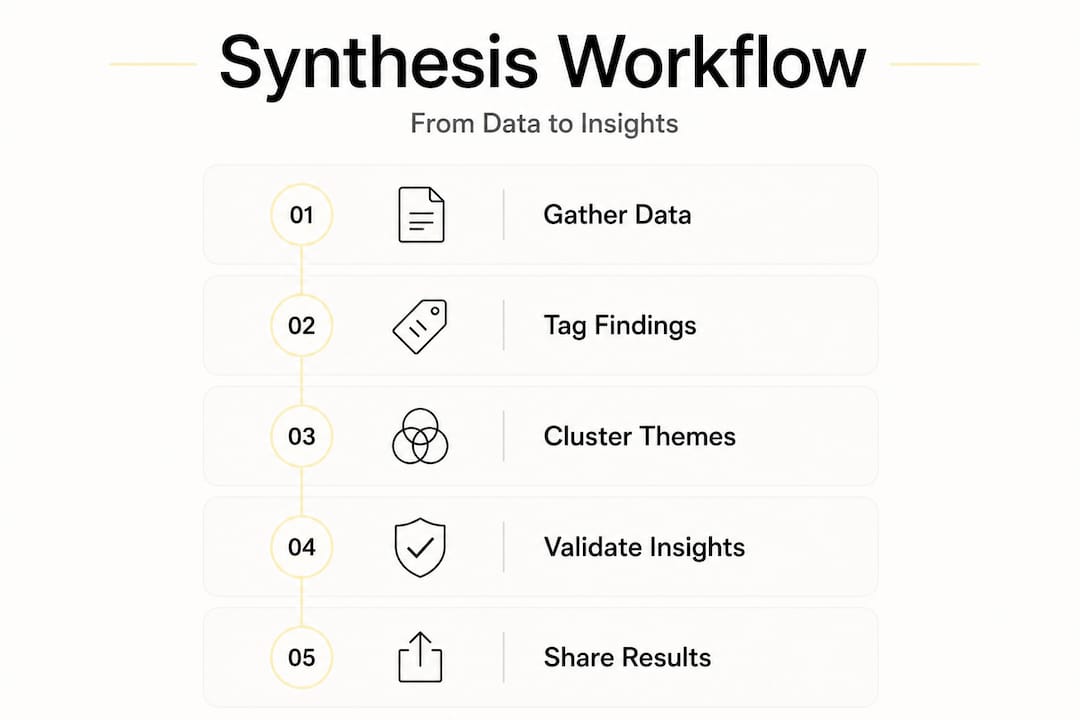
A repeatable, transparent workflow prevents the most common synthesis failures: rushed clustering, decontextualized quotes, and insights that cannot be traced back to original evidence.
-
Gather and familiarize with all input data. Before any tagging begins, every team member reviews the raw data independently. This phase builds individual familiarity and surfaces initial observations without the premature social convergence that occurs when teams discuss findings too early.
-
Tag and cluster findings (manual or AI-assisted). Apply a consistent coding scheme to label observations by theme, user segment, behavior type, or emotional valence. Manual tagging on digital whiteboards (such as Miro or FigJam) encourages spatial reasoning; AI platforms accelerate volume processing. In either case, retain the original source reference alongside each tag.
-
Identify patterns, contradictions, and key moments. Patterns are findings that recur across multiple participants, sessions, or data types. Contradictions, where two credible data sources point in opposing directions, require explicit documentation rather than resolution by omission. Key moments are specific quotes, task failures, or behavioral anomalies that carry outsized explanatory power and deserve direct evidence citation.
-
Triangulate and verify against raw evidence. Cross-check every emerging theme against its constituent raw data points. Using effective research methods at this stage means confirming that a stated pattern is not driven by a single vocal participant or a single data source type.
-
Document synthesized insights with traceable evidence. Each finalized insight should carry a structured record: the insight statement, the supporting evidence count, direct representative quotes, and any contradicting evidence that was considered. This documentation is the foundation for stakeholder communication and future research iteration.
Synthesis step risk assessment:
| Step | Primary risk | Mitigation |
|---|---|---|
| Tagging and clustering | Over-grouping dissimilar findings | Limit cluster size; review with quotes |
| Pattern identification | Confirmation bias | Require minimum evidence threshold |
| Contradiction handling | Omission of uncomfortable data | Flag contradictions as explicit findings |
| Documentation | Shallow narrative | Require evidence counts per insight |
Research indicates that AI cuts synthesis time from days to hours but may risk narrative forcing, a process where the model's output reflects its training patterns rather than the specific texture of your participants' experiences. Applying a design intelligence guide framework helps teams structure verification at each step, ensuring speed gains do not compromise evidentiary quality.

Pro Tip: During team synthesis workshops, cross-check every cluster against at least three direct participant quotes and verify the count of supporting observations. If a cluster cannot be substantiated by multiple sources, it belongs in a provisional findings section rather than the primary insights output.
Synthesis is more than method; avoiding mistakes is essential for trustworthy outcomes.
Common pitfalls and how to verify your synthesis
Even well-resourced teams with rigorous processes encounter synthesis errors. Understanding these failure modes in advance creates the conditions for self-correcting practice.
Most common synthesis pitfalls:
- Confirmation bias: Teams unconsciously weight findings that align with pre-existing product hypotheses. This is particularly acute when synthesis occurs after stakeholder expectations have been communicated to the research team.
- Shallow narratives: Over-summarization collapses nuanced participant experiences into generic themes (for example, "users want simplicity") that are too vague to drive specific design decisions. Shallow narratives feel satisfying but resist operationalization.
- Neglecting contradictions: The participant who did not follow the expected pattern, the survey segment with divergent preferences, or the usability session that contradicted interview self-reports all contain signal that shallow synthesis discards.
- Projection: Researchers inadvertently attribute motivations or emotions to participants that were not explicitly expressed, based on the researcher's own mental models rather than evidence.
- Recency bias: Findings from the most recent research sessions receive disproportionate weight relative to earlier sessions, distorting pattern frequency counts.
Verification strategies address these risks directly. To conduct design analysis in UX with rigor, every synthesized theme should be cross-checked against the raw data from which it was derived. Count the number of participants or sessions that support each insight, not just the presence of a supporting quote. A finding supported by two out of twelve participants is not a majority finding; it is a minority signal that may still be design-relevant but must be labeled accurately.
"Show-your-work synthesis requires that every insight be traceable to its original evidence source, with contradicting data explicitly documented alongside supporting data. Intellectual honesty in synthesis is not a methodological nicety: it is the mechanism that separates evidence-based design from post-rationalized storytelling."
Following a structured design validation workflow after synthesis closes the loop between data collection and decision-making. This means returning synthesized insights to a subset of research participants for member-checking where feasible, or presenting provisional findings to a colleague who was not involved in data collection to test whether the themes are legible without insider knowledge.
Pro Tip: Have a third party, ideally a colleague not involved in the research project, review your synthesized themes before they are finalized. This external perspective reliably surfaces projection, over-generalization, and instances where the evidence count does not match the confidence level of the insight statement. Always triangulate outputs against raw data before presenting findings to stakeholders.
Understanding how to verify synthesis helps teams unlock actionable results that can be defended under scrutiny.
How synthesized research drives design decisions
Synthesis translates evidence into strategic utility. When executed with rigor, the outputs do not simply describe what users did or said; they generate decision-relevant knowledge that product, UX, and strategy teams can act on with confidence.
Decisions enabled by rigorous synthesis:
- Feature prioritization: Synthesized pain points ranked by frequency and severity provide a defensible basis for backlog prioritization, replacing preference-based stakeholder debates with evidence-grounded triage
- Hypothesis validation or invalidation: Synthesis can confirm whether a design hypothesis matches observed user behavior or should be revised before further investment
- Journey map refinement: Clustered usability failures and emotional low points from interview synthesis directly update experience maps with participant-grounded accuracy
- Persona calibration: Behavioral and attitudinal patterns from synthesis refine or challenge existing personas, ensuring they reflect current research rather than historical assumptions
- Accessibility gap identification: Synthesis of diverse participant sessions surfaces friction points experienced disproportionately by specific user segments, informing inclusive design decisions
- Stakeholder alignment: Structured synthesis outputs, especially when presented with direct participant quotes and evidence counts, reduce subjective debate and increase organizational buy-in for design direction
Synthesized insights enable confident, evidence-based design choices across all of these decision types. The mechanism is straightforward: when a design recommendation is accompanied by a traceable chain of evidence from synthesis through to raw data, stakeholders who might otherwise question the basis for a proposal can review the reasoning directly. This transparency builds trust in the research function and reduces the "who asked users?" challenge that frequently derails product team alignment sessions.
Storytelling frameworks amplify the impact of synthesis outputs for stakeholder audiences. Presenting synthesized insights as structured narratives, opening with a representative participant scenario, supporting it with pattern frequency data, and closing with a design implication, creates a format that is both credible and accessible to non-research stakeholders. Identifying design trends from synthesis over multiple research cycles enables this storytelling to extend beyond individual project findings to broader product strategy signals.
Research consistently shows that manual methods build team empathy and shared understanding in ways that AI-accelerated synthesis at scale requires careful verification to replicate. The act of reading transcripts together, discussing interpretation disagreements, and collectively arriving at a shared insight is itself an organizational capability-building exercise. The synthesis process, done well, creates a research-literate team, not just a research output.
With the impact clarified, let's reflect on what most teams miss in current synthesis practice.
Why most teams get synthesis wrong and what actually works
The dominant failure mode in synthesis is not technical: it is organizational. Teams rush synthesis under deadline pressure, treating it as a packaging step rather than an analytical one. The result is insights that are coherent on the surface but lack evidentiary depth, which means they collapse under the first stakeholder challenge or fail to survive contact with the next round of user testing.
AI-assisted synthesis tools have accelerated this failure mode rather than corrected it. When a platform auto-generates themed clusters from interview transcripts in minutes, the temptation is to accept the output as analysis complete. It is not. As traditional manual methods contrast with AI shortcuts in the research literature, the former build the team empathy and shared understanding necessary for organizational buy-in, while the latter risk over-narrativizing findings in ways that suppress contradiction and project coherence onto genuinely ambiguous data.
What actually works is a hybrid approach with deliberate sequencing: use AI for initial tagging and volume reduction, then reintroduce human judgment at the pattern identification and contradiction-detection stages. Small teams benefit from full manual synthesis for at least one complete research cycle before introducing AI assistance, because the manual experience builds the interpretive judgment necessary to evaluate and challenge AI-generated clusters critically.
The show-your-work principle is not bureaucratic overhead; it is the mechanism that forces rigor. When every insight must be supported by a documented evidence trail, synthesis teams cannot rely on impression or consensus feeling. Methodological prompts, structured questions such as "how many participants expressed this?", "what is the strongest counter-evidence?", and "is this finding or interpretation?" keep synthesis grounded. Following design research best practices means building these prompts into your synthesis process as standard procedure, not optional reflection.
The hard-won lesson: empathy and shared understanding built during manual synthesis are not soft outputs. They are the foundation of organizational alignment, the reason stakeholders trust the findings, and the mechanism by which research moves from report to action. Speed without that foundation produces synthesis that nobody acts on.
Explore advanced tools and research summaries for better synthesis
Strong synthesis practice requires both sound methodology and access to the latest research evidence. DesignDex aggregates and distills peer-reviewed UX and design studies into structured, citation-ready summaries that directly support your synthesis and decision-making workflows.
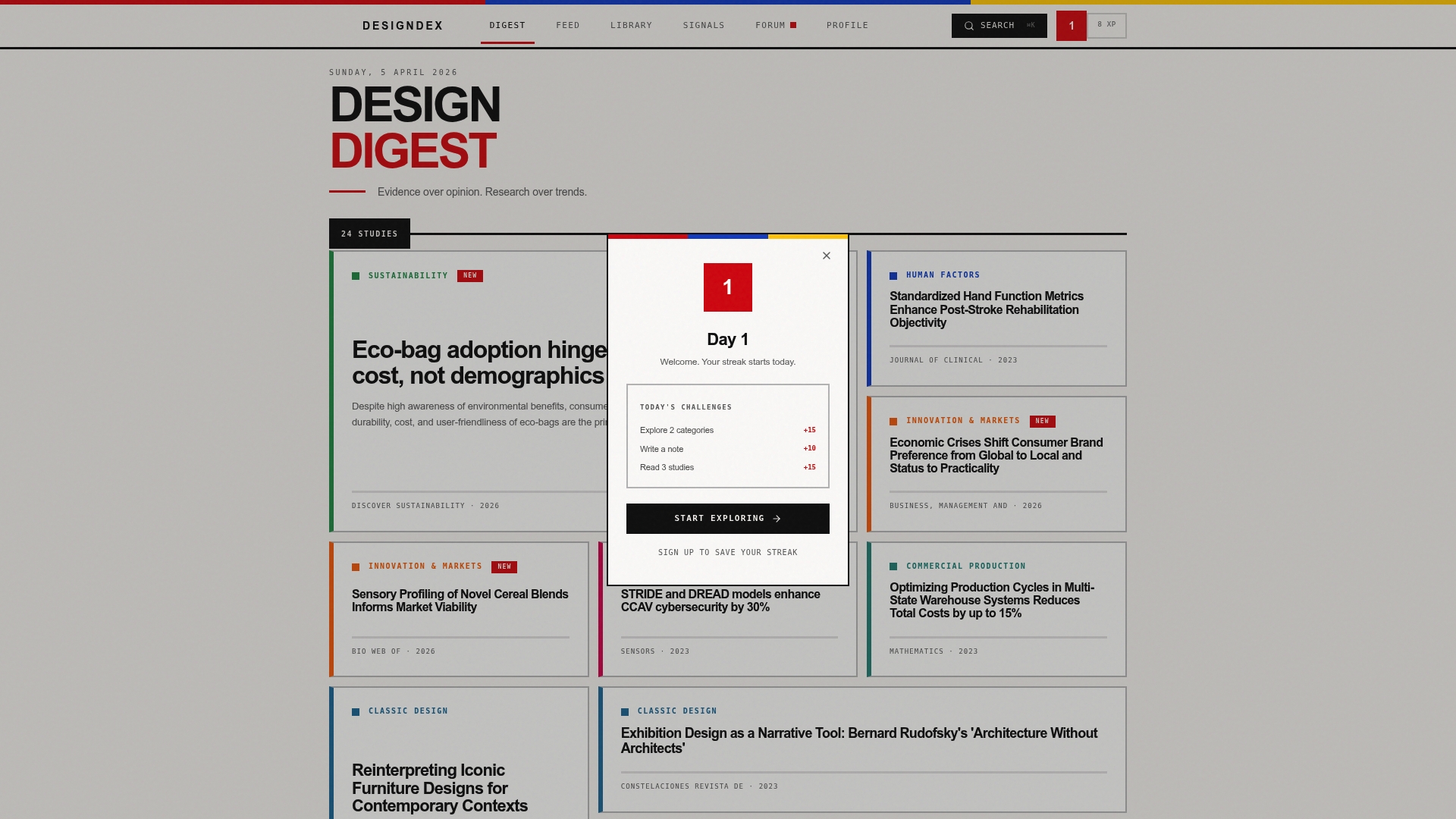
Whether your team is investigating usability testing research to sharpen your synthesis of interface quality findings or exploring VR-driven user research to integrate emerging empathy methodologies, the DesignDex platform provides the structured study breakdowns, trend signals, and practical applications you need to make synthesis faster, deeper, and more defensible. Access daily-updated research intelligence and build the evidence base that transforms your design decisions from intuition into verifiable, stakeholder-ready direction.
Frequently asked questions
What is the main purpose of synthesizing design research?
The main purpose is to transform diverse research data, across qualitative, quantitative, and behavioral sources, into clear, prioritized, actionable insights that directly inform design decisions and product strategy.
How does AI accelerate research synthesis, and what are the risks?
AI reduces synthesis time significantly by auto-tagging and clustering large volumes of data; however, AI requires guardrails and human verification, as it can project false narratives or suppress contradictions present in the raw evidence.
What is triangulation in design research synthesis?
Triangulation means cross-verifying synthesized insights against multiple data source types, such as confirming an interview-derived pattern against usability session data and analytics, to ensure accuracy and reduce interpretive bias. Research guidance consistently recommends to triangulate and verify outputs before presenting findings.
How can teams avoid common pitfalls in synthesizing research?
Teams should apply show-your-work verification methods throughout synthesis, reviewing each insight collaboratively against direct participant quotes, evidence counts, and explicitly documented contradictions before finalizing outputs.