

TL;DR:
- Genuine sustainable product design integrates materials science, process engineering, and circular economy principles to reduce environmental impact comprehensively. It emphasizes non-toxic, durable, and easily disassembled materials, supported by quantitative Life Cycle Analysis tools, while balancing economic, environmental, and social factors. Implementing systemic, cross-disciplinary strategies and learning from real-world examples like Polestar enables effective transition toward impactful, scalable sustainability.
Selecting recycled materials is not the same as designing sustainably. Many product teams treat material substitution as a finished strategy, yet this approach addresses only a fraction of a product's total environmental burden across manufacturing, distribution, use, and end-of-life (EOL) management. Genuinely sustainable product design (SPD) integrates materials science, process engineering, circular economy frameworks, and informed business model decisions into a coherent, evidence-driven methodology. This guide covers foundational SPD principles, validated factor frameworks, real-world brand examples, and practical Life Cycle Assessment (LCA) tools to help you build sustainability into every stage of the design process.
Table of Contents
- Key principles of sustainable product design
- Economic, environmental, and social factors in sustainable design
- Learning from real-world examples: Polestar and beyond
- Eco-design versus circular design: Choosing your approach
- Common pitfalls: Why sustainable products sometimes fail
- Integrating life cycle analysis and assessment tools
- Our perspective: Why systems thinking is the real game changer in sustainable design
- Move from theory to sustainable practice with DesignDex resources
- Frequently asked questions
Key Takeaways
| Point | Details |
|---|---|
| Use holistic frameworks | Effective sustainable design balances economic, environmental, and social factors for meaningful impact. |
| Go beyond materials | Focusing only on green materials misses deeper sustainability opportunities in process and business model. |
| Avoid common pitfalls | Ensure infrastructure compatibility and beware greenwashing to create real-world sustainable products. |
| Leverage assessment tools | Life cycle analysis and data-driven evaluation guide better sustainable choices throughout the design process. |
Key principles of sustainable product design
With the need for deeper strategies established, let's define the core principles that make product design genuinely sustainable. Effective SPD rests on five interconnected pillars that together reduce environmental burden while maintaining product viability.
- Non-toxic and recycled materials: Prioritize inputs with verified low toxicity profiles and certified recycled content; avoid materials that create hazardous waste streams at EOL.
- Energy-efficient and low-impact manufacturing: Select fabrication methods that minimize energy intensity, water use, and process waste; additive manufacturing often outperforms subtractive processes on material efficiency.
- Durability and longevity: Extending the functional life of a product is one of the highest-leverage sustainability interventions available; a product that lasts twice as long generates roughly half the per-use environmental impact.
- Facilitating disassembly, reuse, and recycling: Design joints and material boundaries to allow clean separation; mono-material assemblies and snap-fit (rather than adhesive-bonded) connections support this goal.
- Life Cycle Analysis (LCA) tools: Platforms such as Sustainable Minds provide quantitative environmental profiles across production, use, and disposal phases, enabling evidence-based design decisions.
Following product design best practices grounded in LCA data allows teams to prioritize which pillar delivers the greatest impact reduction for a specific product category. A structured design process is critical for embedding these sustainability checkpoints at appropriate stages rather than retrofitting them at the end of development.
Pro Tip: Run a rapid LCA during concept selection, not just before launch. Early-stage LCA data costs a fraction of late-stage redesign and can shift material or manufacturing decisions when they are still inexpensive to change.
| Principle | Primary impact area | Example metric |
|---|---|---|
| Non-toxic materials | Human health, EOL safety | Restricted Substance List compliance |
| Energy-efficient manufacturing | Carbon emissions, operating cost | kWh per unit produced |
| Durability and longevity | Resource consumption | Years of functional life |
| Design for disassembly | EOL recovery rate | % material recovered |
| Life Cycle Analysis | All phases | kg CO₂e per functional unit |
Economic, environmental, and social factors in sustainable design
Building on core principles, robust sustainability requires attending to intersecting economic, environmental, and social factors. Research from the University of Padua validated 20 key SPD factors: 8 economic (including dependability, manufacturability, and cost management), 6 environmental (resource utilization and EOL management), and 6 social (user-centered design and stakeholder well-being). This tripartite structure prevents teams from optimizing one dimension at the expense of the others, a common failure mode in sustainability programs.
The 20 factors organized by dimension
- Economic: Dependability, manufacturability, total cost of ownership, market adaptability, regulatory compliance, supply chain resilience, intellectual property protection, and scalability.
- Environmental: Resource utilization efficiency, energy consumption, emissions and effluent management, hazardous material reduction, EOL recovery potential, and biodiversity impact.
- Social: User-centered functionality, stakeholder well-being, equitable labor practices, accessibility and inclusivity, community impact, and long-term safety.
Statistic callout: A holistic analysis of SPD factors shows that environmental dimensions alone account for only 30% of the validated framework, underscoring that economic viability and social equity are equally essential to durable sustainability outcomes.
| Dimension | Number of factors | Sample factors |
|---|---|---|
| Economic | 8 | Manufacturability, cost, scalability |
| Environmental | 6 | Resource use, EOL management, emissions |
| Social | 6 | User-centered design, stakeholder well-being |
Why does this matter practically? When product teams concentrate exclusively on environmental metrics, they frequently produce goods that are too costly to manufacture at scale or that fail to meet user needs, both outcomes that prevent market adoption and therefore prevent the environmental benefit from materializing at scale. Integrating design system consistency into sustainable workflows ensures that economic and social criteria are evaluated alongside environmental ones from the earliest ideation phase.
Learning from real-world examples: Polestar and beyond
Once you've identified the right factors, it's critical to see how leading brands put these concepts into practice. Polestar, the Swedish electric vehicle manufacturer, provides one of the most data-rich case studies in contemporary sustainable product design. The company reduced emissions per vehicle by 31% through a combination of 80% post-industrial waste aluminum, traceable wool upholstery, and low-carbon leather alternatives, while applying mono-material design principles to new models to facilitate EOL material recovery.
Several specific strategies from Polestar's approach are transferable to non-automotive product categories:
- Post-industrial waste sourcing: Substituting virgin aluminum with post-industrial scrap reduces primary energy demand and upstream emissions without compromising structural performance.
- Material traceability: Polestar uses verified supply chain data to substantiate sustainability claims, a practice that directly addresses greenwashing risk.
- Mono-material design: Reducing the number of distinct materials in an assembly simplifies recycling and increases the recovered material value at EOL.
- Measurable targets: Setting a specific emissions reduction goal (31% per unit) creates accountability and enables iterative improvement across model generations.
| Design strategy | Polestar application | Broader applicability |
|---|---|---|
| Post-industrial waste aluminum | Body structure, chassis components | Consumer electronics, furniture |
| Traceable natural materials | Wool and leather interiors | Apparel, packaging, home goods |
| Mono-material components | Interior trim panels | Toys, small appliances, tools |
| Quantified emissions target | 31% reduction per vehicle | Any product with defined functional unit |
"Sustainability cannot be a marketing claim without material traceability and measurable outcomes. The design team must own both the specification and the evidence." This principle, embodied in Polestar's approach, is equally applicable to consumer electronics, furniture, and apparel design.
Approaches from the natural world also offer validated innovation pathways; biomimicry in sustainable design demonstrates how biological strategies for material efficiency and closed-loop nutrient cycling translate directly into product innovation frameworks.

Pro Tip: When presenting sustainable material choices to stakeholders, always pair the claim with a quantified metric (CO₂e reduction, recycled content percentage, or material recovery rate). Unquantified claims invite skepticism and regulatory risk.
Eco-design versus circular design: Choosing your approach
Shifting from theory to frameworks, designers must know how their sustainability approach shapes products, processes, and impact. Two dominant frameworks govern contemporary sustainable product development, and they differ substantially in scope, infrastructure requirements, and business model implications.
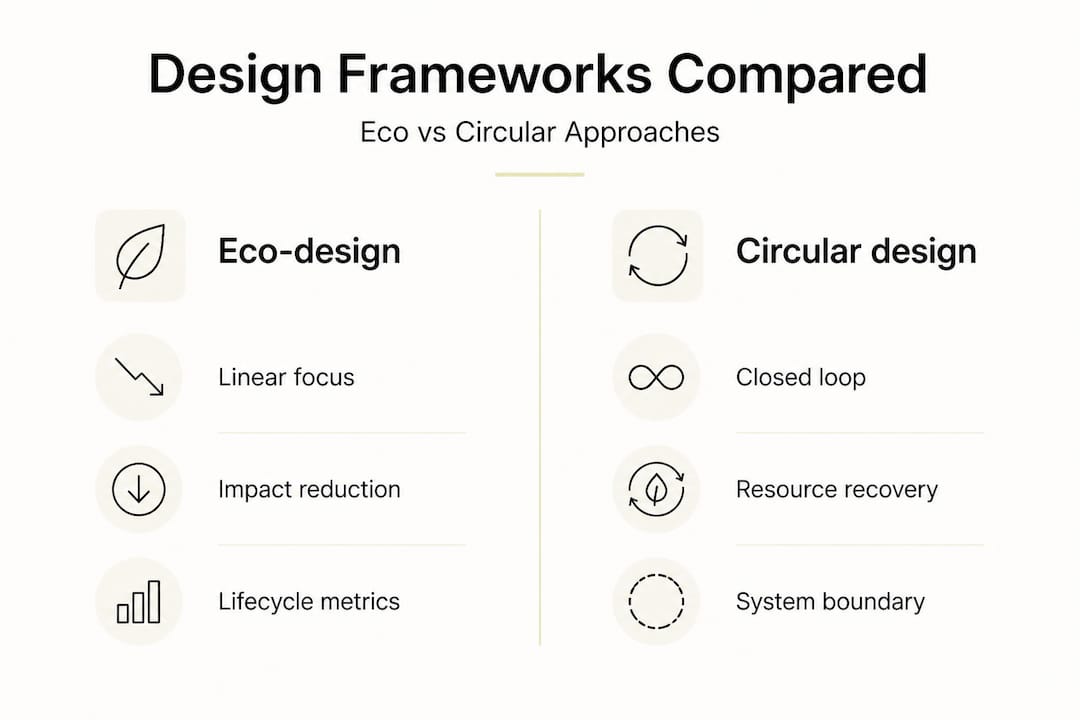
Eco-design reduces harmful impacts within existing linear lifecycles, making products "less bad" through material substitution, energy reduction, and waste minimization. Circular design, by contrast, rethinks the entire product system to enable closed-loop reuse, repair, remanufacturing, and regeneration, requiring corresponding changes to business models, logistics infrastructure, and consumer behavior.
Key distinctions:
- Scope: Eco-design operates within established supply chains and product categories; circular design may redefine product ownership models (leasing vs. selling) and require reverse logistics networks.
- Impact ceiling: Eco-design can incrementally reduce environmental burden but cannot eliminate it within a linear system; circular design, when fully realized, approaches cradle-to-cradle material neutrality.
- Implementation complexity: Eco-design is accessible to most design teams with existing tools; circular design demands cross-functional collaboration with business development, operations, and policy stakeholders.
- Risk profile: Eco-design carries lower transition risk; circular design requires upfront infrastructure investment with longer payback horizons.
"Circular design is not an upgrade to eco-design; it is a different paradigm that requires systemic rather than incremental thinking." This distinction shapes every design decision from concept through EOL specification.
| Criterion | Eco-design | Circular design |
|---|---|---|
| System boundary | Product lifecycle | Product and system lifecycle |
| Business model impact | Minimal change | Significant (leasing, take-back) |
| Infrastructure required | Existing recycling systems | New reverse logistics and recovery |
| Environmental ceiling | Reduced harm | Closed-loop regeneration |
| Entry barrier | Low to moderate | Moderate to high |
Choosing the right framework is not purely an ideological decision. It depends on available infrastructure, category-specific material recovery rates, and the organization's capacity to build or partner with circular economy ecosystems. Accessing practical design intelligence resources helps design teams assess which framework aligns with their constraints and sustainability ambitions.
Common pitfalls: Why sustainable products sometimes fail
No guide is complete without recognizing what often derails well-intentioned sustainable design initiatives. Even rigorously designed products can fail to deliver environmental benefits when deployed into real-world systems that are not equipped to handle them.
- Assuming recyclability equals sustainability: A material may be theoretically recyclable but practically unrecoverable if regional collection and processing infrastructure does not support it. Research indicates that only 8.5% of new products effectively incorporate recycled polymers due to infrastructure gaps, quality degradation, and economic barriers.
- Overlooking supplier accountability: Material claims made by suppliers are not always verified. Designers who lack veto power in sourcing decisions face the risk of specifications being substituted without environmental assessment.
- Greenwashing through incomplete claims: Highlighting one positive attribute (e.g., recycled packaging) while ignoring larger impacts (e.g., high-energy manufacturing) creates false impressions and exposes brands to regulatory and reputational risk.
- Neglecting use-phase impacts: For many product categories, the use phase dominates total lifetime environmental impact; a product made from recycled materials but designed for high energy consumption may produce worse lifecycle outcomes than a conventional alternative.
- Insufficient stakeholder engagement: Sustainable design that does not account for user behavior, maintenance practices, or local EOL options will underperform relative to modeled outcomes.
"Designers need veto power in sourcing decisions, not just advisory roles. Without it, sustainability specifications are vulnerable to cost-driven substitutions that invalidate the original design intent."
Pro Tip: Build supplier verification checkpoints directly into your design process gates. At each stage review, require documentary evidence (certifications, third-party audits, or test data) for any material or process with a sustainability claim attached to it.
Integrating life cycle analysis and assessment tools
With pitfalls addressed, close the process loop by adopting tools that allow designers to objectively track and showcase sustainability outcomes. LCA is the methodological backbone of credible sustainable product design, providing quantified data on environmental impacts across all lifecycle phases: raw material extraction, manufacturing, distribution, use, and EOL.
Step-by-step LCA integration
- Define the functional unit: Establish what the product does and over what timeframe, for example, one liter of water filtered per day over five years. This creates a consistent basis for comparison.
- Map the system boundary: Decide whether the assessment covers cradle-to-gate (production only), cradle-to-grave (full lifecycle), or cradle-to-cradle (including material recovery).
- Collect inventory data: Gather material quantities, energy inputs, and process emissions; use verified databases such as ecoinvent for background data.
- Run impact assessment: Apply impact categories relevant to your product (global warming potential, water use, human toxicity) using platforms like Sustainable Minds or SimaPro.
- Interpret and iterate: Identify hotspots, the phases or materials contributing the most impact, and redesign to address them. Document results for stakeholder communication and regulatory reporting.
| LCA tool | Best for | Key feature |
|---|---|---|
| Sustainable Minds | Early-stage design teams | Integrated design guidance |
| SimaPro | Academic and professional deep analysis | Extensive database access |
| OpenLCA | Budget-constrained teams | Open-source, customizable |
| Sphera (GaBi) | Enterprise supply chain analysis | Global inventory databases |
Connecting design analysis for sustainability practices with formal LCA methodology transforms qualitative intent into quantitative accountability. Tools supporting design evaluation for sustainability enable teams to benchmark iterations against a baseline and demonstrate progress to clients, regulators, and investors. Referencing climate resilience metrics research provides additional frameworks for aligning product-level decisions with broader built-environment sustainability targets.
Pro Tip: Use LCA summary data in your design rationale documentation. Citation-ready impact data strengthens client presentations, supports regulatory compliance, and provides the evidence base that differentiates genuinely sustainable products from greenwashed alternatives.
Our perspective: Why systems thinking is the real game changer in sustainable design
Most sustainable design guides stop at materials and features. The more consequential insight, supported by research, is that individual product improvements rarely scale into systemic impact without corresponding changes to infrastructure, business models, and consumer behavior. A product optimized for disassembly still contributes to landfill if no take-back program exists. A low-carbon material still creates emissions if the manufacturing facility runs on unabated fossil energy.
The shift to circular systems requires designers to think beyond the product boundary, advocating for policy environments that support material recovery, engaging operations teams in reverse logistics planning, and collaborating with business strategists to redesign ownership models. This is not optional idealism. It is the only pathway to the scale of environmental impact reduction that climate science requires.
Designers who cultivate cross-disciplinary influence, who sit at strategy tables alongside supply chain managers, business developers, and policymakers, are uniquely positioned to drive these systemic changes. The design process stages framework must therefore expand to include stakeholder mapping, infrastructure assessment, and business model analysis as standard deliverables, not peripheral considerations. Embracing this expanded role is where sustainable design transitions from compliance activity to genuine competitive differentiation.
Move from theory to sustainable practice with DesignDex resources
Ready to put these sustainability insights into action? DesignDex aggregates and distills peer-reviewed research in UX and industrial design into structured, citation-ready intelligence that supports exactly the kind of evidence-driven decisions this guide describes.
Whether you're evaluating material alternatives, benchmarking LCA outcomes, or building the business case for circular design, DesignDex provides daily-updated research summaries with aims, methods, findings, and real-world applications. Explore studies on usability testing research and VR for user empathy to understand how evidence-based design tools extend sustainability thinking into user experience dimensions. For design students and professionals who need to justify choices with data, not intuition, DesignDex functions as your decision-support infrastructure for every stage of the sustainable design process.
Frequently asked questions
What is the difference between eco-design and circular design?
Eco-design minimizes negative impacts within existing linear product lifecycles, while circular design reforms entire product systems to enable continuous reuse, repair, and regeneration, typically requiring new business models and reverse logistics infrastructure.
Which materials are truly sustainable for product design?
Non-toxic, recycled, and durable materials that align with available regional recycling systems and demonstrate low lifecycle impacts are most sustainable; verified recycled materials supported by LCA data provide the strongest evidence base for sustainable material claims.
Why do some sustainable products fail in the real world?
Many fail because recyclability claims are not matched to regional infrastructure, with research showing only 8.5% of new products effectively incorporate recycled polymers; greenwashing through unverified supplier claims compounds this failure mode.
What tools support life cycle analysis in design?
Platforms such as Sustainable Minds assess production, use, and disposal impacts across all lifecycle phases, providing data-driven evidence to support sustainable design decisions and stakeholder communications.