

TL;DR:
- Structured design processes, like the Double Diamond model, improve predictability, repeatability, and quality.
- Each stage—Discover, Define, Develop, Deliver—builds upon the previous to ensure thorough and validated solutions.
- Iterative cycles within stages, rather than strict stage completion, are key to achieving better design outcomes.
Inconsistent project outcomes remain one of the most persistent challenges facing design teams: work that excels in one sprint collapses in the next, and clients receive deliverables that diverge sharply from initial briefs. The root cause, more often than not, is the absence of a clearly defined, repeatable process framework. Structured design process models provide the scaffolding that transforms ad hoc creativity into predictable, evidence-backed results. This article unpacks each critical stage found in leading professional design models, with concrete techniques and practical examples that you can integrate into your next project workflow immediately.
Table of Contents
- Why structure matters: The impact of clear design stages
- Stage 1: Discover—Exploring and empathizing
- Stage 2: Define—Refining and framing the problem
- Stage 3: Develop—Ideation, prototyping, and iteration
- Stage 4: Deliver—Testing, validation, and launch
- Comparing major design process models
- Perspective: Why iteration is the true power stage
- Take the next step: Advanced tools and research for design excellence
- Frequently asked questions
Key Takeaways
| Point | Details |
|---|---|
| Framework structure matters | A repeatable, staged design process leads to consistent project success and higher quality outcomes. |
| Empathy starts the process | Empathy-building and discovery research are essential for understanding real user problems. |
| Iteration fuels improvement | Short cycles of prototyping, testing, and refinement yield better solutions than linear methods. |
| Model choice depends on context | Selecting a process—Double Diamond, Design Thinking, Lean UX, or Agile UX—should fit team needs and project type. |
Why structure matters: The impact of clear design stages
A "structured" design process is not simply a checklist of activities; it is a system that alternates between expanding inquiry and narrowing focus, ensuring that teams neither rush to solutions nor stall in open-ended exploration. This principle is most explicitly codified in the Double Diamond model developed by the British Design Council, which organizes work into four phases: Discover (explore the problem), Define (refine the problem), Develop (ideate solutions), and Deliver (implement the solution), with each phase governed by either divergent or convergent thinking.
The practical benefits of this structure are significant and measurable. Repeatability means that a team can apply the same framework across product categories, client types, and project scales without reinventing the approach each time. Predictability allows project managers to allocate time and resources with greater confidence. Quality improves because validation is built into the process rather than bolted on at the end.
Common workflow pain points that structured stages directly address include:
- Premature solutioning: Teams jump to wireframes before the problem is fully understood, producing solutions that solve the wrong challenge.
- Lack of validation checkpoints: Without defined stages, feedback loops are skipped, and critical usability issues surface only after launch.
- Scope creep: Undefined stage boundaries allow stakeholders to continuously expand requirements without triggering a formal re-evaluation.
- Communication breakdowns: Unclear process stages make it difficult for cross-functional teams to understand where the project stands and what decisions have been made.
Notably, research on Double Diamond applications shows that edge cases are best handled through diverse ideation, inclusive research, and post-launch monitoring; rushing to solutions without problem validation is identified as a primary failure mode across project types.
"The Double Diamond is not a rigid prescription but a thinking model: its value lies in making the invisible logic of design visible to everyone on the team, from strategists to engineers."
Pro Tip: Before your next project kickoff, map your existing workflow against the Double Diamond's four phases. Identify which stages your team currently skips or compresses, and treat those gaps as your highest-priority process improvement targets. Consulting a design intelligence guide can help you benchmark your current process against established frameworks.
Stage 1: Discover—Exploring and empathizing
The Discover stage is the broadest, most divergent phase of any structured design process. Its primary aim is to build a rich, evidence-based understanding of users, their contexts, and the systemic forces shaping the problem space, before any solution thinking begins. Teams that compress or skip this stage consistently produce designs that are technically functional but contextually misaligned.
Effective discovery relies on a layered set of design research methods that generate both quantitative signals and qualitative depth. Core mechanics include:
- Empathy-building interviews: Structured and semi-structured conversations with users that surface latent needs, frustrations, and mental models not captured in analytics data.
- Contextual observation: Ethnographic field studies where researchers observe users in their actual environments, revealing behaviors that self-reported data consistently misses.
- Stakeholder workshops: Collaborative sessions that align internal teams and clients on assumptions, constraints, and strategic goals before fieldwork begins.
- Competitive and analogous research: Systematic analysis of adjacent products and industries to identify proven patterns and unmet opportunities.
Research on UX process mechanics confirms that empathy-building via interviews and observations, combined with brainstorming that prioritizes quantity over quality in early ideation, low-fidelity prototyping for quick testing, and usability testing for validation, forms the operational core of effective discovery and development cycles.
A critical principle in this stage is that quantity of insight matters more than premature quality filtering. Teams should resist the urge to evaluate or rank findings during discovery; the goal is to accumulate a broad, unfiltered picture of the problem space that the Define stage will then structure and prioritize.
Pro Tip: Consider integrating VR immersion tools during discovery workshops. Studies on VR empathy in design demonstrate that immersive simulations significantly strengthen team empathy by placing designers directly within user environments, producing richer, more accurate problem framing than traditional persona documents alone.
Stage 2: Define—Refining and framing the problem
After gathering a broad base of insights in the Discover phase, the Define stage applies convergent thinking to synthesize those learnings into clear, actionable problem statements. This is the phase where raw research transforms into strategic design criteria, and where the entire trajectory of subsequent work is set.
The British Design Council's four-phase model positions the Define stage as the first convergent movement: narrowing from a wide field of discovery findings to a focused challenge that the team will commit to solving. The quality of this convergence directly determines the relevance of every solution generated afterward.
A rigorous Define process follows these steps:
- Synthesize research findings: Cluster interview notes, observation records, and stakeholder inputs using affinity mapping or thematic analysis to identify recurring patterns and contradictions.
- Establish design criteria: Translate synthesized patterns into measurable criteria that any successful solution must satisfy, distinguishing between "must have" constraints and "nice to have" aspirations.
- Conduct collaborative definition sessions: Facilitate structured workshops with both design team members and key client or stakeholder representatives to pressure-test emerging problem framings and surface blind spots.
- Draft a strong, actionable problem statement: Formulate a "How Might We" statement or equivalent that is specific enough to guide ideation but open enough to allow creative solutions.
"A well-crafted problem statement is the most leveraged artifact in the entire design process: it frames every subsequent decision and provides the evaluative standard against which all solutions are measured."
Transitioning from broad observations to focused challenges requires discipline. Teams often struggle with the temptation to include every discovered insight in the problem statement, which dilutes focus and produces solutions that attempt to address everything while excelling at nothing. Referencing a design intelligence framework during this phase helps teams apply consistent criteria for what to include versus defer.
Stage 3: Develop—Ideation, prototyping, and iteration
With clear problem statements established, teams shift into the Develop stage: the second divergent phase, where creative solution generation is structured, measured, and progressively refined through prototyping and critique cycles. This stage is where the intellectual rigor of the earlier phases pays off in tangible artifacts.

Effective ideation sessions in this stage are governed by specific mechanics. Brainstorming that prioritizes quantity over quality, combined with low-fidelity prototyping for rapid testing and usability validation, forms the operational backbone of the Develop phase. Teams should measure ideation output not only by the number of concepts generated but also by the diversity of approaches: solutions that cluster around a single strategy indicate insufficient creative range.
Prototype types progress through a deliberate fidelity ladder:
- Sketches and paper prototypes: Fastest to produce; ideal for exploring structural logic and user flows without investment in visual design.
- Wireframes: Mid-fidelity representations that communicate information architecture and interaction patterns, suitable for early stakeholder alignment.
- Digital mockups and interactive prototypes: Higher-fidelity artifacts used for usability testing with real users, generating actionable feedback on specific interaction decisions.
Different process models adapt this stage differently. Classic Design Thinking (five stages) suits complex projects requiring comprehensive exploration; Lean UX emphasizes rapid hypothesize-and-test cycles optimized for startups; Agile UX compresses ideation and testing into time-boxed sprints; and Double Diamond structures the entire phase within an explicit divergence-then-convergence logic. Choosing the right adaptation depends on project scale, team composition, and timeline constraints.
| Prototype type | Fidelity | Primary use | Time investment |
|---|---|---|---|
| Paper sketch | Low | Concept exploration | 1 to 4 hours |
| Wireframe | Medium | Architecture alignment | 1 to 3 days |
| Interactive mockup | High | Usability testing | 3 to 7 days |
| Functional prototype | Very high | Pre-launch validation | 1 to 3 weeks |
Pro Tip: Integrate a design validation workflow at the end of each ideation sprint. Defining testable hypotheses before building prototypes ensures that each iteration cycle generates evidence rather than just artifacts, preventing teams from cycling through revisions without measurable progress.
Stage 4: Deliver—Testing, validation, and launch
Once potential solutions have been refined through iterative prototyping, the Deliver stage focuses on real-world validation and structured deployment. This is the second convergent phase: narrowing from multiple tested solutions to the single, validated design that proceeds to launch.
Effective delivery follows a structured testing and refinement sequence:
- Conduct moderated usability testing: Recruit representative users and observe them interacting with high-fidelity prototypes under controlled conditions, capturing both behavioral data and verbal feedback.
- Analyze and prioritize findings: Score usability issues by frequency and severity, distinguishing between critical failures that block task completion and minor friction points that reduce satisfaction.
- Execute targeted iteration cycles: Address high-priority findings in focused revision sprints, typically two to three weeks in duration, before retesting with a fresh participant cohort.
- Establish post-launch monitoring protocols: Define the metrics and feedback channels that will signal whether the deployed solution performs as intended in real-world conditions.
Experts consistently emphasize that iteration cycles of two to three weeks, combined with usability score tracking rather than simple task completion rates, provide the most actionable signal for design quality improvement. Completion rates measure whether users can finish a task; usability scores measure how efficiently, confidently, and satisfactorily they do so, which is the more operationally relevant metric for design decisions.
Referencing usability testing enhancements research during this phase provides evidence-backed benchmarks for what constitutes acceptable usability performance across product categories, enabling teams to set defensible quality thresholds rather than relying on subjective judgment. Pairing these benchmarks with a structured design validation methods protocol ensures that the Deliver stage produces not just a launched product but a documented evidence base for future iterations.
Comparing major design process models
With a thorough understanding of each stage, selecting the appropriate process model for a given project context becomes a strategic decision rather than a default choice. Each major model offers distinct structural advantages and corresponding limitations.
Classic Design Thinking, Lean UX, Agile UX, and Double Diamond each address different project realities: Design Thinking's five-stage structure suits complex, ambiguous problems requiring deep user research; Lean UX's rapid hypothesis-and-test cycles optimize for speed in startup environments; Agile UX's sprint-based compression works well in engineering-led organizations with fixed delivery cadences; and Double Diamond's explicit divergence-convergence structure provides the clearest pedagogical framework for teams building process literacy.
| Model | Best fit | Key strength | Key limitation |
|---|---|---|---|
| Classic Design Thinking | Complex, ambiguous problems | Deep user research integration | Time-intensive; less suited to fast cycles |
| Lean UX | Startups, MVP development | Speed; hypothesis-driven | Risk of under-researching the problem |
| Agile UX | Engineering-led organizations | Sprint alignment; delivery focus | Design depth can be compressed |
| Double Diamond | Process-building teams | Explicit diverge/converge logic | Can feel rigid without adaptation |
Hybrid workflows that combine elements from multiple models are increasingly common in high-performing teams. A practical hybrid might use Double Diamond's stage structure for project framing, Lean UX's rapid cycle mechanics during the Develop phase, and Agile UX's sprint cadence for the Deliver stage. Consulting a design intelligence comparison resource and tracking emerging design trends can inform which hybrid configurations are gaining traction across the industry.
Perspective: Why iteration is the true power stage
Structured frameworks are indispensable, but they carry a subtle risk: teams can treat stage boundaries as completion checkpoints rather than as organizational heuristics, producing a "stage checklist" mentality that mistakes process compliance for design quality. The evidence consistently points elsewhere.
Experts stress that iteration cycles of two to three weeks, tracked via usability scores rather than task completion rates, are the most reliable predictor of design improvement over time. This finding reframes the entire framework: the stages are not destinations but containers for iterative loops, and the quality of those loops determines outcomes far more than the tidiness of stage transitions.
Real-world design rarely follows a single linear path through any framework. High-performing teams move backward from Define to Discover when new research invalidates earlier assumptions. They compress Develop and Deliver into overlapping cycles when project timelines demand it. What distinguishes these teams is not their adherence to a model but their discipline in running structured feedback loops within whatever stage they occupy.
The lesson most overlooked by practitioners new to structured process models is that iteration is not a remediation activity; it is the primary value-generating mechanism. Frameworks provide the language and logic for organizing that iteration. Integrating design analysis in UX practices at every stage, rather than reserving analysis for the Deliver phase, is what separates teams that use frameworks as tools from those that use them as bureaucratic formalities.
Take the next step: Advanced tools and research for design excellence
Understanding the stages of leading design process models is a strong foundation. Applying that understanding with evidence-backed precision is where sustained project excellence is built.
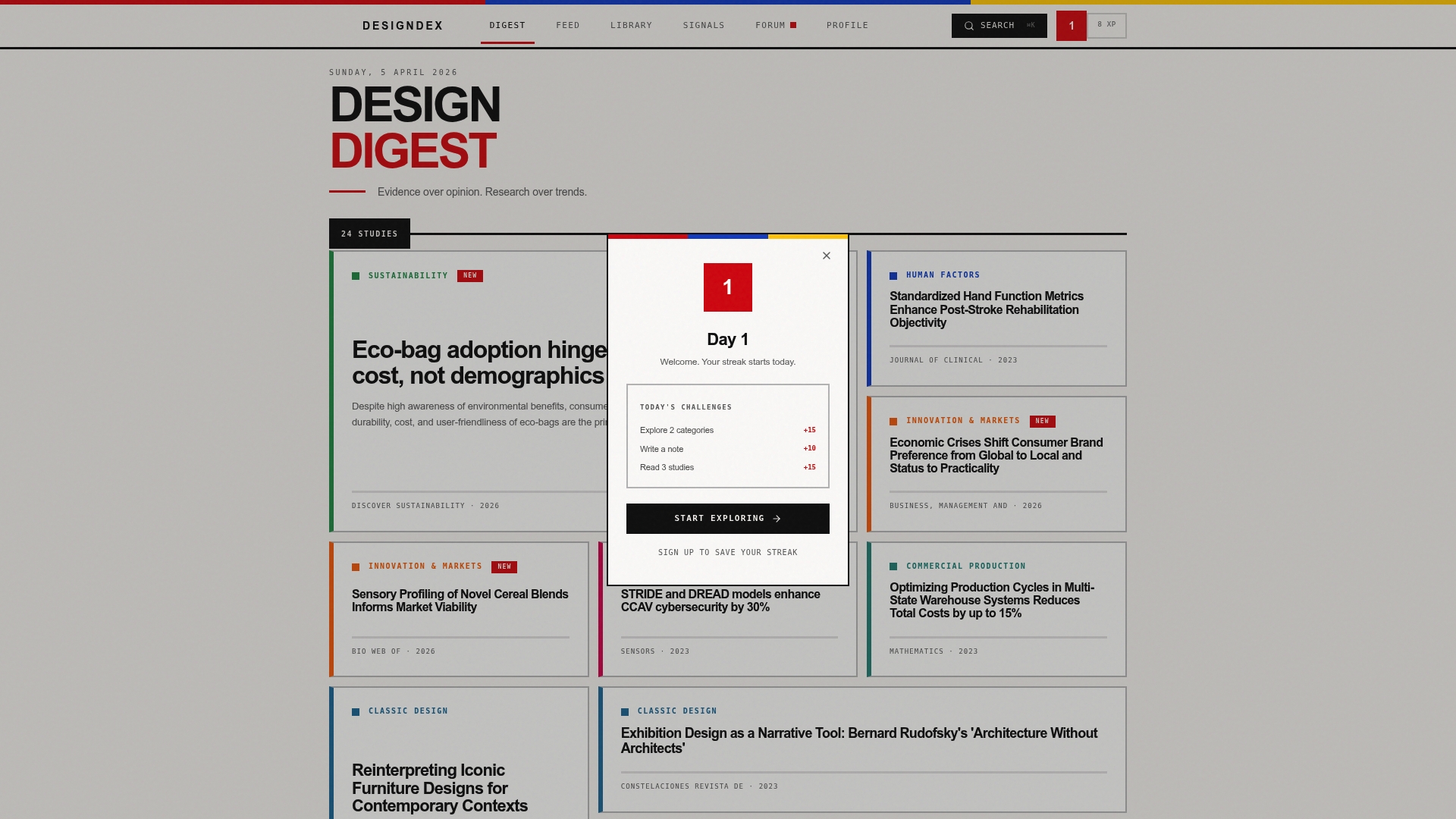
DesignDex aggregates and distills peer-reviewed UX and industrial design research into structured, citation-ready insights that map directly to each process stage. Whether you need benchmarks for usability research to anchor your Deliver phase, evidence on VR empathy in design to strengthen your Discover phase, or daily signals on emerging research to inform model selection, the Design Digest resource provides structured access to the evidence base your next project requires. Move from intuition-driven decisions to research-justified design choices.
Frequently asked questions
What is the Double Diamond design process?
The Double Diamond is a four-stage model developed by the British Design Council, comprising Discover, Define, Develop, and Deliver phases, which alternates between divergent and convergent thinking to structure the full design process from problem exploration to solution implementation.
How does Lean UX differ from classic design thinking?
Lean UX emphasizes rapid hypothesize-and-test cycles optimized for startup speed, while Classic Design Thinking applies five more comprehensive stages suited to complex, ambiguous problems that require deeper user research investment before solution generation begins.
Why are iteration cycles important in design?
Iteration cycles of two to three weeks, tracked via usability scores, allow teams to incorporate ongoing user feedback systematically, improving design quality through evidence-based refinement rather than subjective revision.
What techniques help build user empathy?
Interviews, observations, and VR immersion each contribute distinct layers of user understanding: interviews surface mental models, observations reveal actual behavior, and VR immersion places designers directly within user environments to generate experiential insight that secondary research cannot replicate.