

TL;DR:
- Evidence-based research and structured processes significantly improve product design outcomes.
- Building scalable design systems and preparing for edge cases enhances reliability and user experience.
- Quantifying UX impact and ROI demonstrates the strategic value of evidence-driven design choices.
Even the most experienced product designers struggle to reconcile creative instinct with the structured, evidence-backed rigor that consistently delivers superior outcomes. The gap between intuition and validation is where costly failures originate: misaligned features, overlooked edge cases, and products that serve organizational hierarchies rather than actual users. This article presents five research-grounded best practices for product designers and UX/UI professionals, spanning user research, design systems, edge case planning, mobile performance optimization, and empirical impact measurement. Each section delivers actionable frameworks, structured comparisons, and data-driven guidance to elevate your decision-making process from assumption-based to evidence-informed.
Table of Contents
- Start with user research: The foundation of effective design
- Build scalable systems: Reusable components, tokens, and guidelines
- Design for edge cases: Preparing for real-world complexity
- Optimize for mobile and performance: Responsive, fast, and accessible
- Quantify your impact: Empirical benchmarks and business value
- Our take: Why evidence always wins over intuition in product design
- Next steps: Dive deeper with DesignDex
- Frequently asked questions
Key Takeaways
| Point | Details |
|---|---|
| User research first | Start every design project by deeply understanding real user needs to avoid costly mistakes. |
| Systems enable scalability | Building with reusable components and clear guidelines ensures consistent, efficient product development. |
| Edge cases matter | Designing for uncommon scenarios prevents UX failures and delivers robust experiences for all users. |
| Mobile-first and performance | Prioritize responsiveness, speed, and accessibility so your design shines across devices. |
| Prove design ROI | Using empirical benchmarks and measurements demonstrates the real business value of good UX. |
Start with user research: The foundation of effective design
Validating ideas with users before committing resources is the single most impactful decision a design team can make. User research best practices confirm that skipping this stage, or worse, designing for stakeholders rather than users, directly contributes to low conversion rates and product abandonment. The distinction matters: stakeholder-driven design optimizes for internal priorities, while user-centered research surfaces the needs, mental models, and friction points that determine whether a product succeeds in the field.
Common research mistakes compound quickly. Teams that rely on anecdotal feedback, conduct single-round interviews, or interpret data without triangulation introduce systematic bias into their design decisions. The result is a product that performs well in controlled presentations but fails under real-world conditions. Applying structured design research methods mitigates this risk by standardizing how evidence is collected and interpreted.
A rigorous user research process follows a clear sequence:
- Define the research question: Formulate specific, answerable questions about user behavior or needs before recruiting participants.
- Select appropriate methods: Match qualitative methods (contextual inquiry, diary studies) or quantitative methods (surveys, analytics) to the research question.
- Recruit representative participants: Ensure your sample reflects actual user demographics, including edge populations.
- Conduct and document sessions: Record sessions with participant consent; use structured note-taking protocols.
- Synthesize findings: Use affinity mapping or thematic analysis to identify patterns across sessions.
- Communicate actionable insights: Translate findings into design requirements using established research methodology tips that support team-wide alignment.
Pro Tip: Participatory design methods, where users co-create solutions alongside designers, consistently outperform traditional observation-only approaches. A participatory design case study from New Zealand primary schools demonstrated measurable gains in user satisfaction when students actively shaped their learning environments. Integrate participatory workshops early in the discovery phase for deeper, more actionable insight.
Build scalable systems: Reusable components, tokens, and guidelines
With validated user insights in hand, the next imperative is establishing a structural foundation that guarantees efficiency and reliability at scale. Design systems strategies demonstrate that organizations employing reusable components, design tokens, and documented guidelines achieve faster development cycles, reduced inconsistency, and lower long-term maintenance costs. Companies like Airbnb have operationalized this approach, producing design infrastructure that enables cross-functional teams to ship cohesive experiences without redundant decision-making.
A design system's core elements interact as an integrated framework:
- Reusable components: Modular UI elements (buttons, forms, navigation patterns) built once and deployed across all product surfaces.
- Design tokens: Named variables for color, typography, spacing, and motion that abstract visual decisions from implementation, enabling global updates with minimal rework.
- Guidelines and documentation: Prescriptive usage rules, accessibility standards, and pattern rationale that align designers and developers on intent.
- Governance model: A defined process for proposing, reviewing, and deprecating components, ensuring the system evolves without fragmentation.
| Dimension | Airbnb (Design System) | Standard design team |
|---|---|---|
| Component reuse rate | High (centralized library) | Low (ad hoc duplication) |
| Design-to-dev handoff time | Significantly reduced | Prolonged iteration cycles |
| Brand consistency | Systematically enforced | Inconsistent across surfaces |
| Onboarding speed | Accelerated | Dependent on tribal knowledge |
Investing in design analysis in UX during the system-building phase surfaces inconsistencies before they calcify into technical debt. The audit process identifies redundant patterns, contradictory guidelines, and accessibility gaps that undermine scalability.

Pro Tip: Establish your design system before the product reaches mid-development. Retrofitting a system onto an existing product requires significantly more effort than building one from the outset; teams that delay this investment consistently report costly redesign cycles when scaling.
Design for edge cases: Preparing for real-world complexity
Even the most rigorously tested design systems can fail when confronted with real-world unpredictability. Edge case design scenarios are not rare outliers; they constitute the lived reality of a diverse, imperfect user population. Scenarios including name changes (e.g., post-marriage or legal transition), shared accounts across households, poor or intermittent network connectivity, deceased users whose accounts remain active, and bad actors exploiting system logic represent genuine, recurring use cases that expose structural fragility in product design.
Key edge cases that every design team must evaluate:
- Users with non-standard name formats (hyphens, diacritics, mononyms)
- Shared device or account access across multiple individuals
- Offline or degraded network conditions interrupting critical workflows
- Data entry errors from users with cognitive or motor differences
- Account recovery scenarios for incapacitated or deceased users
- Adversarial inputs from automated systems or malicious actors
For human-centered design tips to translate into resilient products, design teams must stress-test flows against each scenario above before user acceptance testing begins.
| Scenario | Impact if ignored | Outcome when addressed |
|---|---|---|
| Poor connectivity | Data loss, user frustration | Offline mode, graceful degradation |
| Name format errors | Account creation failure | Flexible input validation |
| Shared accounts | Privacy and permission conflicts | Role-based access controls |
| Bad actors | Security vulnerabilities | Input sanitization, rate limiting |
A practical edge case checklist ensures coverage: map every critical user flow; identify all data input fields and their failure modes; simulate degraded conditions in staging environments; and involve accessibility specialists to evaluate non-standard interaction patterns. Designing for the margins improves the experience for the center.
Optimize for mobile and performance: Responsive, fast, and accessible
Regardless of how robust your design system is or how thoroughly you have addressed edge cases, performance and accessibility are the qualities users register first. Responsive design guidelines consistently identify mobile-first development as the foundational approach for modern product design, given that the majority of digital interactions now originate on mobile devices. Designing for the smallest screen first forces prioritization, which inherently improves clarity across all breakpoints.
Optimizing for mobile performance follows a structured sequence:
- Adopt a mobile-first layout strategy: Define core content hierarchy for small viewports before scaling to tablet and desktop.
- Implement skeleton screens and loading states: Replace blank screens with structural placeholders that communicate progress and reduce perceived latency.
- Compress and lazy-load assets: Defer non-critical images, scripts, and fonts until they enter the viewport.
- Apply touch-target guidelines: Maintain minimum 44x44pt interactive zones as specified in Apple HIG updates and Google's Material Design system.
- Conduct multi-device testing: Validate layouts, performance, and accessibility across a representative device matrix that includes low-end hardware and slow network conditions.
"Performance is a design decision, not an engineering afterthought. Every millisecond of load time affects user perception, task completion, and retention. Integrate performance budgets into your design process from day one."
Tracking design intelligence signals related to mobile performance benchmarks enables teams to contextualize their metrics against broader industry patterns. Establishing internal performance budgets, maximum page weight, time-to-interactive thresholds, and Core Web Vitals targets, anchors optimization efforts in measurable outcomes rather than subjective assessments.
Pro Tip: Test on real devices, not only browser emulators. Emulators do not accurately replicate CPU throttling, memory constraints, or network variability that low-end devices expose. A monthly device rotation audit across your team prevents performance regressions from going undetected.
Quantify your impact: Empirical benchmarks and business value
Strong mobile experiences deliver measurable user value, but translating that value into organizational investment requires empirical benchmarking. UX ROI statistics from Forrester Research quantify that $1 invested in UX yields approximately $100 in return, a 9,900% ROI that reframes design from cost center to revenue driver. McKinsey's analysis further establishes that design-led companies outperform the S&P 500 by 228% over a ten-year period. UX investment also reduces development rework by 40 to 60%, compressing release cycles and lowering engineering overhead.
Top metrics product designers should track to demonstrate impact:
- Task completion rate: The percentage of users who successfully complete a defined workflow without abandonment.
- System Usability Scale (SUS) score: A validated, standardized measure of perceived usability benchmarked against industry norms.
- Time on task: Duration required to complete key workflows; reductions indicate improved information architecture and interaction efficiency.
- Error rate: Frequency of user mistakes per session, correlated with cognitive load and interface clarity.
- Net Promoter Score (NPS): A proxy for user satisfaction and loyalty, directly linked to retention and referral behavior.
Structured usability testing research validates these metrics through controlled evaluation, enabling teams to isolate design variables and attribute performance changes to specific interventions. Benchmarking against documented standards and understanding design policy and UX frameworks strengthens the evidentiary case for sustained investment. Present these metrics in quarterly design reviews alongside business KPIs to establish design as a strategic function, not a service role.
Our take: Why evidence always wins over intuition in product design
Intuition is a legitimate cognitive tool; it accelerates pattern recognition and supports rapid prototyping decisions. However, intuition unaided by evidence is also the primary source of costly design failures. The majority of documented product failures trace to one of two root causes: research was skipped in favor of speed, or edge cases were dismissed as improbable. Both are failures of process, not imagination.
The most effective design teams we observe through DesignDex's research aggregation are distinguished not by superior creative talent, but by superior process discipline. They anchor every significant decision to research-driven design evidence, iterate against measurable criteria, and employ structured design validation workflow protocols before committing to production. This approach does not constrain creativity; it directs creative energy toward problems that are real, validated, and worth solving. Build your process around evidence, and intuition becomes a complement rather than a substitute.
Next steps: Dive deeper with DesignDex
If you are ready to operationalize these best practices, DesignDex provides immediate access to distilled, peer-reviewed research structured for professional application. Every insight on the platform is organized around design aims, methods, findings, and real-world applications, so you spend less time reading and more time building.
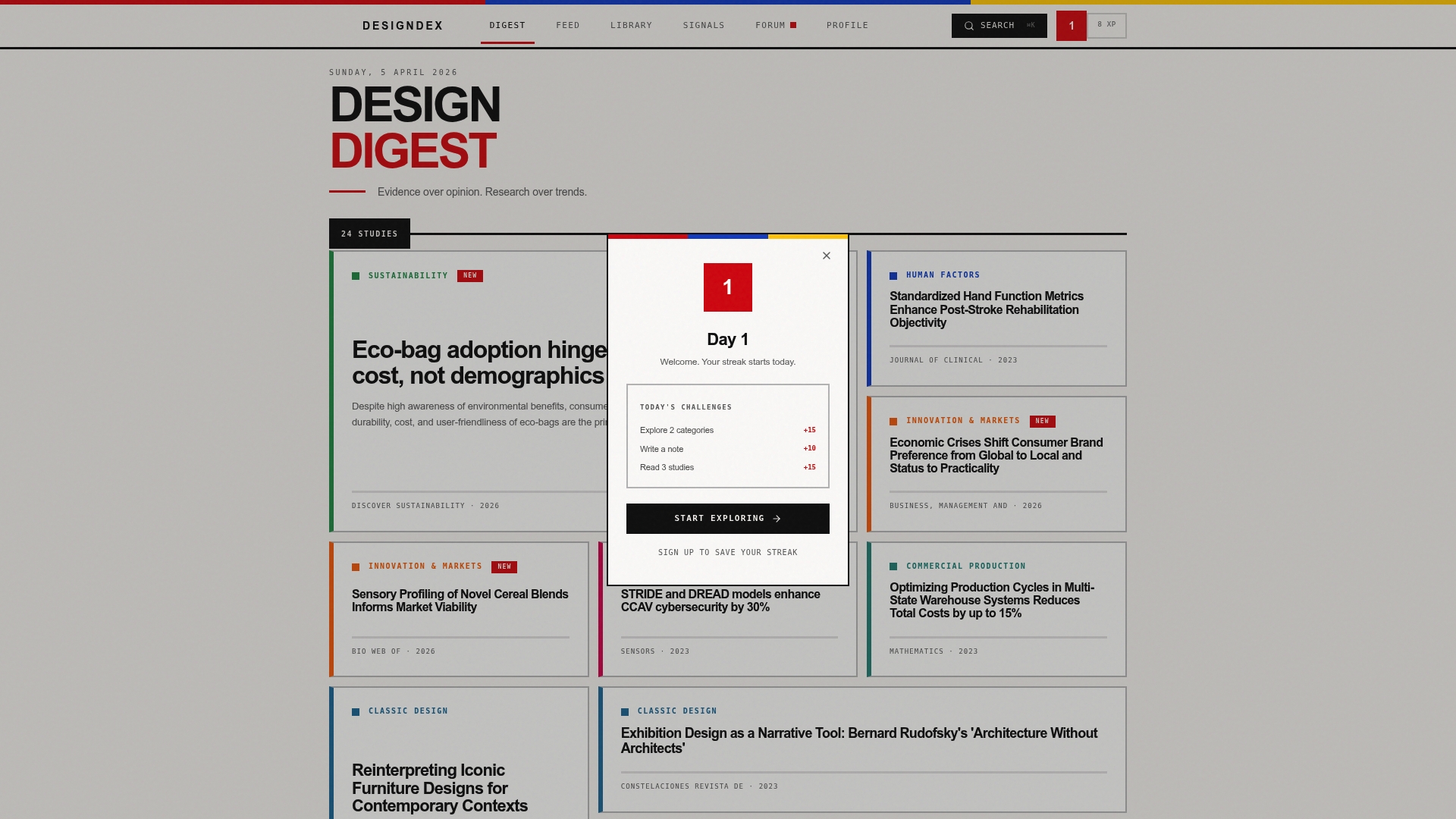
Explore usability testing research to benchmark your evaluation methods against peer-reviewed standards. Monitor emerging trends through design intelligence signals to stay ahead of UX shifts before they reach mainstream adoption. For a full catalog of evidence-backed design resources, the DesignDex digest surfaces new studies daily, giving your team a continuously updated foundation for smarter design decisions.
Frequently asked questions
What is a design system and why is it important?
A design system is a structured library of reusable components, tokens, and documented guidelines that enforces consistency, accelerates development, and enables scalable product delivery across distributed teams.
How do edge cases impact user experience?
Ignoring edge cases like connectivity failures or non-standard name formats creates UX breakdowns for real user populations; proactively designing for these scenarios prevents failure at scale and improves overall product resilience.
How can I measure the ROI of UX design?
Empirical data shows that $1 in UX investment returns approximately $100 in value, and McKinsey documents that design-focused firms outperform the S&P 500 by 228% over a decade.
What are actionable steps for improving mobile UX?
Adopt a mobile-first responsive strategy, implement skeleton screens to reduce perceived latency, enforce minimum touch-target sizes, and conduct multi-device testing that includes low-end hardware under degraded network conditions.
Why is user research vital in product design?
User research surfaces genuine needs and prevents stakeholder-driven bias; skipping research systematically leads to low conversion rates and products that fail to address the problems users actually experience.