

TL;DR:
- Design thinking is a structured, human-centered, iterative problem-solving methodology applicable across disciplines.
- It emphasizes empathy, iteration, collaboration, experimentation, and flexibility in process models.
- Evidence shows it enhances creativity, accelerates innovation, and improves user satisfaction when properly implemented.
Design thinking is frequently dismissed as a buzzword reserved for creative studios and product teams, yet the evidence positions it as one of the most rigorous, adaptable methodologies available for structured problem-solving across disciplines. As a human-centered, iterative methodology, it integrates user desirability, technological feasibility, and business viability into a single, coherent process. For design professionals and students alike, understanding its foundations, process models, empirical outcomes, and known limitations is essential for applying it with precision rather than enthusiasm alone. This article distills that knowledge into actionable frameworks and evidence-backed insights.
Table of Contents
- What is design thinking? The fundamentals explained
- Unpacking the design thinking process: Leading models compared
- Why design thinking matters: Evidence-based impact in learning and business
- Criticisms and limits: When design thinking falls short
- Our take: How to get real value from design thinking
- Explore more: Take your design thinking deeper with DesignDex
- Frequently asked questions
Key Takeaways
| Point | Details |
|---|---|
| Human-centered approach | Design thinking starts with empathy for users and focuses on their needs in the problem-solving process. |
| Iterative, flexible process | The method involves cycles of prototyping and testing rather than a fixed, linear path. |
| Proven innovation impact | Research confirms design thinking boosts innovation effectiveness in businesses and education. |
| Mind the limitations | While powerful, design thinking is not a cure-all and works best when integrated with strategy and follow-through. |
What is design thinking? The fundamentals explained
Design thinking is frequently mischaracterized as either a creative brainstorming session or an exclusive domain of visual designers. In practice, it is a structured, iterative methodology that prioritizes understanding human needs before generating solutions. Its origins trace to the design sciences of the 1960s and 1970s, but its modern form was largely shaped by institutions such as IDEO and Stanford's d.school, which formalized its principles for broad professional application.
At its core, design thinking integrates desirability, feasibility, and viability: what users genuinely need, what technology can deliver, and what an organization can sustain. This three-part lens prevents the common failure mode of building technically sound products that no one wants, or desirable products that cannot be profitably delivered.
"Design thinking is not a single method but a general orientation toward creative problem-solving that centers the human experience at every stage of development."
Several principles distinguish design thinking from conventional problem-solving approaches:
- Empathy: Systematic observation and engagement with users to surface latent needs, not just stated preferences.
- Iteration: Repeated cycles of prototyping and testing rather than linear progression from brief to final output.
- Collaboration: Cross-functional teams that integrate diverse expertise, reducing siloed decision-making.
- Experimentation: Low-fidelity prototypes tested early to reduce the cost of failure.
- Ambiguity tolerance: Comfort with undefined problems before converging on solutions.
A critical point for professionals new to the methodology: design thinking is not exclusively for designers. Engineers, educators, healthcare administrators, and policy analysts apply it effectively. Exploring human-centered design tips reveals how the same empathy-first logic transfers across sectors with minimal adaptation. The methodology's power lies precisely in its domain-agnostic structure, making it as applicable to curriculum development as to product interface design.
Unpacking the design thinking process: Leading models compared
With the conceptual foundation established, the next question is operational: how does design thinking actually work in practice? Two institutions dominate the landscape of process models, each offering distinct but compatible frameworks.
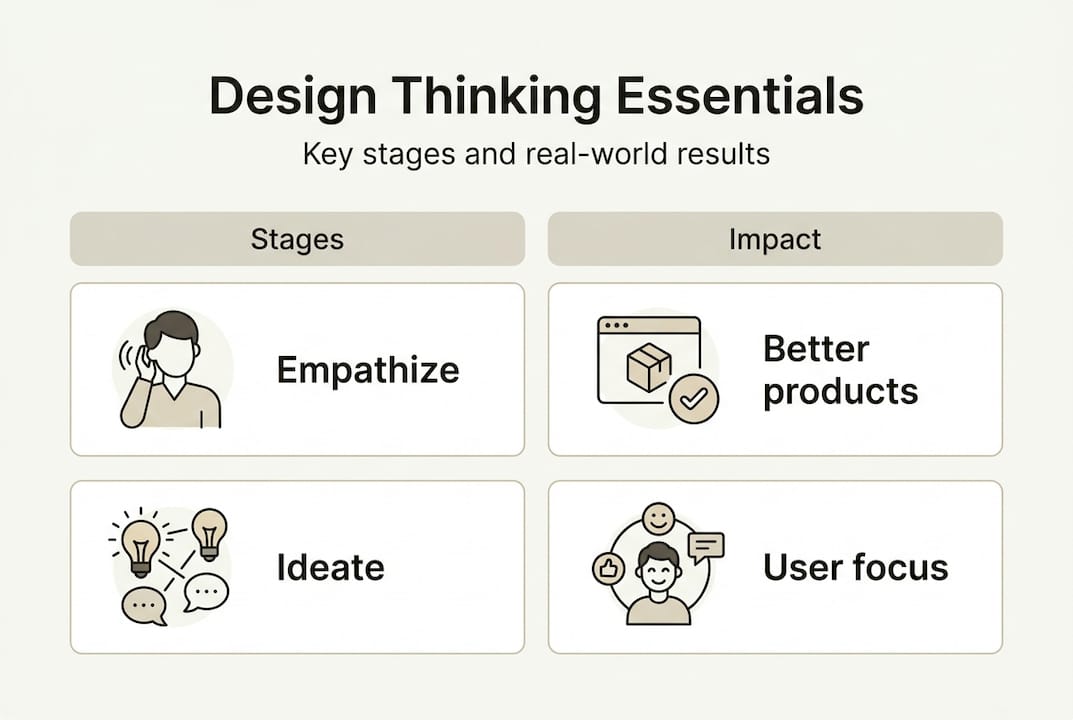
The Stanford d.school model outlines five core stages: Empathize, Define, Ideate, Prototype, and Test. Each stage has a distinct purpose:
- Empathize: Conduct interviews, observations, and immersive research to understand user context.
- Define: Synthesize research into a clear, actionable problem statement (often a "How Might We" question).
- Ideate: Generate a broad range of potential solutions without premature judgment.
- Prototype: Build low-fidelity representations of the most promising ideas.
- Test: Expose prototypes to real users, gather feedback, and iterate.
IDEO offers both a 7-step and a 3-stage process, emphasizing adaptability over rigid sequencing. IDEO's 3-stage model groups activities into Inspiration (understanding the problem space), Ideation (generating and developing ideas), and Implementation (bringing solutions to life). The 7-step variant adds granularity: Define, Research, Ideate, Prototype, Choose, Implement, and Learn.
| Model | Stages | Key emphasis | Best suited for |
|---|---|---|---|
| Stanford d.school | 5 | Empathy and iteration | Education, early-stage projects |
| IDEO 3-stage | 3 | Inspiration to implementation | Business innovation |
| IDEO 7-step | 7 | Granular execution | Complex, multi-team projects |
A design thinking overview confirms that neither model is intended as a strict linear sequence. Practitioners regularly loop back from testing to ideation, or from defining to additional empathy research, based on what the evidence surfaces. Consulting a design intelligence guide and reviewing design research methods can help you select and calibrate the right tools for each stage.
Pro Tip: Resist the urge to follow any single model as a checklist. Map the stages to your project's specific constraints, team size, and timeline. The core values (empathy, iteration, collaboration) are non-negotiable; the sequencing is not.
Why design thinking matters: Evidence-based impact in learning and business
Theoretical frameworks gain credibility through measurable outcomes. The empirical record on design thinking is substantive, spanning educational settings, corporate transformations, and innovation benchmarks.

In educational contexts, the results are statistically significant. Paired t-tests show highly significant creative skill improvements (p<0.001) in students who completed structured design thinking programs, indicating that the methodology reliably develops creative capacity rather than simply exposing students to it. This finding is particularly relevant for design students seeking evidence that the programs they invest in produce measurable competency gains.
At the organizational level, IBM's large-scale adoption of design thinking transformed product development workflows across major business units, reducing time-to-market and improving cross-functional alignment. IBM trained over 100,000 employees in design thinking principles, treating it not as a workshop activity but as an operational standard.
On the innovation dimension, frequent experimentation in design thinking enhances innovation effectiveness, particularly when digital tools are integrated into the prototyping and testing phases. This finding aligns with the broader evidence base on rapid iteration as a driver of product-market fit.
Measurable benefits documented across real-world applications:
- Accelerated product development cycles through early-stage failure identification.
- Improved user satisfaction scores linked to empathy-driven requirement gathering.
- Higher team cohesion and cross-disciplinary communication in collaborative design sprints.
- Reduced rework costs when prototyping precedes full-scale development.
- Stronger alignment between user needs and final product specifications.
For a deeper examination of how these outcomes are measured and validated, reviewing design analysis in UX and examining student satisfaction in design research provides methodological context for interpreting these results.
Criticisms and limits: When design thinking falls short
A balanced assessment of design thinking requires direct engagement with its documented limitations. Uncritical adoption of any methodology introduces risk, and design thinking is no exception.
The most frequently cited critique is what practitioners call "design thinking theatre": the performance of the process (sticky notes, empathy maps, brainstorming sessions) without substantive integration into strategic decision-making or actual product development. Critics identify issues including over-emphasis on empathy, poor systemic handling, ambiguous return on investment, and a tendency to generate insights that never translate into implemented solutions.
"Design thinking, as commonly practiced, often stops at the ideation stage. The hard work of implementation, organizational change, and scaling is where the methodology's guidance becomes thin."
Additional structural limitations include:
- Scalability constraints: The methodology performs well in small, focused project contexts but can be weak on implementation at scale, particularly in large organizations with entrenched processes.
- Systemic complexity: Problems involving regulatory, political, or deeply systemic variables often exceed the methodology's resolution capacity.
- Measurement ambiguity: Empathy-driven insights are qualitative by nature, making ROI quantification difficult for stakeholders who require financial justification.
- Overconfidence in user research: User interviews and observations surface stated and observed needs but can miss latent systemic drivers that require analytical modeling.
A design thinking critique from practitioners in the field reinforces that the methodology is most effective when paired with rigorous delivery frameworks, not positioned as a standalone solution. Integrating a design validation workflow into the testing phase substantially mitigates the implementation gap that critics most frequently identify.
Pro Tip: Treat design thinking as one instrument in a larger toolkit. Pair it with systems thinking for complex problems, and with agile delivery frameworks for implementation. The methodology excels at problem framing and solution generation; it requires complementary approaches to drive execution.
Our take: How to get real value from design thinking
The evidence is clear: design thinking produces measurable outcomes when applied with discipline. The failures documented in the literature are not failures of the methodology itself but failures of execution, organizational commitment, and strategic integration. Shallow adoption, the kind that stops at ideation workshops and never reaches prototyping or testing, accounts for the majority of reported disappointments.
What distinguishes high-performing design thinking implementations is the pairing of iterative, empathy-driven exploration with rigorous delivery metrics and accountability structures. Organizations and practitioners that treat the process as a complete cycle, from empathy research through tested, implemented solutions, consistently report stronger outcomes than those who treat it as a front-end creative exercise.
The most productive orientation is adaptive rather than dogmatic. Select the process model that fits your project's scope, integrate practical design intelligence to ground decisions in evidence, and measure outcomes at each stage. Design thinking is not a guarantee of innovation; it is a structured probability enhancer when applied with rigor and organizational alignment.
Explore more: Take your design thinking deeper with DesignDex
For design professionals and students ready to move beyond surface-level frameworks, DesignDex provides direct access to peer-reviewed research distilled into structured, actionable insights. Rather than navigating full academic papers, you access concise breakdowns of study aims, methods, findings, and real-world applications.
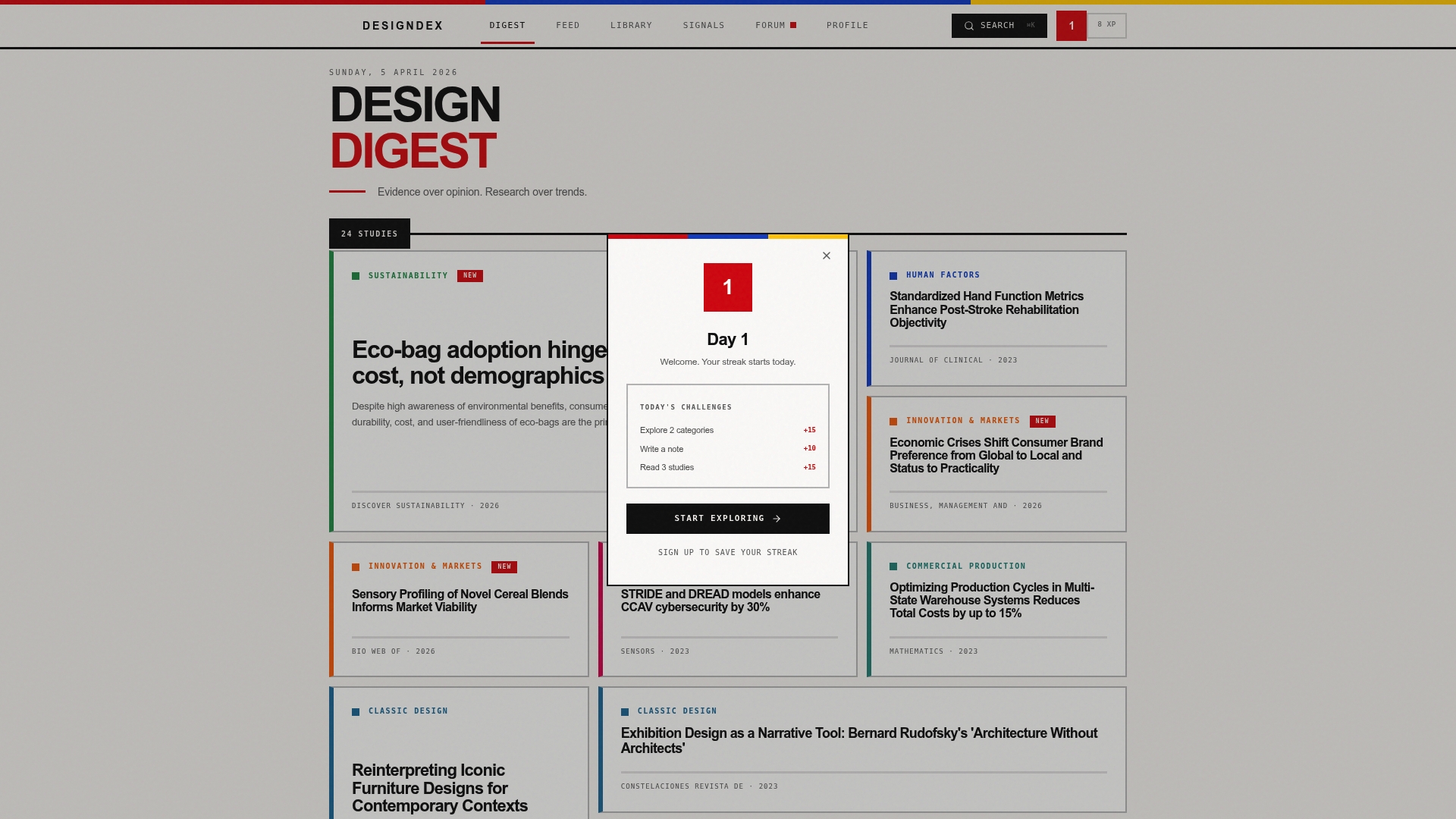
Explore how usability testing research informs iterative design decisions, or examine how VR for user empathy is reshaping the empathy stage of design thinking. The DesignDex platform updates daily, surfaces emerging research signals, and provides citation-ready content that supports evidence-based design decisions at every stage of your process.
Frequently asked questions
What are the five stages of design thinking?
The five stages are Empathize, Define, Ideate, Prototype, and Test, as formalized by the Stanford d.school model; they are intended as iterative rather than strictly sequential.
Does design thinking actually improve innovation?
Yes; experimentation in design thinking improves innovation effectiveness and efficiency, particularly when digital tools support rapid prototyping and testing cycles.
What are common criticisms of design thinking?
Critiques include superficiality, strategy disconnect, and weak handling of systemic complexity, particularly when the process is adopted without genuine organizational commitment to implementation.
Can I use design thinking for non-design problems?
Absolutely; design thinking applies beyond traditional design to any challenge that benefits from structured empathy, creative ideation, and iterative experimentation, including education, healthcare, and policy.
How do I pick the right design thinking process model?
Select the model (d.school, IDEO 3-stage, or IDEO 7-step) that aligns with your project's scope and team size, as core values align across models while sequencing remains flexible.