

TL;DR:
- Relying on research-backed and evidence-based inspiration enhances design credibility and effectiveness. Implementing structured evaluation methods, such as healthcare design models or heuristic critique, improves decision-making and stakeholder confidence. Embracing a systematic approach to sourcing and documenting research insights fosters professional growth and innovation across design disciplines.
Relying on intuition or personal aesthetic preference when presenting design decisions is a credibility liability. Clients, reviewers, and stakeholders increasingly expect rationale grounded in evidence, not gut feeling. This article presents a structured, research-informed framework for sourcing and evaluating design inspiration, organized around empirically validated methods drawn from healthcare design, usability research, interactive systems, and immersive technology. Each inspiration category is supported by documented methodologies, measurable outcomes, and peer-reviewed findings, equipping both students and professionals with the citation-ready ammunition needed to defend and advance their design choices.
Table of Contents
- How to evaluate design inspiration using research
- Top research-backed design inspirations for your next project
- Comparing approaches: What the research reveals
- Tailoring inspiration: When to use which research method
- Why most designers don't use research as inspiration and how you can stand out
- Bring research-backed inspiration to your design workflow
- Frequently asked questions
Key Takeaways
| Point | Details |
|---|---|
| Assess with research | Always evaluate design inspiration using clear, evidence-based criteria for maximum impact. |
| Structured methods work | Designs rooted in research processes deliver more reliable and defensible outcomes. |
| Variety of inspirations | Research-backed inspiration sources range from usability testing to VR empathy and education models. |
| Choose by project needs | Select your research method based on timeline, goals, and complexity for best results. |
| Stand out with evidence | Citing research with your choices gives you a professional edge over style-driven competitors. |
How to evaluate design inspiration using research
Having set the stage for why research matters in design, let's outline how to evaluate inspiration ideas using academic rigor and real evidence. Not all inspiration is created equal. A mood board pulled from a design blog carries fundamentally different weight than an insight extracted from a randomized controlled study or a structured post-occupancy evaluation.
What classifies as "evidence-based" inspiration? Evidence-based inspiration draws directly from documented studies, structured evaluation processes, or validated frameworks that connect design variables to measurable outcomes. It is traceable, replicable, and contextually grounded.
A robust evaluation framework for research-backed inspiration involves five sequential steps:
- Define the design goal with measurable criteria. Vague goals such as "improve user experience" are insufficient; specify the metric (e.g., task completion rate, error frequency, dwell time).
- Locate and appraise relevant research. Identify peer-reviewed studies, structured case studies, or validated evaluation frameworks. Assess methodological rigor, sample size, and context relevance.
- Create and test concept prototypes. Develop design concepts based on research insights, then pilot them under controlled or real conditions.
- Collect baseline performance measures. Establish pre-intervention benchmarks to enable valid before-and-after comparisons.
- Conduct post-occupancy or post-deployment evaluation. As applied in evidence-based design within healthcare environments, this structured process defines goals, locates and appraises evidence, creates and tests concepts, collects baseline performance measures, and uses post-occupancy evaluation to compare outcomes against benchmarks.
Understanding design research methods at each stage is critical, because the strength of your inspiration depends directly on the methodological quality of its source.
Pro Tip: When auditing an inspiration source, ask three questions: What was measured? How was it measured? What was the effect size? If you cannot answer all three, the source may not meet evidence-based standards.
Why do post-project evaluations matter so specifically? Because inspiration sourced without feedback loops becomes detached from real-world performance. Structured design evaluation processes close this gap by connecting the conceptual origin of a design decision to its measured impact, reinforcing or refuting its value for future projects.
Top research-backed design inspirations for your next project
With evaluation criteria established, here are specific inspiration categories you can adopt with confidence, each supported by robust research traditions.
Healthcare design as a process model. The healthcare sector has operationalized evidence-based design more rigorously than most other fields. The structured evidence-based design process used in clinical environments, which integrates goal definition, evidence appraisal, prototype testing, baseline measurement, and post-occupancy evaluation, is directly transferable to product, interior, and digital design contexts. Designers in other sectors can adopt this cyclical model to systematically validate their creative choices against performance outcomes.

Heuristic evaluation as structured critique. Heuristic evaluation, developed from Nielsen's usability principles, provides a fast, expert-driven framework for identifying interface problems. It is one of the most widely cited methods in UX research because it bridges expert knowledge and empirical observation. Importantly, researchers are actively quantifying evaluator agreement and severity ratings to reduce subjectivity when multiple experts assess the same interface, strengthening its rigor.
Usability testing for interface design inspiration. Usability testing enhances interactive interface quality by surfacing friction points that designers systematically overlook during production. Studies in this area document specific interaction failures, interaction success rates, and preference data, making them rich sources of inspiration for redesign decisions.
VR-driven empathy as a design input. Research on VR immersion and user empathy demonstrates that immersive simulations increase designers' understanding of user context, pain points, and behavioral patterns significantly more than traditional persona documents or written scenarios. This finding positions VR empathy research as a compelling inspiration source for inclusive, user-centered projects.
Key categories of research-backed inspiration to build into your practice:
- Structured process models: Borrow the define-evidence-test-measure cycle from healthcare design
- Expert heuristic frameworks: Apply standardized usability principles as critique lenses
- Empirical usability studies: Use documented failure patterns to inspire interface improvements
- Behavioral and cognitive research: Draw from studies on attention, memory load, and decision-making to inform visual hierarchy
- Immersive empathy research: Use VR-based findings to deepen user context understanding
Methods for synthesizing research insights across these categories produce the most defensible design rationale. A single-source inspiration approach is inherently weaker than a triangulated one that draws from multiple validated frameworks simultaneously.
Studies applying evidence-based design strategies in product development have consistently demonstrated that design teams who formalize their inspiration sourcing achieve higher stakeholder confidence scores and fewer costly late-stage revisions than those relying on creative intuition alone.
Pro Tip: Maintain a "research brief" alongside every project brief. For each major design decision, document the study or framework that informed it, the specific finding applied, and the outcome metric you will use to validate it post-launch.
Comparing approaches: What the research reveals
Once you've reviewed the leading inspirations, it's productive to examine how the underlying research-based methods compare directly against one another, because context determines which approach delivers the most valid, actionable results.
"Heuristic evaluation is fast but not purely qualitative; there is active research on quantifying agreement and severity to reduce subjectivity when multiple experts evaluate the same interface."
This ongoing refinement is significant. It means that heuristic evaluation, often dismissed as "just expert opinion," is evolving toward a more statistically grounded practice, which elevates its credibility as an inspiration and validation source.
| Approach | Speed | Rigor | Cost | Best fit context |
|---|---|---|---|---|
| Evidence-based structured process | Low (weeks to months) | Very high | High | Complex, long-cycle projects (healthcare, institutional, product) |
| Heuristic evaluation | High (days) | Moderate to high | Low | Interface and UX projects with fast iteration cycles |
| Usability testing | Moderate (1-2 weeks) | High | Moderate | Digital products, interactive systems, app design |
| VR empathy simulation | Moderate (1-2 weeks) | High (behavioral data) | High | Inclusive design, spatial design, public service design |
| Literature synthesis | Low to moderate | Very high | Low | Academic projects, strategic design decisions |
The table clarifies a fundamental tension designers face: rigor and speed are typically inversely correlated. The design evaluation steps required to achieve high evidentiary value demand time, controlled conditions, and often dedicated research resources.
However, the cost-to-credibility ratio differs by context. For a mobile application redesign with a two-week sprint cycle, a well-structured heuristic evaluation supported by quantified severity ratings may deliver more actionable inspiration per hour invested than a full usability study. For a multi-year institutional building project, the structured healthcare process model is both appropriate and expected by stakeholders.
Statistical rigor also matters when selecting your source. Studies that report effect sizes, confidence intervals, and inter-rater reliability scores carry substantially more evidential weight than those reporting only anecdotal or qualitative impressions. Consulting a design intelligence guide can help you interpret statistical reporting in design research before integrating findings into your workflow.
Expert consensus, while not a substitute for empirical data, adds meaningful support when corroborating peer-reviewed findings. Multi-expert agreement on heuristic severity ratings, for instance, raises the confidence level of an evaluation outcome and strengthens the inspiration it generates.
Tailoring inspiration: When to use which research method
Now that the main approaches are clear, the next step is selecting the right method for your specific project, informed by timeline, evidence requirements, and stakeholder expectations.
Decision criteria for method selection:
| Project characteristic | Recommended method | Evidence strength |
|---|---|---|
| Short timeline (under 2 weeks) | Heuristic evaluation | Moderate; strengthen with quantified severity |
| Complex, multi-phase project | Evidence-based structured process | Very high; most defensible |
| Digital interface or app | Usability testing | High; behavioral and task-based data |
| Inclusive or spatial design | VR empathy simulation | High; behavioral and attitudinal data |
| Academic or thesis project | Literature synthesis | Very high; citation-ready |
| Strategic or systems-level design | Combined literature + usability | Very high |
The design ideation process benefits from method alignment at the earliest stage: inspiration sourced from a method appropriate to the project's scale and complexity produces more relevant, defensible concepts than inspiration imported from an unrelated context.
Practical checklist for justifying design decisions with research:
- Identify the decision category. Is this a spatial, interface, product, or communication design choice?
- Match the decision to a validated method. Use the table above to select the most appropriate research approach.
- Locate at least two independent sources. Triangulation strengthens credibility substantially.
- Document outcome metrics upfront. Specify how you will measure success before the project concludes.
- Conduct a post-project evidence review. Compare actual outcomes against the research predictions that informed your choices; this data feeds future projects.
As documented in healthcare design practice, the combination of baseline measurement and post-occupancy evaluation is what converts a single design decision into a transferable, generalizable insight, compounding the value of research investment over time.
Research-backed inspiration is not a one-time event. It is an iterative cycle in which each project adds to a growing evidence base that improves future decision-making accuracy and professional credibility.
Why most designers don't use research as inspiration and how you can stand out
The uncomfortable reality is that most designers avoid research-backed inspiration not because they are unaware of it, but because they perceive it as incompatible with creative freedom. There is a persistent cultural narrative within design communities that rigorous research constrains ideation, produces predictable outputs, and drains the inventive energy that separates good design from great design. This perception is empirically unfounded.
Research does not prescribe solutions; it characterizes the problem space with greater precision. The distinction is critical. A study documenting how users misinterpret icon semantics under time pressure does not tell you what icon to design; it tells you what properties the icon must reliably communicate, which is actually a richer creative brief than "design an intuitive icon."
The competitive advantage here is tangible. Designers who consistently document and articulate research-backed rationale win more pitches, survive more rounds of stakeholder review, and accumulate a portfolio of evidence that compounds in professional value. They are the designers that clients return to because decisions feel grounded, not arbitrary.
The practical challenge is habituation. Most designers are not trained to integrate research documentation into their standard workflow; it feels like additional overhead rather than integral process. The shift happens when you reframe research not as a post-hoc justification mechanism but as the primary inspiration source itself. Challenge yourself to document the research origin of every major design decision in your next brief, not retrospectively, but at the moment of ideation. This single behavioral change produces measurably different outcomes in client communication and project cohesion.
Embracing research-driven innovation as a core practice also signals professional maturity to collaborators and clients who increasingly operate in evidence-driven organizational cultures. In sectors like healthcare, education, and public services, designers without research fluency are at a systematic disadvantage.
Bring research-backed inspiration to your design workflow
Consistently locating, appraising, and applying peer-reviewed design research is time-intensive without the right infrastructure. DesignDex addresses this directly by aggregating and distilling research into structured, citation-ready summaries that fit directly into professional workflows.
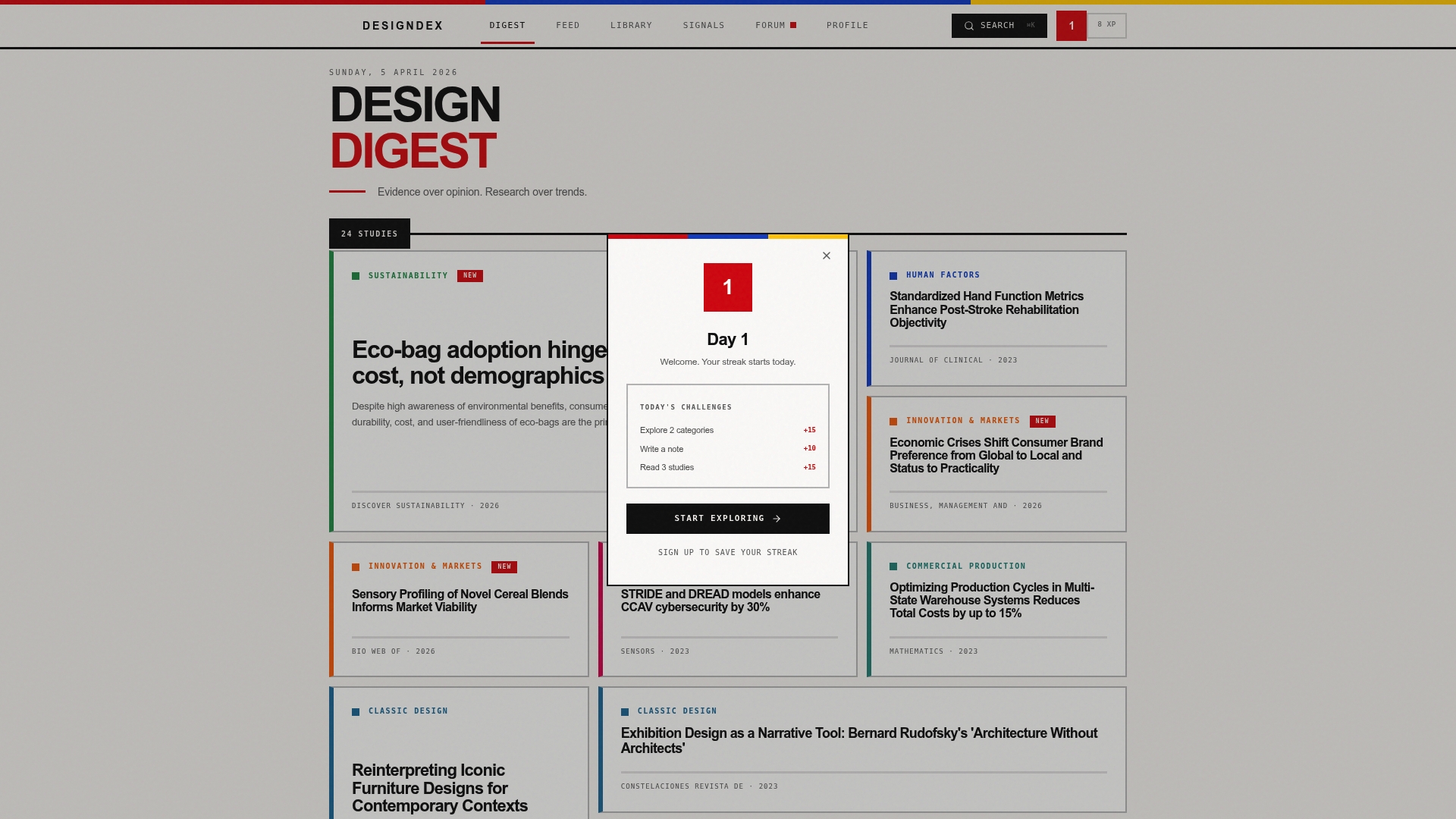
Whether you are drawing inspiration from usability testing findings that document interface quality improvements, or integrating insights from VR immersion research to strengthen empathy-driven design decisions, DesignDex provides the evidentiary foundation you need without requiring you to read full academic papers. The platform updates daily, surfaces emerging trends, and delivers structured breakdowns of aims, methods, findings, and real-world applications. Explore the full research library to integrate evidence into every stage of your design process.
Frequently asked questions
What does "research-backed design inspiration" actually mean?
It refers to design concepts or methods supported by quantifiable, empirical evidence from peer-reviewed studies or structured evaluation processes; specifically, those that define goals and measure outcomes against pre-established benchmarks.
How do I know if a design inspiration is really based on research?
Look for documented processes, outcome comparisons, or direct references to studies that measure the effectiveness of the design decision; structured post-occupancy evaluations against benchmarks are a reliable indicator of evidentiary rigor.
Is heuristic evaluation really research-based?
Yes; heuristic evaluation draws from decades of usability research and is being actively refined through techniques that quantify severity and evaluator agreement, reducing subjectivity and increasing its standing as an empirically grounded method.
Why should design students care about evidence-based inspiration?
Using research-backed ideas allows students to justify design decisions with documented rationale, which significantly strengthens portfolio presentations, thesis defenses, and early-career client proposals.
Can I apply healthcare design research to other project types?
Yes; the structured methodology used in evidence-based healthcare design, including goal definition, evidence appraisal, prototype testing, and post-occupancy evaluation, is adaptable to education, housing, digital product, and service design contexts.