

TL;DR:
- Design thinking is an iterative framework moving teams from user insights to validated solutions.
- The five core stages are Empathize, Define, Ideate, Prototype, and Test, with frequent revisits.
- Mastery requires integrating evidence-based research and flexible navigation between stages.
Creative teams across UX and industrial design regularly face the same structural gap: rich research on one side, final deliverables on the other, and an uncertain path connecting them. Design thinking addresses this gap directly, offering a repeatable, evidence-grounded framework that moves teams from abstract user insight to validated, deployable solutions. Each stage builds purposefully on the one before it, creating a system where decisions are justified by evidence rather than intuition. This article outlines every stage, explains how they interact, and provides practical guidance for applying the process across real-world design projects.
Table of Contents
- What are the stages of design thinking?
- Stage 1: Empathize – Understand your users
- Stage 2: Define – Reframe the challenge
- Stage 3: Ideate – Generate innovative solutions
- Stages 4 & 5: Prototype and Test – Bring ideas to life
- Why design thinking is more iterative (and less linear) than you think
- Advance your mastery of design thinking with DesignDex
- Frequently asked questions
Key Takeaways
| Point | Details |
|---|---|
| Structured creativity | Following the five stages keeps projects focused while fostering innovation. |
| Iterative process | Design thinking works best when revisited, not as a strict step-by-step checklist. |
| Empathy is essential | Deep understanding of users underpins all effective design solutions. |
| Rapid prototyping wins | Quickly testing ideas leads to stronger outcomes and fewer costly mistakes. |
| Framework flexibility | Teams can adapt the stages and tools to suit unique project demands. |
What are the stages of design thinking?
With a clear sense of why structure is needed, the logical next step is to examine the stages that define the design thinking process and how each one contributes to the overall framework.
The standard design thinking model includes five key stages: Empathize, Define, Ideate, Prototype, and Test. These stages provide a structured sequence of activities that guide design teams from raw, unfiltered user observation through to validated solutions ready for iteration or deployment.
However, it is critical to recognize that design thinking is iterative, not strictly linear. Teams frequently revisit earlier stages as new information emerges, particularly after testing reveals unforeseen user behaviors. The design intelligence guide positions this iterative quality as a feature, not a limitation.
The five stages are:
- Empathize: Conduct user research to understand real needs and behaviors.
- Define: Synthesize findings into a focused, actionable problem statement.
- Ideate: Generate a broad set of potential solutions to the defined challenge.
- Prototype: Build tangible, testable representations of selected ideas.
- Test: Validate prototypes with real users and extract actionable feedback.
| Stage | Primary Activities | Key Outcome |
|---|---|---|
| Empathize | Interviews, observation, empathy mapping | Deep user insight |
| Define | Affinity mapping, insight clustering | Clear problem statement |
| Ideate | Brainstorming, SCAMPER, brainwriting | Diverse solution concepts |
| Prototype | Mockups, wireframes, physical models | Tangible design artifact |
| Test | Usability testing, feedback sessions | Validated or refuted design directions |
Each stage produces a defined output that feeds directly into the next, maintaining coherence across the entire process.
Stage 1: Empathize – Understand your users
Now that you know the holistic journey, it is worth examining each stage in depth, starting with Empathize, the stage that sets the analytical foundation for every decision that follows.
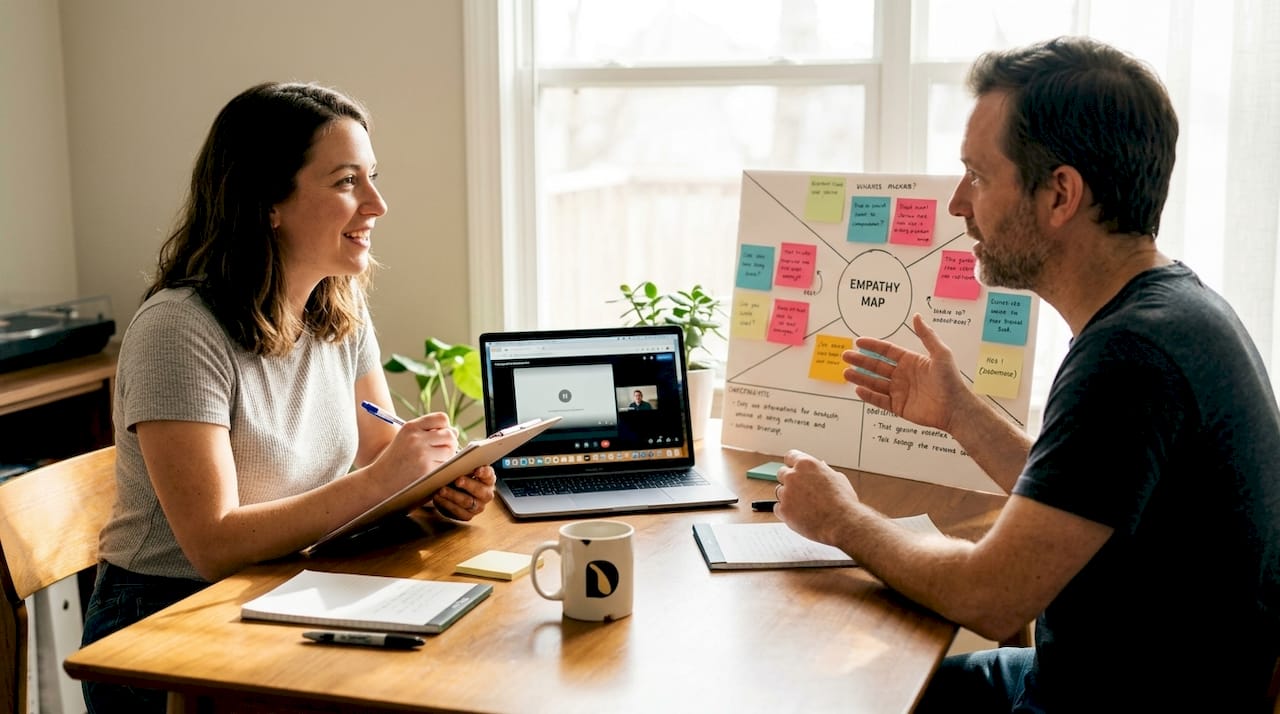
The goal of the Empathize stage is to place the design team in the experiential position of the user: observing, questioning, and recording real needs and pain points rather than assumed ones. Empathy mapping and direct user interviews are foundational tools for understanding user needs and form the methodological core of this stage.
Common methods used during the Empathize stage include:
- User interviews: One-on-one conversations designed to surface motivations, frustrations, and mental models.
- Contextual observation: Watching users interact with existing products or environments in their natural setting.
- Empathy mapping: A structured visualization tool that captures what users say, think, feel, and do.
- Diary studies: Longitudinal self-reporting tools that capture user experiences over time.
Effective empathy research requires more than interviewing average users. Teams working on design research methods frequently find that insights from edge-case participants reveal systemic needs that mainstream users cannot articulate.
Pro Tip: Recruit at least two to three "extreme users" per research round. Extreme users operate at the boundaries of the problem space and often expose needs that typical users take for granted.
"You are not the user. Every assumption you bring into the Empathize stage is a variable that needs to be tested, not accepted."
Skipping or compressing this stage is one of the most costly errors design teams make. All subsequent stages depend on the quality and rigor of user insight collected here.
Stage 2: Define – Reframe the challenge
After collecting valuable user insights, the next critical task is turning that data into focus by defining the challenge with precision and strategic intent.
The Define stage transforms raw empathy data into a single, actionable problem statement that orients the entire project. A well-framed problem statement helps teams avoid premature solutioning, a pattern where teams skip to answers before genuinely understanding the problem architecture.
The process for synthesizing findings into a strong problem definition follows a structured sequence:
- Cluster research findings using affinity mapping to group related observations.
- Identify patterns within clusters that point to recurring user needs or friction points.
- Prioritize themes based on frequency, severity, and alignment with project scope.
- Draft a problem statement using specific user language and grounded in observed behavior.
- Validate the statement with team members and, where possible, with research participants.
For insights on how design analysis in UX frameworks support this synthesis process, structured analytical models can accelerate the transition from data to definition.
Pro Tip: Frame your problem statement as a "How might we...?" question. This formulation is specific enough to guide ideation but open enough to allow creative responses. Compare these two examples: Weak: "Users do not use our app's navigation." Strong: "How might we redesign navigation so first-time users locate key features within 30 seconds?"
A sharply defined problem statement is the single most reliable predictor of focused, productive ideation in the next stage.
Stage 3: Ideate – Generate innovative solutions
With a sharp problem statement established, design teams are positioned to expand the solution space systematically and creatively in the Ideate stage.
The goal of Ideation is not to find the right answer immediately; it is to generate the widest possible pool of candidate answers so that the strongest can be identified and refined. Diverse teams and ideation tools such as brainwriting expand creative options significantly compared to conventional group brainstorming.
Core ideation methods used by experienced design teams include:
- Classic brainstorming: Rapid, verbal idea generation in a time-boxed session.
- Brainwriting (6-3-5 method): Six participants each write three ideas in five minutes, then pass the sheet; builds on others' thinking without social pressure inhibiting contribution.
- SCAMPER: A structured prompt framework (Substitute, Combine, Adapt, Modify, Put to other uses, Eliminate, Reverse) that interrogates an existing concept from multiple angles.
- Mind mapping: Visual association technique that branches out from the core problem statement.
For further guidance on structuring participatory design sessions, human-centered design tips offer research-backed protocols for sustaining creative momentum across team sizes.
Pro Tip: Suspend evaluative judgment for the first 50% of any ideation session. Teams that critique ideas too early converge on safe, obvious solutions rather than novel ones. Quantity before quality is not a creative luxury; it is a validated strategy.
At the close of the Ideate stage, teams should select two to three high-potential concepts using criteria grounded in user need, technical feasibility, and strategic alignment. These become the inputs for prototyping.
Stages 4 & 5: Prototype and Test – Bring ideas to life
With a shortlist of solutions identified, the process shifts to building and learning rapidly through the Prototype and Test stages, which function most effectively as a paired cycle.
Prototyping makes abstract ideas tangible. The purpose is not to build a polished product but to create a model that is sufficiently detailed to generate real user feedback. Early, low-fidelity prototypes save time and costs by catching design flaws before significant resources are committed to development.
| Prototype type | Fidelity level | Best used when | Key advantages |
|---|---|---|---|
| Paper sketches | Very low | Early concept validation | Rapid, zero-cost, highly modifiable |
| Digital wireframes | Low to medium | Flow and navigation testing | Quick to build, supports remote testing |
| Interactive mockups | Medium to high | Usability and interaction testing | Realistic feel, detailed feedback |
| Functional prototypes | High | Pre-launch validation | Closest to final product behavior |
The design validation workflow literature consistently supports a low-to-high fidelity progression, matching prototype complexity to the specific question being tested. For broader context on how design policy and UX frameworks influence validation standards, institutional guidelines increasingly mandate early-stage testing protocols.
Key testing practices that maximize insight quality include:
- Observe user behavior without intervening or guiding.
- Record sessions (with consent) to capture micro-interactions that verbal feedback misses.
- Ask participants to think aloud during task completion.
- Document unexpected behaviors as primary signals, not deviations to dismiss.
"The best insights often come from feedback on early, imperfect prototypes, before assumptions calcify into fixed design decisions."
Test findings feed directly back into earlier stages, and this feedback loop is precisely where design thinking proves its value over linear product development models.
Why design thinking is more iterative (and less linear) than you think
Now that each stage has been examined individually, there is a crucial structural truth that most guides and tutorials consistently underemphasize: real-world design thinking rarely follows a clean, sequential path from stage one to stage five.
Many design professionals, particularly those new to the framework, treat the five stages as a checklist. They empathize once, define once, and prototype once, treating each stage as a box to check rather than a lens to return to repeatedly. Expert practitioners operate differently. They jump between stages based on what the evidence demands, revisiting the Empathize stage after testing surfaces unexpected user behaviors, or returning to the Define stage when ideation reveals that the original problem statement was too narrow.
This fluid navigation is not a sign of process failure; it reflects mature design judgment. The design intelligence perspective supports treating the design thinking framework as a compass rather than a rigid map: directional and orienting, but responsive to terrain.
Pro Tip: After every test cycle, schedule a structured retrospective that explicitly asks whether the original problem statement still holds. Growth in understanding almost always surfaces in the loops, not the linear path.
Advance your mastery of design thinking with DesignDex
Mastering each stage of design thinking requires more than theoretical knowledge; it demands access to current, evidence-grounded research that keeps your practice calibrated to emerging findings.
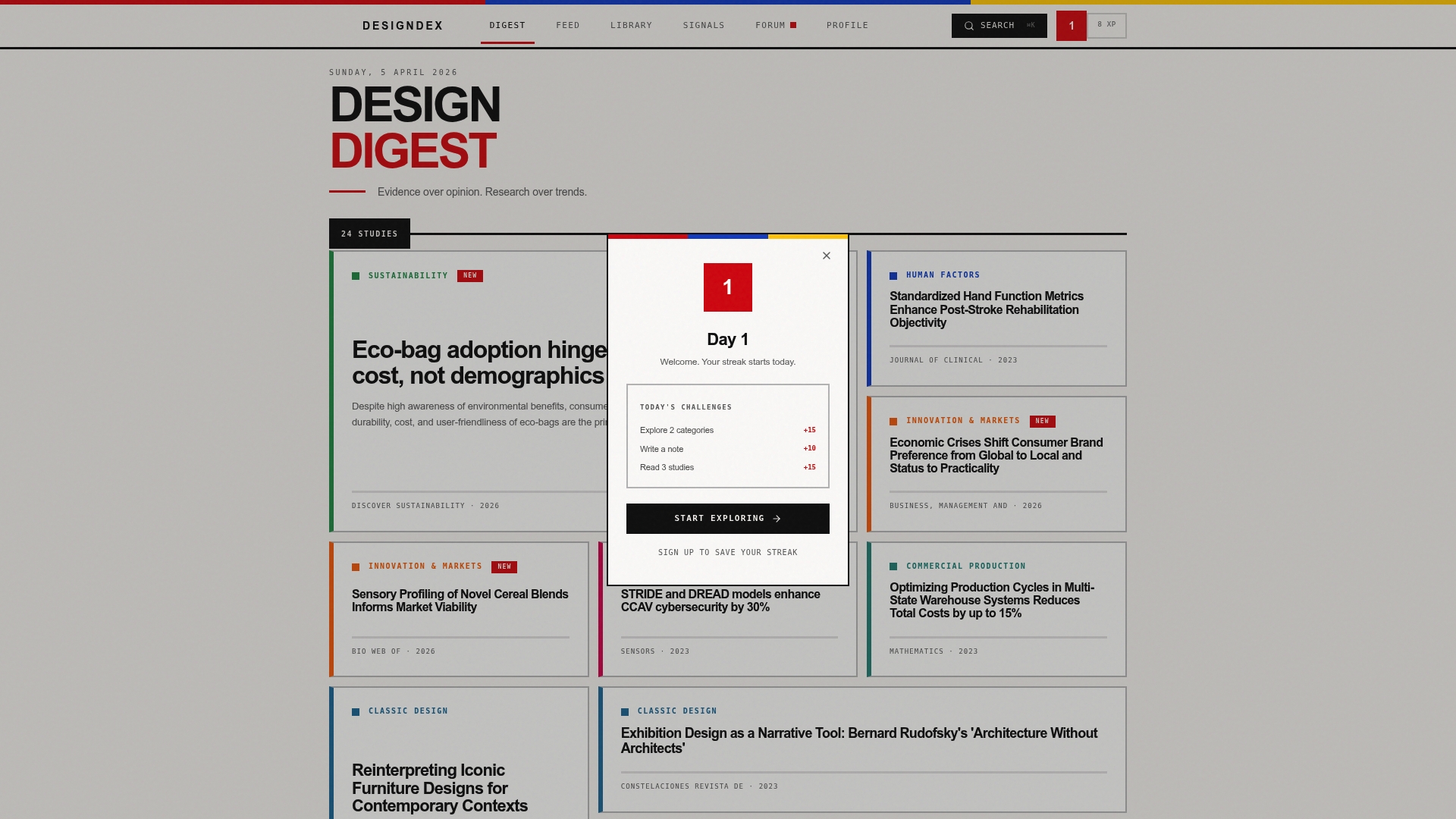
DesignDex is built precisely for this purpose. The platform's Design Digest aggregates peer-reviewed studies across UX and industrial design, distilling them into structured, citation-ready insights that support every stage of the design thinking process. For practitioners focusing on the Empathize stage, the VR empathy study offers compelling, research-backed evidence on immersive methods. For teams refining their Test stage, the usability testing research digest provides validated protocols. Explore DesignDex to make evidence your competitive advantage.
Frequently asked questions
Are the design thinking stages always followed in order?
No, teams regularly cycle back and forth between stages as project insights evolve. Design thinking is not a strictly linear process and derives significant value from iterative loops between stages.
Which design thinking stage is most critical for success?
Empathize is widely considered the foundational stage, as the depth of user understanding it produces directly conditions the quality of every stage that follows. User research and empathy are essential drivers of effective design thinking outcomes.
How do I present design thinking stages to stakeholders?
Structured visual aids such as stage tables or process infographics communicate the methodology clearly to non-specialist audiences. Clear visual representations of the design process are documented to support team communication and stakeholder alignment.
Can design thinking be adapted for agile teams?
Yes; agile teams can integrate design thinking stages as sprint-level frameworks that sustain continuous user feedback and iterative improvement. Iterative, user-centered frameworks like design thinking are well-documented complements to agile practice.
Are there advanced stages or tools beyond the basic five?
Many mature design teams extend the core five stages with supplementary tools such as journey mapping, service blueprints, or participatory co-design sessions, selected based on project complexity. Design research methods can flexibly extend the core framework as project scope demands.