

TL;DR:
- Effective system design considers products, users, organizations, and environments as interconnected parts.
- It emphasizes holistic thinking, feedback loops, and continuous adaptation rather than isolated problem-solving.
- Frameworks like Double Diamond and V-model help map complex interactions and promote cross-disciplinary collaboration.
System design is frequently reduced to a technical exercise in diagramming architectures or mapping user flows, a narrow interpretation that leaves most of its transformative potential untapped. In reality, effective system design is rooted in holistic, interconnected thinking that treats products, users, organizations, and environments as interdependent parts of a living ecosystem. Systems thinking frameworks integrate pillars such as research, design systems, UX interaction, collaboration, and measurement, addressing feedback loops and ecosystem interactions that traditional design methods tend to overlook. This guide covers definitions, core principles, key methodologies, and real-world applications.
Table of Contents
- What is system design? Core principles demystified
- Systems thinking vs. design thinking: Key differences
- Essential methodologies and frameworks in system design
- Applying system design: Practical examples and best practices
- Why most designers underestimate system design's impact
- Explore more: Cutting-edge research and resources
- Frequently asked questions
Key Takeaways
| Point | Details |
|---|---|
| Holistic approach | System design goes beyond individual features to address the entire ecosystem and user journey. |
| Core pillars | Research, collaboration, feedback loops, and measurement form the foundation of successful system design. |
| From thinking to application | Applying system design principles leads to more resilient, adaptable, and impactful solutions in UX and industrial design. |
| Frameworks matter | Understanding and using structured methodologies guides teams to better outcomes and fewer blind spots. |
What is system design? Core principles demystified
System design, as applied within UX and industrial design, refers to the structured, holistic practice of conceptualizing, planning, and refining interconnected components of a product or service ecosystem. Where conventional design thinking tends to isolate problems and solve them in sequence, system design demands simultaneous consideration of all components, their interactions, and their evolution over time. This distinction is not cosmetic; it determines whether a design solution fails in a live environment or sustains performance across changing conditions.
At its foundation, systems thinking in design reorients the designer's lens away from isolated artifacts toward the network of relationships, constraints, and feedback mechanisms that govern how those artifacts perform. A digital product, for example, does not exist in isolation: it interacts with organizational workflows, user mental models, platform constraints, and business objectives simultaneously. Failing to account for any one of these dimensions at the design stage routinely produces solutions that are technically sound but operationally fragile.
The table below contrasts the scope of system design with conventional design thinking across four critical dimensions:
| Dimension | Conventional design thinking | System design |
|---|---|---|
| Problem scope | User-centered, localized | Ecosystem-wide, holistic |
| Iteration | Sequential, phase-gated | Continuous, adaptive |
| Feedback integration | End-of-cycle testing | Ongoing, built-in loops |
| Collaboration model | Discipline-specific | Cross-functional, systemic |
A well-established framework for modern product design identifies five foundational pillars that define the discipline:
- Research: Continuous inquiry into user behavior, environmental constraints, and system performance data.
- Design systems: Formalized component libraries and interaction patterns that ensure consistency and scalability.
- UX interaction: The quality and coherence of all user-system touchpoints, evaluated at both local and systemic levels.
- Collaboration: Structured engagement across disciplines including engineering, business strategy, and behavioral science.
- Measurement: Quantified evaluation of outcomes that feeds directly back into design iteration.
"Systems thinking evolves from design thinking by focusing on holistic frameworks, addressing ecosystem interactions and feedback loops as first-class design concerns rather than post-release diagnostics."
Human-centered design principles remain essential within this framework; system design does not abandon human focus but expands the definition of "human context" to include all the forces that shape user experience, from organizational culture to technical infrastructure. The result is a design practice that is simultaneously more rigorous and more adaptive than conventional methods.
Systems thinking vs. design thinking: Key differences
Design thinking, as formalized through academic institutions and industry practice over the past four decades, provides a structured, empathy-led approach to problem-solving. Its typical phases: empathize, define, ideate, prototype, and test, create a powerful scaffold for understanding user needs and generating creative solutions. However, design thinking's evolution into systems thinking becomes necessary when problems involve multiple interacting variables, emergent behaviors, and long-term feedback dynamics that a linear or iterative single-loop process cannot fully address.
The core distinction is one of scope and feedback architecture. Design thinking excels at identifying and solving a well-defined problem for a specific user segment. Systems thinking, by contrast, asks how that solution will interact with adjacent systems, what feedback loops it creates or disrupts, and how its performance will shift as the surrounding environment changes. These are not competing paradigms; they are sequential layers of sophistication, with systems thinking building directly on design thinking's foundations.
| Attribute | Design thinking | Systems thinking |
|---|---|---|
| Primary focus | User needs and problem definition | Ecosystem dynamics and feedback loops |
| Complexity model | Complicated (solvable) | Complex (adaptive) |
| Outcome orientation | Solution to a defined problem | Ongoing system optimization |
| Risk management | Prototype and test | Model, simulate, and monitor |
Consider a practical example in UX design: a team using design thinking might optimize an onboarding flow based on user testing feedback, achieving measurable improvements in task completion rates. A systems thinking approach would additionally model how changes to onboarding affect downstream support ticket volume, user retention curves, feature adoption rates, and the engineering team's maintenance burden. The solution is richer, more resilient, and aligned with organizational goals beyond the immediate user experience.
Four practical steps help designers transition from design thinking to systems thinking:
- Map the full ecosystem: Identify every stakeholder, system component, and external factor that interacts with the design artifact before defining the problem scope.
- Identify feedback loops: Document both reinforcing loops (where outputs amplify inputs) and balancing loops (where outputs constrain inputs) within the system.
- Model emergent behavior: Use service blueprints, system maps, or causal loop diagrams to visualize how individual interactions generate systemic outcomes.
- Integrate measurement by design: Define success metrics that capture system-level outcomes, not just task-level performance, before building anything.
Pro Tip: When facilitating a systems thinking workshop, start by asking the team to list what happens after the user completes the intended action. This single question routinely surfaces three to five undocumented feedback loops that would otherwise remain invisible until post-launch.
Engaging with a design intelligence guide provides further structured frameworks for operationalizing this mindset across project stages, from brief to delivery.
Essential methodologies and frameworks in system design
Frameworks serve as the operational infrastructure of system design, translating abstract holistic principles into structured, repeatable processes. Several methodologies have demonstrated sustained utility across UX and industrial design contexts, each addressing different aspects of system complexity.
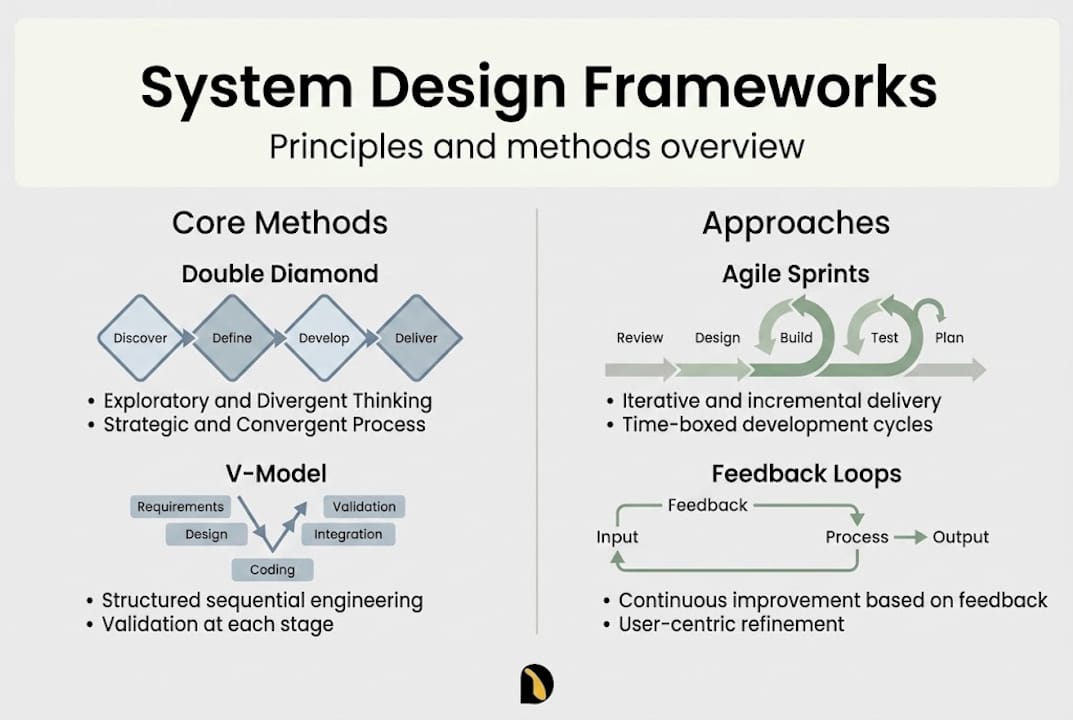
The Double Diamond framework, developed by the Design Council, organizes design activity into two sequential divergent-convergent phases: discover and define (the first diamond) and develop and deliver (the second). Its strength lies in formalizing the distinction between problem exploration and solution development, ensuring that system-level research findings directly inform design decisions rather than being filtered through assumption.
The V-model, adapted from systems engineering, structures design and validation as parallel tracks: each design decision on the left arm of the V has a corresponding validation method on the right arm. This model is particularly relevant in industrial design contexts, where physical system components must meet regulatory and performance requirements at every level of abstraction, from subsystem specifications to integrated product testing.
Circular and iterative approaches, such as Agile-influenced design sprints, introduce continuous feedback integration at shorter intervals, making them well-suited to digital product ecosystems where user behavior data is available in near real-time. These approaches align closely with the measurement pillar identified in holistic system design frameworks, reinforcing the principle that research, design, and evaluation are not sequential phases but concurrent disciplines.
The following table summarizes key frameworks and their primary application contexts:
| Framework | Primary context | Key strength |
|---|---|---|
| Double Diamond | UX and service design | Separates problem exploration from solution development |
| V-model | Industrial and systems engineering | Aligns design decisions with explicit validation criteria |
| Agile design sprints | Digital product design | Enables rapid, evidence-based iteration |
| Causal loop diagrams | Complex system modeling | Visualizes feedback dynamics and system behavior |
| Service blueprinting | Service and UX design | Maps frontstage and backstage interactions holistically |
Effective design research methods anchor all these frameworks to empirical evidence, ensuring that system models reflect observable user and environmental realities rather than internal assumptions. Similarly, a rigorous design research methodology ensures that data collection and analysis practices are appropriate to the system's complexity and the project's scope.
- Multidisciplinary collaboration: No single discipline holds all the expertise required to model a complex system accurately; structured collaboration protocols are therefore a design requirement, not an organizational preference.
- Modular component design: Building systems from clearly defined, interchangeable components reduces cascading failures and simplifies future iteration.
- Living documentation: System design artifacts (blueprints, component libraries, interaction models) must be treated as dynamic documents that evolve with the system.
Pro Tip: Establish a design validation workflow at the project's outset, linking each design decision to an explicit validation method. Teams that skip this step spend significantly more time and resources on late-stage rework when system interactions produce unexpected outcomes.
Applying system design: Practical examples and best practices
Moving from conceptual frameworks to project-level application requires deliberate structuring of both process and mindset. Two scenarios, one from UX and one from industrial design, illustrate how system design principles generate superior outcomes when rigorously applied.
UX scenario: Healthcare patient portal. A design team tasked with improving patient engagement on a digital health platform initially focused on interface usability, running standard usability tests and optimizing navigation structures. Applying system design principles, the team expanded its scope to include the clinical workflow that generates patient data, the notification system that drives portal logins, and the administrative processes that determine data accuracy. Measurement and feedback mechanisms were embedded directly into the redesign, capturing not just task completion rates but downstream outcomes such as appointment adherence and support call volume. The resulting solution reduced support calls by 34% and increased appointment adherence by 19%, outcomes that a usability-only approach would not have addressed.

Industrial design scenario: Consumer appliance lifecycle. An industrial design team developing a household appliance used a system design approach to map the product's full lifecycle: from material sourcing and manufacturing through consumer use, maintenance, and eventual disposal. By modeling the feedback between user maintenance behavior and long-term product performance, the team identified a critical design opportunity: simplified modular components that consumers could replace themselves, reducing both product failure rates and total cost of ownership. This systems-level insight was invisible when the design process focused solely on ergonomics and aesthetics.
Common mistakes in system design practice and how to avoid them:
- Isolating subsystems: Teams that optimize one component (such as a checkout flow or a single physical component) without modeling upstream and downstream interactions routinely create new system-level problems. Map all interactions before optimizing any individual element.
- Treating feedback as a post-launch activity: Feedback loop design must be embedded in the project structure from the outset, not added reactively when problems emerge.
- Underestimating collaboration costs: Multidisciplinary coordination introduces communication overhead that must be planned for explicitly; without structured collaboration protocols, teams default to siloed work.
- Over-modeling at the expense of action: System maps and causal loop diagrams are decision-support tools, not deliverables in themselves. Fix a time boundary on modeling activities to prevent analysis paralysis.
Practical steps for embedding system design thinking daily:
- Begin every project brief by asking: what systems does this artifact interact with, and what feedback loops does it participate in?
- Use design analysis methods to evaluate existing system performance before defining the design problem.
- Schedule cross-functional reviews at the close of each design phase to surface system-level interactions that discipline-specific reviews would miss.
- Document feedback loops explicitly in project records, with assigned owners responsible for monitoring each loop post-launch.
Pro Tip: Build a simple one-page system map at the start of every project. It does not need to be exhaustive; even a rough visualization of major components and their interactions surfaces critical dependencies that detailed wireframes and technical specifications routinely obscure.
Why most designers underestimate system design's impact
The professional tendency to focus narrowly on deliverables such as wireframes, component specifications, or CAD models is both understandable and consequential. Deliverables are measurable, reviewable, and billable; systemic dynamics are diffuse, slow-moving, and difficult to attribute to any single design decision. This creates a structural incentive to optimize the visible artifact and defer systemic thinking to a later phase that often never arrives.
Feedback loops and ecosystem interactions are among the most consequential yet consistently underinvested aspects of modern product design. A poorly designed feedback loop does not produce immediate failure; it produces gradual drift, accumulating friction that manifests as user churn, maintenance burden, or product obsolescence months or years after launch. By the time the systemic cause is identified, the cost of remediation has multiplied significantly.
The mindset shift required is not primarily methodological but perceptual. Effective system designers learn to read a product not as a static artifact but as a dynamic participant in a larger design analysis ecosystem, one that will behave differently as its context evolves. Adopting this perceptual framework early in a career produces compounding professional returns: every project becomes a source of systemic insight rather than an isolated deliverable.
Explore more: Cutting-edge research and resources
Deepening your practice of system design requires continuous engagement with the latest empirical research across UX, interaction design, and industrial design disciplines.
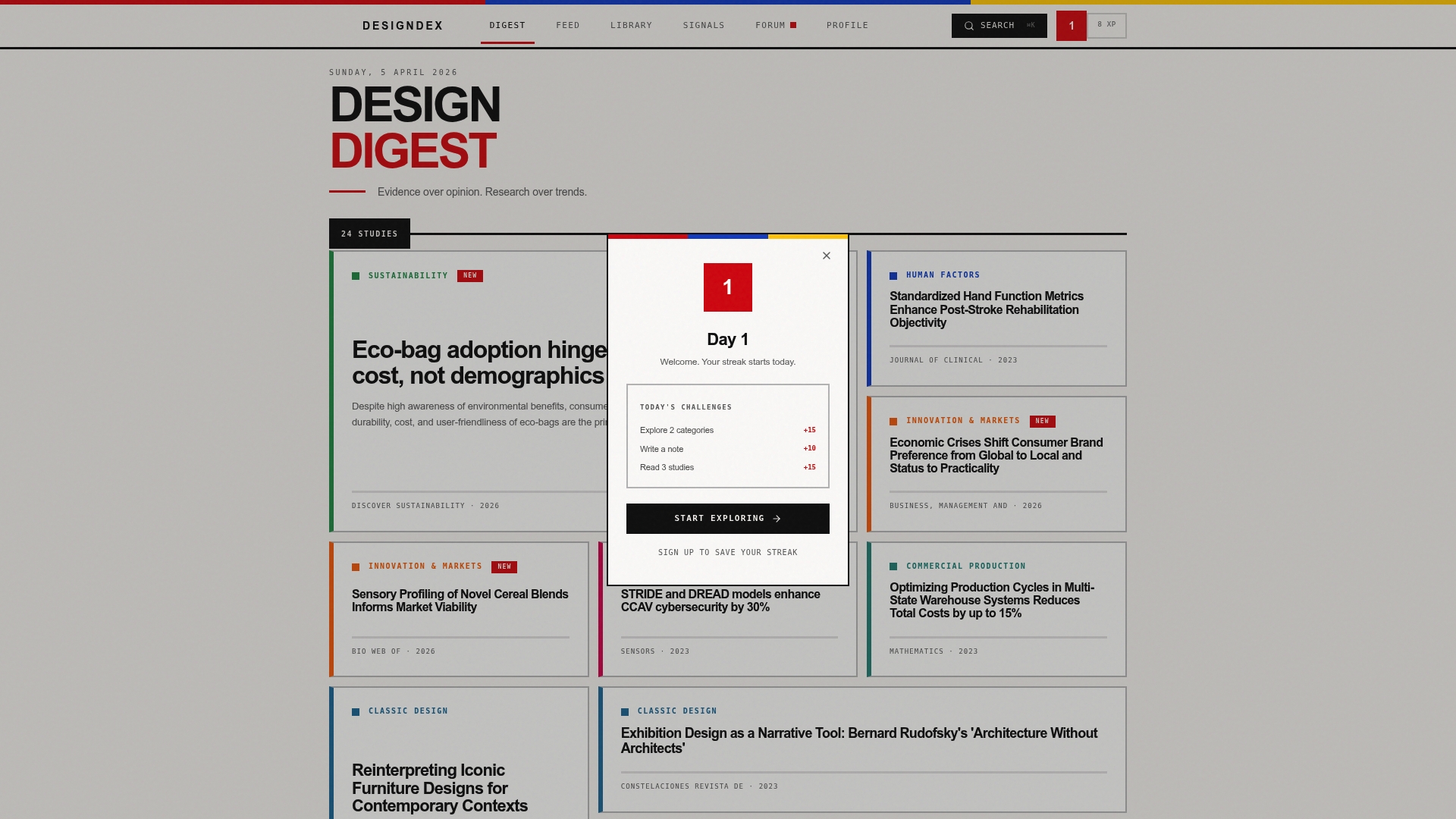
DesignDex aggregates and distills peer-reviewed studies into structured, citation-ready insights so you can apply evidence-based system design principles without reading hundreds of full papers. Explore how VR immersion enhances user empathy in design research, or examine the latest findings on how usability testing improves interface quality at a system level. Visit DesignDex to access the full research library, updated daily with structured breakdowns of aims, methods, findings, and real-world applications tailored for design professionals and students.
Frequently asked questions
What are the main pillars of system design?
The main pillars are research, design systems, UX interaction, collaboration, and measurement, as identified in holistic frameworks for modern product design. Each pillar represents a distinct but interdependent dimension of effective system design practice.
How is system design different from design thinking?
System design expands on design thinking by modeling ecosystem interactions and feedback loops, not just user-centered problem-solving processes. Design thinking addresses localized user needs; system design addresses how solutions behave within and across complex, adaptive environments.
Why are feedback loops important in system design?
Feedback loops enable designers to adapt solutions based on real-world outcomes and ongoing user input, making the overall system resilient to changing conditions. Critical ecosystem interactions are frequently overlooked in conventional design processes, producing solutions that degrade over time without traceable cause.
Can system design principles be used outside of UX or industrial design?
Yes; system design principles apply wherever holistic coordination and continuous improvement are required, including healthcare system design, organizational change management, and urban planning. The holistic frameworks with pillars underpinning the discipline are domain-agnostic and scale readily to any complex adaptive system.