

TL;DR:
- Interaction design governs how users engage with products through behaviors, feedback, and usability.
- Core principles include discoverability, feedback, consistency, and affordances, grounded in human factors research.
- Iterative testing with real users and empathy are essential for creating effective, impactful interactions.
Interaction design is frequently mischaracterized as a discipline concerned primarily with visual polish, yet its actual scope extends far beyond color palettes and typography choices. At its core, interaction design governs how users engage with digital and physical systems: the sequence of actions, the quality of feedback, the logic of navigation, and the overall usability of a product. For designers and design students seeking to build evidence-based practices, understanding interaction design as a structured, research-driven discipline is essential. This article defines the field, examines its foundational principles, traces its application across real projects, and positions it clearly among related disciplines.
Table of Contents
- What is interaction design?
- Core principles of interaction design
- How interaction design works in real projects
- Comparison: Interaction design vs. related disciplines
- Why real impact in interaction design comes from iteration and empathy
- Unlock evidence-based interaction design resources
- Frequently asked questions
Key Takeaways
| Point | Details |
|---|---|
| Interaction design defined | Interaction design focuses on shaping how users interact with systems, not just visuals. |
| Principles drive usability | Core principles like feedback and consistency are foundational to effective interaction design. |
| Human-centered approach | Applying research, usability testing, and iteration leads to designs that genuinely work for users. |
| Collaboration matters | Understanding the overlap with UX, UI, and industrial design clarifies roles for better project outcomes. |
| Evidence leads to impact | Using evidence-based insights and real-world research results in better, more effective interactive experiences. |
What is interaction design?
Interaction design (IxD) is the practice of defining and shaping the behaviors that occur between a user and a product or system. This encompasses digital products such as mobile applications, websites, and software interfaces, as well as physical products and environments where users engage with interactive elements. Critically, interaction design is not concerned with how a product looks in isolation; it is concerned with how a product responds, behaves, and communicates with the people using it.
A practical illustration: when a designer adjusts a mobile button so that it visually depresses and changes color upon touch, providing immediate confirmation of the user's action, that is interaction design in practice. The visual treatment is secondary to the behavioral logic: the system must communicate that an action has been registered, reducing uncertainty and building user confidence.
Interaction design is closely related to, but distinct from, UX design and UI design. UX design addresses the full spectrum of a user's experience, including emotional responses, satisfaction, and journey mapping across multiple touchpoints. UI design focuses on the visual and typographic elements of an interface. Interaction design sits at the intersection, governing the dynamic behaviors that connect visual elements to user goals.
The following table clarifies these distinctions:
| Discipline | Primary focus | Key outputs |
|---|---|---|
| Interaction design | User-system behaviors and responses | Interaction models, prototypes, flow diagrams |
| UX design | End-to-end user experience and satisfaction | Journey maps, personas, research reports |
| UI design | Visual presentation of interface elements | Style guides, component libraries, mockups |
| Industrial design | Form, function, and manufacturability of physical products | 3D models, material specifications, ergonomic studies |
Standards-based practice reinforces this framework. Human-centered design (ISO 9241-210) is a process standard that frames HCD as focusing on users, their needs and requirements, and applying human factors and usability knowledge throughout development for usability outcomes and evaluation. Interaction design operates squarely within this framework, prioritizing user needs as the primary driver of design decisions rather than aesthetic preference or technological capability.
Key characteristics that define interaction design as a discipline include:
- User needs as the primary driver: Design decisions are grounded in observed and validated user behaviors, not assumptions.
- Iterative refinement: Designs are tested, evaluated, and revised across multiple cycles before finalization.
- Usability as a measurable outcome: Effectiveness, efficiency, and satisfaction are quantifiable targets, not vague aspirations.
- Behavioral logic over visual logic: The sequence and quality of interactions take precedence over surface-level styling.
Applying human-centered design tips throughout the design process ensures that interaction design decisions remain grounded in evidence rather than intuition.
"Good interaction design is invisible to the user. When it fails, every friction point becomes visible."
Core principles of interaction design
Now that the boundaries are clear, it is time to explore the core principles that make interaction design effective. These principles are not arbitrary conventions; they are derived from decades of human factors research, usability studies, and iterative practice across industries.
Discoverability refers to the degree to which users can determine what actions are possible and how to perform them without external guidance. A well-designed interface surfaces its capabilities naturally, allowing users to explore with confidence rather than confusion. When discoverability is poor, users abandon tasks, make errors, or require costly support interventions.
Feedback is the mechanism by which a system communicates the result of a user's action. Feedback can be visual (a button state change), auditory (a confirmation tone), haptic (a vibration on a mobile device), or textual (an error message). The absence of timely, clear feedback is one of the most consistently cited sources of user frustration in usability research.

Consistency ensures that similar actions produce similar results across a product or system. Inconsistency forces users to relearn behaviors, increases cognitive load, and erodes trust. Consistency applies at multiple levels: within a single interface, across a product family, and in alignment with platform conventions that users bring from prior experience.
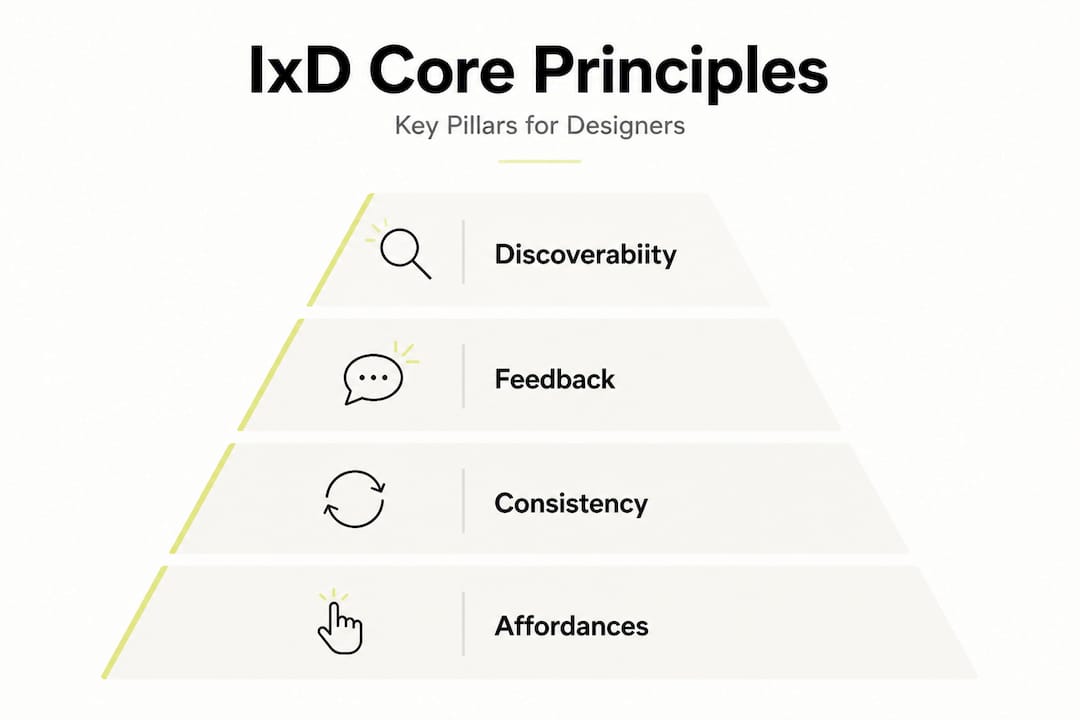
Affordances are the perceived and actual properties of an object that signal how it should be used. A button that appears raised affords pressing; a slider affords dragging. Effective interaction design leverages affordances to guide user behavior without requiring explicit instruction.
Beyond these four principles, effective interaction design integrates human factors knowledge, including cognitive load management, error prevention and recovery, and accessibility considerations, throughout the design process. Applying human factors and usability knowledge throughout development for usability outcomes and evaluation is not optional; it is the methodological backbone of rigorous interaction design practice.
Developing design intelligence in this area means treating usability as a continuous variable to be optimized, not a checkbox to be ticked at the end of a project. Designers who internalize this mindset approach each design decision as a hypothesis to be tested rather than a conclusion to be defended.
Pro Tip: Involve users in testing as early as the paper prototype stage. Early-stage usability testing research consistently demonstrates that identifying interaction failures before high-fidelity development saves significant time and resource expenditure. A five-user moderated session at the wireframe stage frequently surfaces more actionable insights than a polished prototype tested with twenty users after development.
"Usability knowledge applied throughout development, not retrofitted at the end, is what separates functional products from genuinely effective ones."
The practical implication for designers is clear: treat each of these principles as a lens through which every design decision is evaluated. Ask whether a proposed interaction is discoverable, whether it provides adequate feedback, whether it is consistent with established patterns, and whether its affordances accurately signal the intended behavior.
How interaction design works in real projects
With principles in hand, let us look at how interaction design comes to life in a typical project. The process is neither linear nor sequential in the rigid sense; it is iterative, evidence-driven, and responsive to findings at each stage.
A structured interaction design process generally follows these stages:
- Research and discovery: Identify user needs, behaviors, and pain points through contextual inquiry, interviews, surveys, and analysis of existing usage data. This stage establishes the evidence base that informs all subsequent decisions.
- Ideation and concept development: Generate multiple interaction models and behavioral frameworks that address identified user needs. Sketching, storyboarding, and collaborative workshops are common tools at this stage.
- Prototyping: Translate interaction concepts into testable artifacts, ranging from low-fidelity paper prototypes to interactive digital mockups. The fidelity of the prototype should match the questions being investigated.
- Usability testing: Observe real users engaging with the prototype under realistic conditions. Collect both quantitative data (task completion rates, error frequencies, time-on-task) and qualitative data (verbal protocols, observed confusion, expressed preferences).
- Evaluation and iteration: Analyze testing findings, identify interaction failures and opportunities, and revise the design accordingly. Return to prototyping and testing as many times as the evidence requires.
A concrete example illustrates this cycle effectively. A product team designing a mobile banking application identified through initial research that users were frequently abandoning the fund transfer flow at the confirmation step. Ideation generated three alternative confirmation interaction models. Prototyping produced interactive mockups of each. Usability testing with twelve participants revealed that two of the three models created confusion around the directionality of the transfer (who was sending to whom). The third model, which used a spatial layout mirroring the user's mental model of "moving money from left to right," achieved a 94% task completion rate with no directional errors. Iteration refined the visual feedback at the completion state, and the final design was validated in a second testing round before development.
This example demonstrates the critical role of HCD as focusing on users, their needs and requirements, and applying human factors and usability knowledge throughout development, rather than relying on designer intuition or stakeholder preference.
Consulting established design research methods at each stage of the process ensures that decisions are grounded in validated evidence rather than assumptions.
Pro Tip: Define measurable usability outcomes (specific task completion rates, maximum acceptable error frequencies, target satisfaction scores) at the project outset. Teams that establish these benchmarks before ideation begins are significantly less likely to encounter late-stage redesigns, because success criteria are objective and agreed upon rather than subjective and contested.
Comparison: Interaction design vs. related disciplines
To fully leverage interaction design, it is important to recognize how it compares and connects with other design disciplines. Role clarity enables more effective collaboration, reduces scope conflicts, and ensures that each discipline's expertise is applied where it delivers the greatest value.
| Discipline | Core question | When to involve | Primary methods |
|---|---|---|---|
| Interaction design | How do users interact with the system? | Throughout, from concept to evaluation | Prototyping, usability testing, interaction modeling |
| UX design | What is the quality of the overall user experience? | From project initiation through post-launch | Journey mapping, user research, satisfaction measurement |
| UI design | How should interface elements be visually presented? | During detailed design and component development | Visual design, style guides, accessibility auditing |
| Industrial design | How should a physical product be formed and manufactured? | During concept and detailed physical design | Ergonomic analysis, materials specification, 3D modeling |
Overlap between these disciplines is both inevitable and productive. Interaction designers and UX designers frequently collaborate on user research and evaluation; interaction designers and UI designers share responsibility for component behavior and visual feedback states; interaction designers and industrial designers work together on physical products with embedded digital interfaces, such as medical devices, automotive controls, and smart home systems.
HCD as focusing on users, their needs and requirements, and applying human factors and usability knowledge is a principle that cuts across all four disciplines, providing a shared methodological foundation even where specific outputs and tools differ.
Essential skills that distinguish interaction designers from practitioners in adjacent roles include:
- Behavioral modeling: The ability to map and anticipate user action sequences, error states, and edge cases across complex interaction flows.
- Prototype fidelity judgment: Knowing when a low-fidelity prototype is sufficient and when higher fidelity is required to generate valid test data.
- Usability heuristic application: Systematic evaluation of designs against established usability principles (such as Nielsen's ten heuristics) to identify interaction failures before user testing.
- Quantitative usability analysis: Interpreting task completion data, error rates, and efficiency metrics to prioritize design revisions.
- Cross-disciplinary communication: Translating interaction requirements into terms that UX researchers, UI designers, engineers, and product managers can act upon.
Conducting thorough design analysis for better results across these disciplines enables teams to allocate expertise strategically and avoid the costly overlaps and gaps that arise when role boundaries are poorly defined.
Why real impact in interaction design comes from iteration and empathy
Having covered the frameworks, here is a perspective that is rarely discussed with sufficient candor in design education or professional literature.
Most designers, including experienced ones, significantly underestimate the number of iterations required to achieve genuinely effortless interactions. The first prototype is almost never right. The second is closer. The fifth begins to approach something that real users can navigate without friction. This is not a failure of skill; it is the nature of the discipline. Interaction design operates at the intersection of human cognition, context, and technology, three variables that resist precise prediction.
Empathy, in this context, is not a soft skill or a values statement. It is a rigorous practice: sitting with users, observing where they pause, where they misread affordances, where they express frustration or relief. These moments of observation are where the real design work happens, not in the studio, not in the design review, and certainly not in the stakeholder presentation. Teams that substitute empathy with assumption, however well-intentioned, consistently produce products that perform adequately in controlled conditions and fail in the field.
Consider a scenario that repeats across the industry with notable regularity: a design team produces a prototype that satisfies every heuristic, passes internal review, and receives enthusiastic stakeholder approval. It is, by every internal measure, a success. Then it reaches real users. The navigation model that seemed intuitive to the design team, who built it and therefore understand its logic implicitly, proves opaque to users who encounter it without that context. The feedback states that seemed adequate in isolation are missed entirely under realistic environmental conditions. The error recovery flow that was designed for the expected error turns out to be irrelevant because users make a completely different error that no one anticipated.
This scenario is not exceptional. It is the norm. The solution is not more sophisticated design tools or more rigorous heuristic evaluation, though both have value. The solution is sustained, honest engagement with real users across multiple testing cycles, combined with the humility to revise designs that the team has invested significant effort in creating.
Applying advanced human-centered processes consistently, rather than selectively, is what separates interaction design that achieves measurable impact from interaction design that achieves only aesthetic approval. Humility and openness to evidence are not supplementary virtues in this discipline; they are its operational core.
Unlock evidence-based interaction design resources
If you are ready to level up your practice with research-driven insights, here is how DesignDex can help.
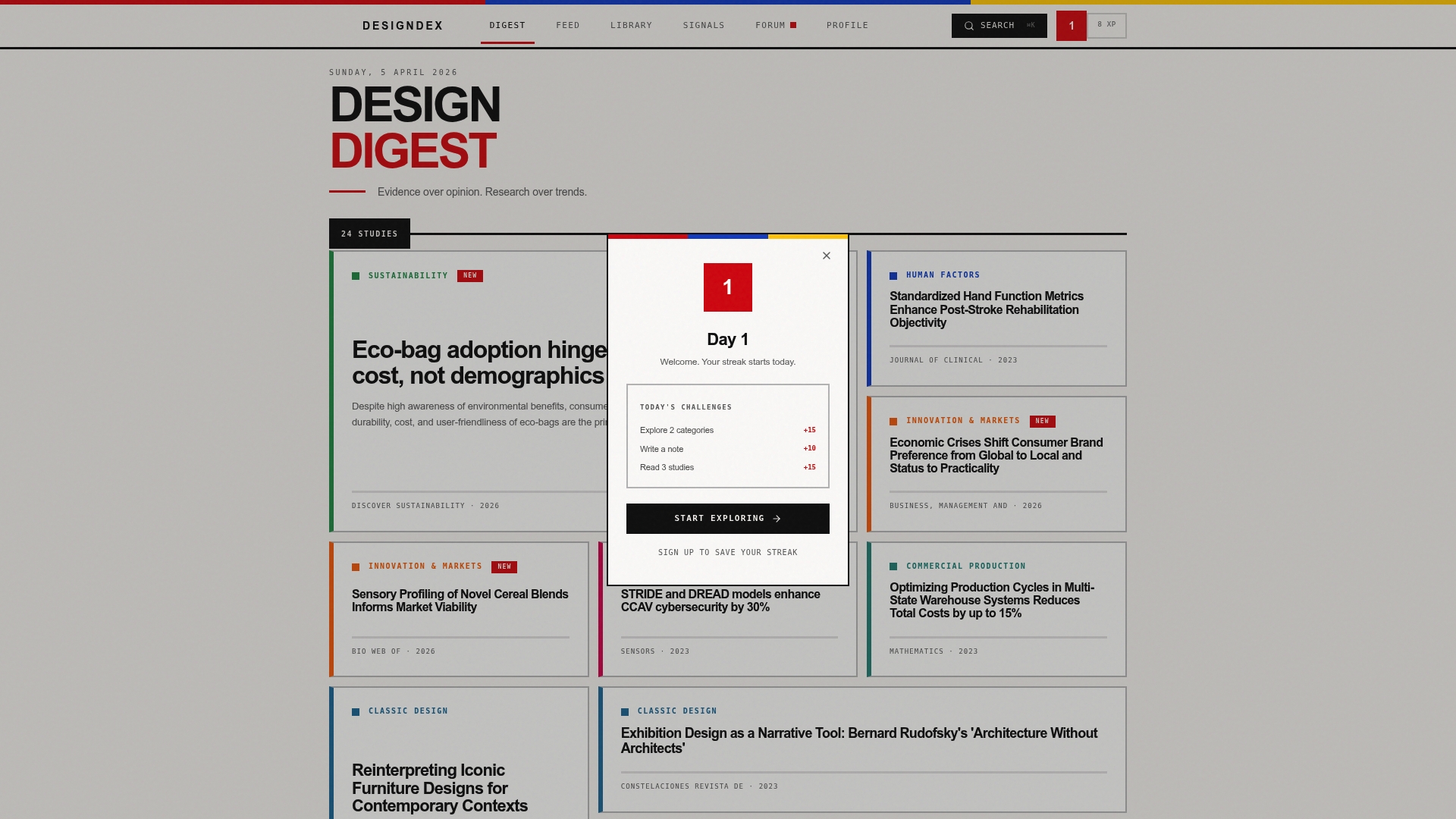
DesignDex aggregates and distills peer-reviewed studies in UX and interaction design into structured, actionable breakdowns covering aims, methods, findings, and real-world applications. Instead of navigating full academic papers, you access citation-ready insights organized for direct application to your projects. The Design Digest updates daily, surfacing emerging research and design signals relevant to practicing designers and students. For deeper trend analysis and pattern recognition across the research landscape, Signals research provides curated intelligence that supports evidence-based decision-making at every project stage. Build your practice on validated knowledge, not intuition.
Frequently asked questions
How does interaction design differ from UX design?
Interaction design focuses specifically on how users interact with products, defining behaviors, feedback states, and action sequences, while UX design addresses the complete user journey, including emotional responses, satisfaction, and multi-touchpoint experience quality.
Why is human-centered design important in interaction design?
Human-centered design ensures that interactive systems are built around validated user needs and requirements, applying human factors and usability knowledge throughout development to produce measurable usability outcomes rather than assumed ones.
What is an example of a good interaction design practice?
Providing clear, immediate visual feedback after a user action, such as a button changing state upon click or tap, directly reduces uncertainty and improves task completion rates by confirming that the system has registered the input.
Is interaction design only for digital products?
No; interaction design applies equally to physical products, built environments, and services wherever users engage with interactive systems, including medical devices, automotive controls, smart appliances, and public information kiosks.