

TL;DR:
- Human-centered design emphasizes user needs, system context, and measurable outcomes over aesthetics.
- It involves an iterative process of planning, understanding, specifying requirements, designing, and evaluating with real users.
- HCD broadens UCD by including all stakeholders, ethical considerations, and lifecycle sustainability, reducing risky assumptions.
Many practitioners assume design begins and ends with visual output: color palettes, typography, and layout. That assumption consistently produces systems that look refined but fail under actual conditions of use. Human-centered design fundamentally reorients the design process around users, their contexts, and measurable outcomes rather than aesthetic intent. This article examines HCD's definition, its ISO-standardized process, how it diverges from user-centered design (UCD), how it operates in both UX and industrial design workflows, and where expert practitioners find its most persistent challenges.
Table of Contents
- Defining human-centered design: More than just usability
- The human-centered design process: From context to evaluation
- How human-centered design differs from user-centered design
- Practical applications: Human-centered design in UX and industrial design
- Expert insights: Addressing challenges and advancing your HCD practice
- Perspective: What most design guides miss about human-centered design
- Advance your human-centered design practice with DesignDex
- Frequently asked questions
Key Takeaways
| Point | Details |
|---|---|
| HCD centers on users | Successful design starts with user needs, not just aesthetics or features. |
| Process is iterative | Effective outcomes come from repeated testing, feedback, and adaptation at each design stage. |
| Scope is broad | HCD considers stakeholders, ethical impact, and product lifecycle—beyond direct user experience. |
| Practical impact proven | Integrating HCD in UX and industrial design leads to safer, more satisfying, and sustainable results. |
Defining human-centered design: More than just usability
Human-centered design is not a stylistic preference or a project phase. It is a systems-level approach with defined objectives, evidence-based methods, and verifiable outcomes. Per ISO 9241-210:2019, HCD focuses on users, their needs and requirements, and applies human factors and ergonomics throughout the full design and development lifecycle. The goal is to produce systems that are simultaneously usable, useful, and satisfying.
These three properties are distinct and carry different evaluative weight:
- Usability: Can users complete tasks accurately, efficiently, and without frustration?
- Usefulness: Does the system solve the right problem in the right context?
- Satisfaction: Does the experience generate positive affect and trust over repeated use?
ISO 9241-210 extends the scope further to include accessibility (ensuring equity across diverse populations) and sustainability (considering long-term system effects on individuals and communities). This scope distinguishes HCD from narrow interface optimization.
"Human-centered design is an approach to system design and development that aims to make interactive systems more usable by focusing on the use of the system and applying human factors/ergonomics and usability knowledge and techniques." — ISO 9241-210:2019
The practical implication is significant. When design analysis in UX is conducted through an HCD lens, the findings extend beyond interface metrics. Teams investigate environmental constraints, social dynamics, and error recovery behaviors that visual-only design processes routinely ignore. The result is a substantially richer requirements base before any solution is proposed.
For design students, this reframing is often counterintuitive. Visual training emphasizes output quality. HCD reorients attention toward input quality: the accuracy and depth of what is understood about users before design decisions are made. Practitioners who internalize this shift, and apply human-centered design principles from project initiation, consistently produce solutions with lower post-launch remediation costs and higher adoption rates.
The human-centered design process: From context to evaluation
The ISO 9241-210 standard specifies five core HCD activities that form an iterative cycle rather than a linear sequence. Understanding both the sequence and the iterative logic is essential for effective application.
- Plan the HCD process: Define scope, assign roles, and establish methods appropriate to the project's risk level and timeline.
- Understand and specify the context of use: Document user characteristics, tasks, goals, equipment, and the physical and social environments in which use occurs.
- Specify user requirements: Translate contextual findings into measurable criteria that solutions must satisfy.
- Produce design solutions: Generate prototypes, wireframes, or physical models that address specified requirements.
- Evaluate against requirements: Test solutions with real users; identify gaps and feed findings back into earlier stages.
Per ISO 9241-210 activities, the process is explicitly iterative: evaluation outcomes routinely trigger re-specification of requirements or additional context research before a solution advances.
The following table summarizes key outputs at each stage:
| HCD stage | Primary output | Evaluation criterion |
|---|---|---|
| Plan | HCD project plan | Feasibility and resource alignment |
| Context of use | Context description document | Completeness and accuracy |
| User requirements | Requirements specification | Measurability and traceability |
| Design solutions | Prototypes or models | Fidelity appropriate to test objectives |
| Evaluation | Usability test report | Alignment with specified requirements |
A critical point for practitioners: requirements specified without genuine contextual research tend to reflect stakeholder assumptions rather than user realities. Integrating essential design research methods at stage two, including contextual inquiry, diary studies, and task analysis, generates requirements that withstand evaluation scrutiny.

Pro Tip: Recruit real users for contextual sessions as early as stage two. Even three to five unstructured interviews consistently surface constraints that no amount of stakeholder workshops will reveal, and those constraints shape every downstream decision.
How human-centered design differs from user-centered design
User-centered design (UCD) is frequently treated as synonymous with HCD. The distinction matters, particularly as design projects scale in social complexity or ethical consequence.
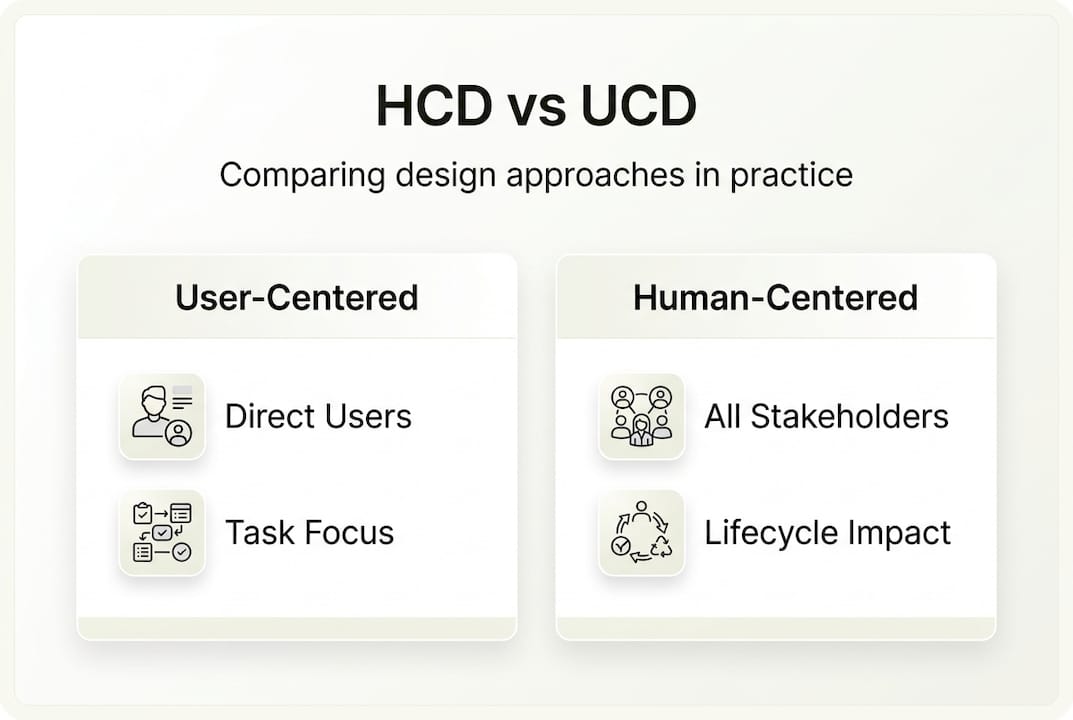
UCD focuses primarily on the direct user: their task performance, error rates, and satisfaction with an interface or product. It is effective for optimizing specific interaction sequences and has a well-established evidence base in usability research. However, UCD's scope is bounded by the user's direct experience.
HCD is broader than UCD, explicitly incorporating all stakeholders affected by a system, including those who do not directly operate it. A hospital information system, for example, affects patients, clinicians, administrators, and families. UCD might optimize the clinician interface; HCD would require accounting for how the system's outputs affect patient safety, administrative burden, and family communication.
Key differences between HCD and UCD:
- Scope of stakeholders: UCD addresses direct users; HCD addresses all affected parties.
- Ethical considerations: HCD explicitly requires evaluation of social and ethical system impacts; UCD does not mandate this.
- Lifecycle span: HCD extends consideration to system decommissioning and long-term environmental effects; UCD typically terminates at product launch.
- Sustainability: HCD integrates sustainability criteria into requirements; UCD treats sustainability as optional.
| Dimension | User-centered design | Human-centered design |
|---|---|---|
| Primary focus | Direct user interaction | All stakeholders and system impacts |
| Ethical scope | Optional | Mandated by ISO 9241-210 |
| Sustainability | Not required | Integrated into requirements |
| Lifecycle coverage | Use phase | Full lifecycle including decommission |
For practitioners working in design intelligence applications, this distinction directly shapes project scoping. Choosing HCD over UCD when social or ethical complexity is present is not a philosophical preference: it is a risk management decision that reduces the probability of harmful unintended consequences.
Practical applications: Human-centered design in UX and industrial design
HCD's theoretical framework generates concrete, replicable workflows in both digital and physical design domains. The methods differ by medium; the underlying logic remains consistent.
In UX practice, a standard HCD-informed workflow proceeds as follows:
- Conduct contextual inquiry and user interviews to build an accurate context of use description.
- Synthesize findings into user requirements, prioritized by frequency and severity of need.
- Produce low-fidelity prototypes and conduct formative usability testing with representative users.
- Iterate based on test findings; increase prototype fidelity progressively.
- Conduct summative evaluation against the original requirements specification before release.
In industrial design, HCD introduces physical ergonomics analysis, safety requirement specification, and long-term use satisfaction as formal inputs. Products designed without this rigor frequently generate post-market corrective actions that are substantially more expensive than the research that would have prevented them.
Two evidence-based applications illustrate HCD's advantage in extending empathy beyond assumptions. VR immersion in design research demonstrates that simulating user contexts through virtual reality significantly enhances designer empathy, producing requirements that better reflect the lived constraints of target populations. Separately, structured usability testing protocols demonstrate measurable improvements in interface quality when testing is embedded at multiple points in the design cycle rather than confined to pre-launch validation.
HCD integration with Agile and systems development lifecycle (SDLC) frameworks delivers better outcomes precisely because it introduces user evidence at sprint intervals, preventing requirement drift and reducing rework cycles.
Pro Tip: Map HCD evaluation activities to Agile sprint review cycles. This creates a rhythmic validation cadence that catches usability failures when correction costs are lowest, before sprint outputs accumulate into a product that requires wholesale redesign.
Researchers and practitioners who want superior UX outcomes consistently report that early, frequent user contact, even in low-fidelity forms, produces requirements that no secondary research method fully replicates.
Expert insights: Addressing challenges and advancing your HCD practice
Applying HCD at scale introduces organizational and methodological challenges that process diagrams rarely capture. The most persistent of these is the reduction of user research to symbolic activity: workshops that produce personas no one references, journey maps that satisfy a deliverable requirement without informing a single design decision.
Context descriptions and prototypes prevent "persona theater" precisely because they are outputs tied to evaluation criteria. A persona that cannot be traced to a specific contextual finding or a measurable user requirement is a creative artifact, not an HCD output. The standard requires traceability from context research to requirements to design decisions to evaluation findings.
Advancing HCD practice requires attention to several interconnected factors:
- Multidisciplinary team composition: Effective HCD integrates cognitive scientists, engineers, industrial designers, domain experts, and end users as active participants, not passive informants.
- Ethical review at requirements stage: Social impact, data privacy, and accessibility must be specified as requirements before design begins, not added as post-hoc features.
- Sustainability via lifecycle consideration: Nature-informed design approaches demonstrate that embedding sustainability criteria at the requirements stage, rather than retrofitting them, produces substantially lower environmental burdens across product lifecycles.
- Evaluation rigor: Formative testing at low fidelity, combined with summative testing at high fidelity, generates the evidence base required to justify design decisions to stakeholders.
"The outputs of the HCD process, including context of use descriptions, user requirements, prototypes, and evaluation reports, form a traceable evidence chain that replaces assumption with verified knowledge." — HCD practitioner synthesis
Organizations that treat HCD as a checklist invariably produce systems that satisfy the form of the process without capturing its function. The discipline's value lies in the quality of evidence generated at each stage, not in the completion of stage activities.
Perspective: What most design guides miss about human-centered design
Most HCD guides focus on tools and stages. The uncomfortable reality practitioners encounter, after repeated application across diverse project types, is that the process itself is not the limiting factor. Teams that follow every ISO activity and still produce inadequate outcomes share a common failure: they optimize for the appearance of user engagement rather than the quality of evidence it generates.
Stakeholder workshops, persona creation sessions, and empathy map exercises can all be conducted with technical correctness while producing zero actionable insight. The distinction between authentic user engagement and performative research is not visible in a process diagram. It is visible only in whether design decisions change as a result of what users actually say and do.
Evidence-driven iteration, not methodological adherence, is the cornerstone of HCD's value. Real empathy in design is not a disposition acquired through persona creation. It accumulates through repeated exposure to users failing, succeeding, and behaving in ways no stakeholder predicted. Practitioners who log hours in observation sessions rather than conference rooms consistently produce work that survives contact with its intended users.
Advance your human-centered design practice with DesignDex
Moving from HCD principles to consistent practice requires access to current, peer-reviewed evidence rather than practitioner folklore. DesignDex aggregates and distills research specifically to support that transition.
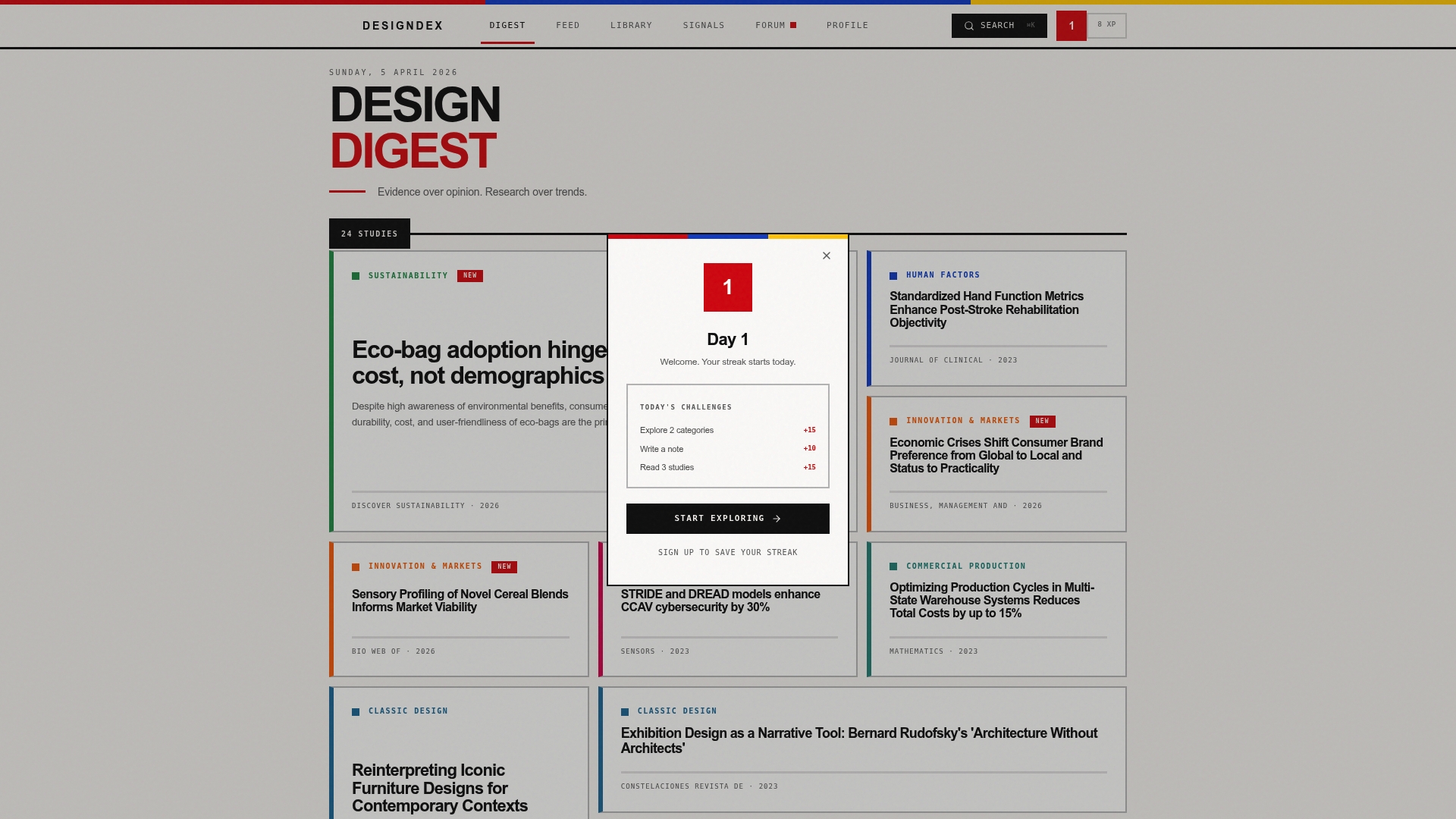
Explore structured breakdowns of studies such as usability testing research and VR empathy research to understand how methodological choices affect design outcomes across domains. Each study on DesignDex is presented with aims, methods, findings, and real-world applications, giving you citation-ready evidence to justify design decisions to clients, stakeholders, and review boards. Updated daily, the platform surfaces emerging signals before they become industry consensus.
Frequently asked questions
How does human-centered design improve product outcomes?
HCD makes systems usable and useful by grounding design decisions in verified user needs rather than assumptions, which reduces post-launch remediation and increases adoption. Effectiveness, efficiency, and satisfaction are the measurable outcomes this approach is specifically engineered to optimize.
What are the main steps in the human-centered design process?
The five core HCD activities per ISO 9241-210 are: plan the process, understand and specify the context of use, specify user requirements, produce design solutions, and evaluate against requirements with iteration. Each stage produces traceable outputs that feed the next.
How is human-centered design different from user-centered design?
HCD's broader scope includes all stakeholders, ethical considerations, sustainability, and full lifecycle impacts, whereas UCD concentrates primarily on optimizing direct user task performance and interface usability.
What are common pitfalls in human-centered design?
The most frequent failure is "persona theater": generating user artifacts that satisfy a deliverable requirement without informing design decisions, which context descriptions and prototypes are specifically designed to prevent through traceable evidence chains.
Can HCD be integrated with Agile or other modern development processes?
Yes; HCD integrates with Agile and SDLC frameworks by mapping evaluation activities to sprint cycles, enabling multidisciplinary teams to introduce user evidence at intervals that prevent requirement drift and reduce rework.