

TL;DR:
- Human factors engineering reduces errors by 50 to 80 percent in complex systems.
- Designing for diverse conditions and users prevents performance degradation and safety risks.
- Embedding user research throughout the design process improves safety, efficiency, and satisfaction.
Over 80% of incidents in complex systems trace back to human error, not equipment failure or software bugs. Yet many design professionals still treat human factors as an afterthought, a box to check rather than a foundational discipline. This assumption is costly. Human factors engineering (HFE) is the systematic study of how people interact with systems, tools, and environments, and it directly determines whether a design succeeds or fails in the real world. This guide clarifies what human factors actually means, outlines its core principles and methodologies, and demonstrates its measurable impact on safety, efficiency, and user satisfaction across industries.
Table of Contents
- What are human factors? Defining the field and its purpose
- Core principles and methodologies of human factors
- The impact: Why human factors matter in design
- Challenges and edge cases in human factors
- Why 'common sense' fails: A practitioner's view on human factors
- Take your designs further with DesignDex research and tools
- Frequently asked questions
Key Takeaways
| Point | Details |
|---|---|
| Human error is widespread | More than 80% of failures in complex systems result from human factors, not technology. |
| Human factors boost outcomes | Designing with human factors can cut error rates in half and raise user satisfaction. |
| Principles guide effective design | User-centered design, systems thinking, and error prevention are core to successful projects. |
| Real-world stressors are critical | Addressing fatigue, multitasking, and diversity ensures inclusive and safe solutions. |
| Testing reveals the unexpected | User research and testing are essential for identifying needs your intuition might miss. |
What are human factors? Defining the field and its purpose
Human factors is frequently conflated with ergonomics or dismissed as common sense. In practice, it is neither. Human factors engineering is a multidisciplinary field applying psychology, physiology, engineering, and design to optimize human-system interactions. The terms "human factors," "HFE," and "ergonomics" are often used interchangeably, though ergonomics traditionally emphasizes physical fit between people and their environments, while HFE encompasses cognitive, organizational, and systems-level considerations as well.
The field draws on contributions from multiple disciplines:
- Cognitive psychology: Understanding perception, memory, attention, and decision-making under load
- Physiology and biomechanics: Mapping physical capabilities, reach envelopes, and fatigue thresholds
- Systems engineering: Analyzing how components interact and where failures propagate
- Industrial and UX design: Translating research findings into tangible product and interface solutions
The primary goals of HFE are safety, efficiency, and user satisfaction. Safety means reducing the probability of error-induced harm; efficiency means minimizing unnecessary cognitive and physical effort; satisfaction means producing interactions that users find intuitive and rewarding. These goals are interdependent: a system that frustrates users tends to generate workarounds, and workarounds introduce errors.
"Human factors engineering is not about designing for the average user. It is about designing for the full range of human variability, including the stressed, distracted, and fatigued user."
The role of human factors extends from consumer electronics and vehicle interiors to surgical instruments and air traffic control interfaces. Every design decision, from button placement to alarm frequency, carries a human factors implication. Recognizing this early in a project prevents costly redesigns and, in safety-critical contexts, prevents harm.
| Domain | Focus area | Example application |
|---|---|---|
| Cognitive ergonomics | Mental workload, decision-making | Dashboard information hierarchy |
| Physical ergonomics | Posture, force, reach | Tool handle geometry |
| Organizational HFE | Team communication, workflow | Surgical team protocols |
| Environmental design | Lighting, noise, temperature | Control room layout |
Core principles and methodologies of human factors
Now that you know what human factors is, the next questions are: what guides this field and how do you put those ideas to work in your projects? Several foundational principles structure HFE practice. User-centered design places the user's capabilities and limitations at the center of every decision. Systems thinking recognizes that no component operates in isolation; a change in one element ripples through the entire system. Error prevention prioritizes design solutions that make mistakes difficult or impossible, rather than relying on user vigilance. Feedback ensures users receive timely, accurate information about system states and the consequences of their actions.
Core methodologies include task analysis, cognitive modeling, usability testing, heuristic evaluation, iterative design, simulation, and prototyping. Each method serves a distinct purpose within the design process:
- Task analysis: Deconstructs user workflows to identify steps, dependencies, and potential failure points
- Cognitive modeling: Predicts how users will process information and make decisions under varying conditions
- Usability testing: Observes real users interacting with prototypes to surface friction and confusion
- Heuristic evaluation: Applies established usability principles to audit interfaces without live users
- Simulation and prototyping: Tests designs in controlled, realistic scenarios before deployment
For practical guidance on integrating these methods into your workflow, design analysis in UX and human-centered design tips offer structured frameworks grounded in current research.
| Methodology | Primary benefit | Best applied when |
|---|---|---|
| Task analysis | Reveals hidden workflow gaps | Early requirements phase |
| Usability testing | Validates real-world behavior | Mid to late prototype stage |
| Heuristic evaluation | Fast, low-cost audit | Limited time or budget |
| Cognitive modeling | Predicts mental workload | Safety-critical interface design |
Understanding what is human factors engineering? in full scope helps clarify which methodology fits which design challenge.
Pro Tip: When timelines are tight and budgets are constrained, usability testing with as few as five representative users consistently surfaces the majority of critical design flaws. Prioritize it over documentation reviews every time.
The impact: Why human factors matter in design
With the principles and methods in mind, let's explore just how much human factors can change real-world results, and the risks of ignoring them. The evidence is unambiguous: HFE reduces error rates by 50 to 80% in complex systems where human error contributes to more than 80% of incidents. These are not marginal improvements; they represent the difference between functional systems and catastrophic failures.
Industry-specific outcomes reinforce this data:
- Healthcare: Redesigned medication labeling and infusion pump interfaces have reduced dosing errors by measurable margins in clinical trials
- Aviation: Cockpit redesigns informed by cognitive task analysis contributed to significant reductions in controlled flight into terrain incidents
- Manufacturing: Workstation ergonomic interventions reduced musculoskeletal injury rates and associated productivity losses
- Digital products: Usability testing for interface quality demonstrates that iterative usability improvements directly correlate with higher task completion rates and lower support costs
The consequences of ignoring human factors are equally well-documented. Poor interface design in medical devices has contributed to patient harm events. Confusing alarm systems in industrial facilities have delayed emergency responses. Poorly designed vehicle controls have increased accident rates. The human factors research starter from EBSCO provides a thorough overview of documented failure cases across these sectors.

Beyond safety, the economic argument is compelling. Redesigning a product post-launch to address human factors deficiencies costs orders of magnitude more than integrating HFE from the outset. Studies in software development estimate that fixing a usability issue in production costs 100 times more than addressing it during the design phase.
The value of ergonomics in operations is similarly documented in maritime contexts, where human factors interventions have reduced fatigue-related navigation errors and improved crew performance under demanding conditions.
Pro Tip: Even incremental ergonomic adjustments, such as repositioning a control by a few centimeters or adjusting display contrast, can reduce workplace injury rates by up to 50% in repetitive-task environments. The return on investment for these changes is typically realized within one operational cycle.
Challenges and edge cases in human factors
Real-world design is rarely straightforward. Let's dig into what happens when you tackle unusual scenarios and diverse user needs. One of the most persistent gaps in HFE practice is the underrepresentation of edge cases during testing. Design teams frequently test with users who are alert, motivated, and demographically similar to themselves, then release products into environments populated by fatigued, stressed, and cognitively overloaded users.
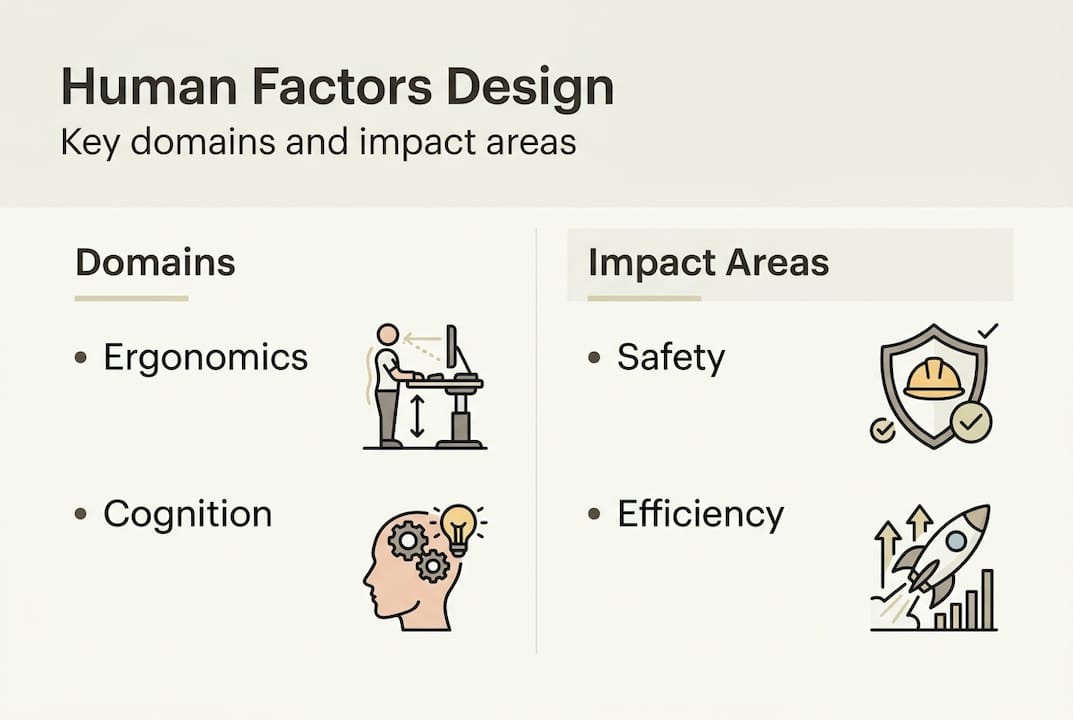
Edge cases in human factors encompass physical demands, fatigue, stress, multitasking, interruptions, and diverse user populations defined by cultural background and anthropometric variation. These are not rare scenarios; they are routine conditions for many users. Ignoring them produces designs that function adequately in lab conditions but degrade rapidly in deployment.
Key challenges include:
- Cognitive stressors: Time pressure, information overload, and interruptions degrade decision-making quality; designs must account for reduced cognitive capacity, not peak performance
- Physical diversity: Anthropometric data reveals substantial variation in body dimensions across global populations; a grip optimized for one demographic may be unusable or injurious for another
- Cultural variation: Iconography, color conventions, and interaction metaphors carry different meanings across cultures; what signals "stop" in one context may signal "proceed" in another
- Extreme workloads: Testing only under moderate conditions misses failure modes that emerge under high-stress, low-visibility, or time-critical scenarios
"Designing for the average user is designing for nobody. The edges of your user population reveal the structural weaknesses of your design."
Methodologies such as participatory design for user satisfaction and VR for empathy in design offer structured approaches for expanding the representativeness of your testing population and simulating conditions that are difficult to replicate in standard usability labs. Consulting an edge case testing guide can also help teams systematize boundary condition testing before deployment.
Why 'common sense' fails: A practitioner's view on human factors
The most dangerous assumption in design practice is that good judgment and professional experience are sufficient substitutes for structured human factors research. This belief is pervasive, and it is consistently disproven by empirical evidence. Experienced designers carry cognitive biases shaped by their own capabilities, cultural context, and interaction histories. These biases are invisible from the inside.
Generic best practices compound the problem. Applying a checklist of usability heuristics without contextual testing produces designs that satisfy the checklist while failing the user. The checklist was derived from prior research; your product exists in a specific context with specific users, and those specifics matter enormously.
Testing with real users breaks assumptions that no amount of expert review can surface. Users interact with interfaces in ways that designers do not anticipate, and those unanticipated interactions reveal the actual cognitive model users bring to the product, not the model the designer intended. This is why the design intelligence guide advocates for embedding research into every phase of the design process, not just validation at the end.
Integrating human factors upstream, during problem framing and concept development, is the single most cost-effective intervention available to design teams. It is not a phase; it is a posture.
Take your designs further with DesignDex research and tools
Applying human factors effectively requires access to current, evidence-based research, not just foundational principles. DesignDex aggregates and distills peer-reviewed studies in UX and industrial design into structured, citation-ready insights that support decision-making at every stage of the design process.
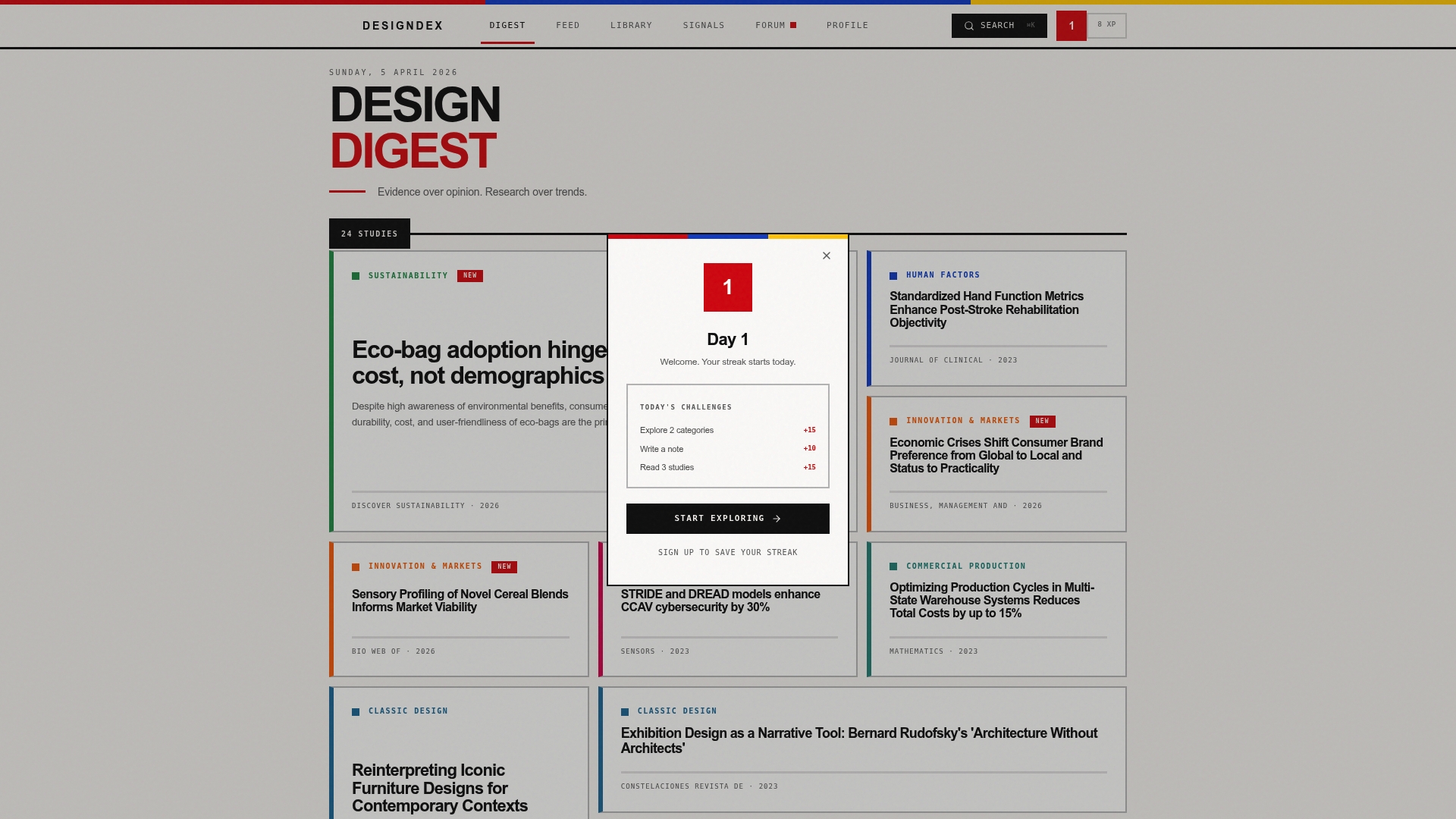
Explore studies such as usability testing research and VR empathy design study to see how leading researchers are operationalizing human factors principles in real projects. The platform updates daily, surfaces emerging trends, and provides the structured breakdowns you need to justify design decisions with evidence. Visit DesignDex to access the full research library and integrate human factors intelligence into your next project.
Frequently asked questions
What is the main goal of human factors in design?
The main goal is to optimize user-system interactions for safety, efficiency, and satisfaction by designing around human capabilities and limitations. Human factors engineering systematically addresses all three outcomes rather than treating them as independent variables.
How does human factors engineering reduce errors?
By analyzing tasks, modeling behavior, and testing with users, HFE identifies and prevents errors, reducing error rates by as much as 50 to 80% in complex systems where human error is the dominant failure mode.
Which fields rely most on human factors expertise?
Healthcare, transportation, technology, manufacturing, and safety-critical industries all depend heavily on human factors to minimize risks and improve outcomes. Human factors impact spans any domain where the consequences of error are significant.
What are common challenges in applying human factors?
Challenges include addressing edge cases such as fatigue, multitasking, and diverse populations, as well as testing in extreme or unfamiliar conditions that standard lab environments cannot replicate.
Why isn't common sense enough for good design?
'Common sense' reflects a designer's own cognitive model, not the user's. Testing with real users consistently surfaces blind spots and interaction patterns that expert intuition fails to predict.