

TL;DR:
- Human-centered imperfection signals authenticity, with visible hand-drawn elements and tactile textures gaining prominence.
- AI functions as infrastructure to speed up workflows, while humans retain strategic and emotional control.
- Maximalist, tactile, and sensory-rich designs surpass minimalism, emphasizing complexity and visual richness.
Flawless, hyper-polished visuals are no longer a competitive advantage. In 2026, imperfect, human-centered aesthetics are actively countering AI-generated perfection through hand-drawn elements, wobbly layouts, and visible textures that signal authenticity rather than algorithmic output. Simultaneously, AI is being integrated as workflow infrastructure rather than a creative replacement, and accessibility standards are now regulatory baselines. This article examines the five dominant shifts reshaping design practice: the return of intentional imperfection, AI as creative partner, maximalist and tactile aesthetics, adaptive multimodal UI/UX, and what all of this means for designers navigating rapid transformation.
Table of Contents
- The rise of human-centered imperfection
- AI as creative infrastructure, not replacement
- Tactile, sensory, and maximalist aesthetics take center stage
- Adaptive, multimodal UI/UX: Accessibility and interaction redefine experience
- Why 'perfect' design is obsolete, and how to future-proof your projects
- Advance your design practice: Next steps with DesignDex
- Frequently asked questions
Key Takeaways
| Point | Details |
|---|---|
| Imperfect is authentic | In 2026, visible handwork and tactile details build trust and uniqueness in design. |
| AI accelerates, humans refine | AI jumpstarts ideation and production, but human oversight ensures lasting impact and emotional resonance. |
| Sensory design dominates | Maximalist, multisensory layouts replace minimalism for attention-grabbing, emotionally engaging experiences. |
| Accessibility is essential | Stricter regulations demand adaptive interfaces and inclusive user experiences as design standards. |
| Longevity through context | Designs grounded in real culture and user needs outlast fast-moving trends. |
The rise of human-centered imperfection
With the context set, let's examine how imperfection and human touch are transforming creative work. The dominant signal in 2026 is a measured revolt against digital sameness. Audiences have developed a refined sensitivity to AI-generated content, and visual communicators are responding by reintroducing the visible marks of human process: uneven strokes, irregular grids, layered collage structures, and tactile surface treatments that read as authored rather than generated.
Canva's 2026 trend research quantifies this shift precisely. The platform recorded a 90% rise in DIY/collage searches and 30% growth in tactile texture usage, with 80% of creators reporting that they now use AI tools as a partner rather than a primary author. The data positions imperfection not as a rejection of technology but as a deliberate strategy to signal authenticity within a technology-saturated environment.
Key elements of the imperfection trend:
- Hand-drawn typography and custom lettering with irregular baselines
- Collage and photomontage compositions with visible cut edges
- Layered paper and fabric textures applied to digital surfaces
- Wobbly, asymmetric grid layouts that break predictable structure
- Raw scan artifacts and grain effects that emphasize material origin
| Search term | 2024 index | 2026 index | YoY growth |
|---|---|---|---|
| Tactile design | 100 | 130 | +30% |
| Collage / DIY | 100 | 190 | +90% |
| Handmade texture | 100 | 148 | +48% |
| Organic layout | 100 | 137 | +37% |
Source: Canva design trend report, 2026
"The most resonant design work in 2026 looks touched, not rendered. The shift from perfection to presence is not a stylistic regression; it is a strategic repositioning of trust."
Applying human-centered design tips at the concept stage accelerates this kind of authentic output. When studying identifying design trends through platforms like Design Digest, practitioners can validate which aesthetic signals carry genuine cultural weight versus which are short-cycle fads.
Pro Tip: When working in digital tools, composite at least two distinct texture layers (linen grain over matte paper) and reduce layer opacity to 15-25% to create a physical depth that reads organically on screen without overwhelming the primary content hierarchy.
AI as creative infrastructure, not replacement
While hand-drawn flaws are in vogue, designers are also leveraging AI at scale, so how does this shift affect creative workflows? The critical distinction in 2026 is that AI functions as infrastructure: a speed and iteration layer that compresses concepting timelines while humans retain responsibility for emotional resonance, strategic intent, and cultural nuance.
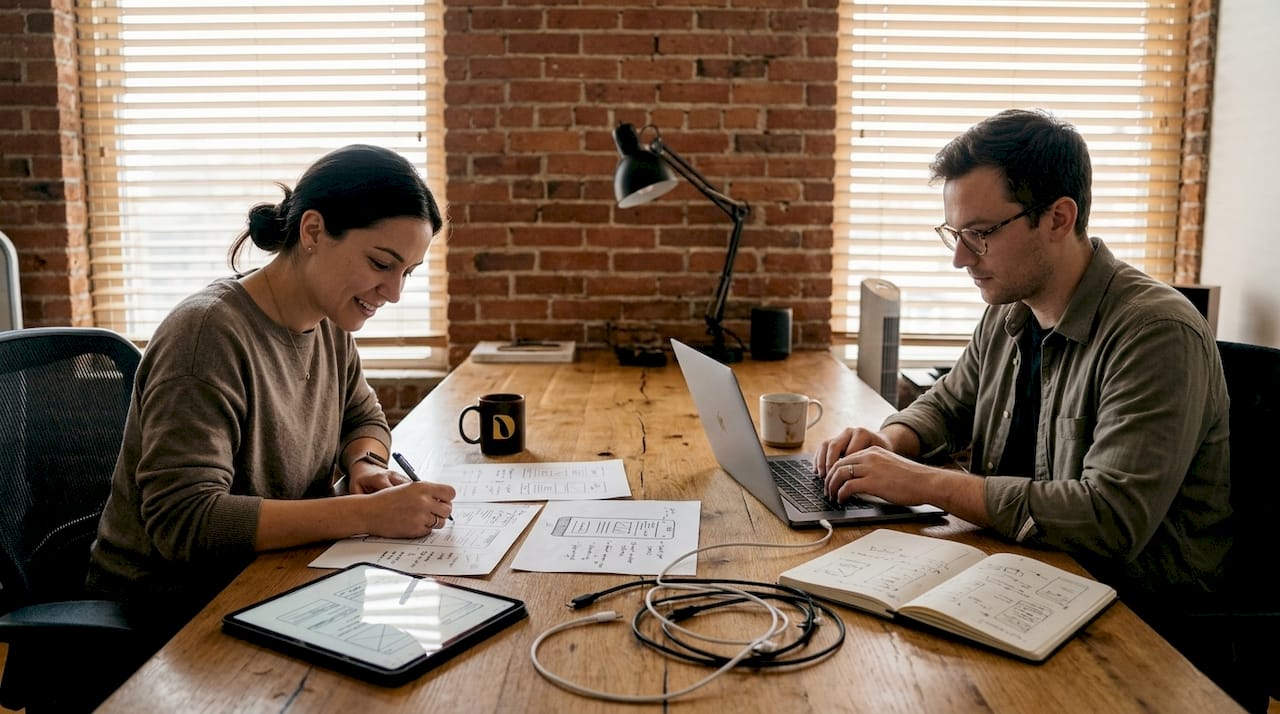
Executive investment data supports this structural repositioning: 88% of organizational leaders are increasing AI budgets in 2026, and approximately 60% of designers now use AI tools during the concepting phase. However, AI's limitations are equally well-documented; the technology struggles with complex maximalist layouts, contextually sensitive imagery, and the kind of layered editorial ambiguity that defines 2026's most compelling visual work.
| Workflow model | Output quality | Timeline | Risk |
|---|---|---|---|
| Human-only | High nuance, high trust | Longer | Creative bottlenecks |
| AI-only | Consistent, low nuance | Very fast | 'AI slop,' low differentiation |
| Hybrid (recommended) | High quality, differentiated | Compressed | Requires clear briefs |
Steps to effectively pair AI with your design process:
- Define creative intent and brand constraints in a written brief before engaging AI tools
- Use AI for rapid visual concepting: generate 20 to 30 directions in under an hour
- Apply human curation to filter outputs against strategic and emotional criteria
- Refine selected directions manually to introduce the nuance and specificity AI cannot replicate
- Document the hybrid process for client communication and future iteration
"The studios producing the strongest work are not using AI to replace thinking. They are using it to think faster, then editing with rigor."
Referencing a solid design intelligence guide helps practitioners structure hybrid workflows systematically. Research on personalized AI design models also illustrates how contextually trained models outperform generic generation, particularly when built on studio-specific semantic design systems.
Further analysis of experience design trends confirms that the studios avoiding 'AI slop' are those treating prompt engineering as a formal discipline, not an informal shortcut.
Pro Tip: Build a semantic design system that documents your brand's visual vocabulary (color relationships, typographic rules, spatial values) and feed it as structured input to AI generation tools. This single step measurably improves on-brief output quality.
Tactile, sensory, and maximalist aesthetics take center stage
AI's partnership sets the table, but what visual and sensory signals are now mainstream for designers? The answer is a deliberate move toward physicality and complexity. Skeuomorphic interfaces and puffy, touchable visuals are creating a form of digital physicality: surfaces that appear pressable, compressible, or materially present, drawing on the human desire for tactile interaction within flat-screen environments. Apple's Liquid Glass interface language is one of the most prominent institutional signals of this direction.
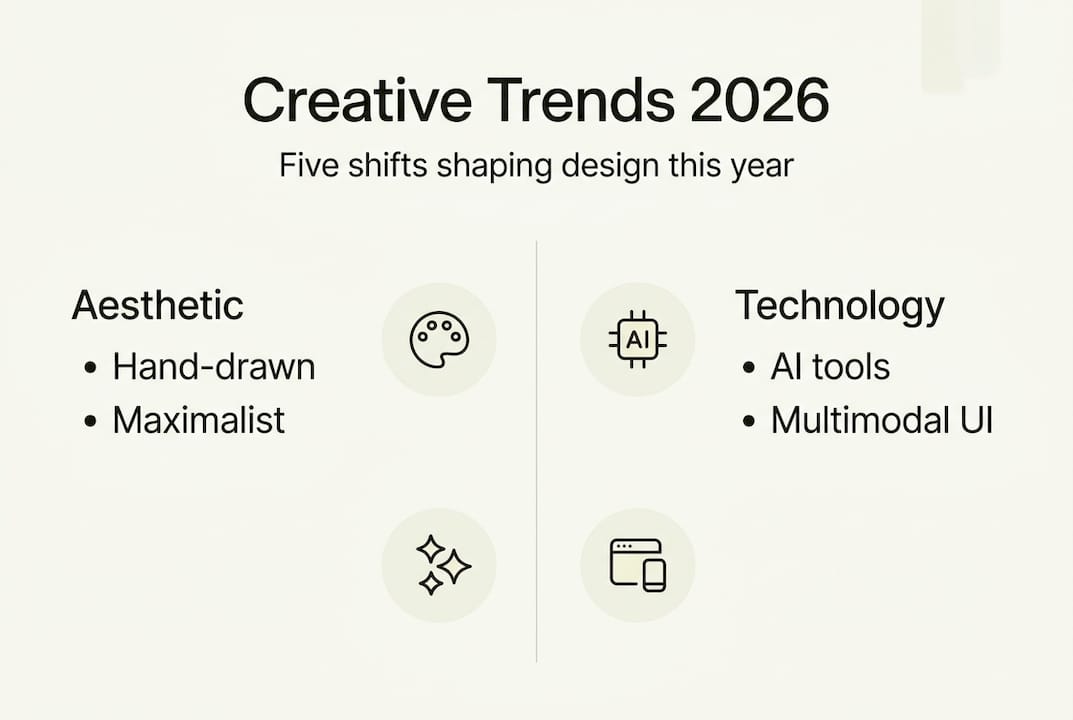
Aside from interface design, maximalism is asserting itself across editorial, brand, and environmental contexts. Canva data documents an 85% increase in zine and Substack layouts, validating the market appetite for dense, layered visual systems that reject the structural austerity of the preceding minimalist decade. Adobe's Creative Trends report for 2026 identifies "All the Feels," "Local Flavor," and "Surreal Silliness" as dominant emotional territories, each of which prioritizes sensory richness over formal restraint.
Maximalist techniques gaining adoption in 2026:
- Layered typographic systems with competing weights, scales, and orientations
- Editorial noise: intentional visual complexity using overlapping image and text fields
- Collage and found-imagery compositions with unresolved negative space
- High-contrast color fields with competing saturation levels
- Pattern-on-pattern surfaces that reward extended viewing
| Aesthetic category | 2024 baseline | 2026 level | Shift |
|---|---|---|---|
| Tactile / textural design | Baseline | +30% search volume | Significant |
| Zine and editorial maximalism | Baseline | +85% layout usage | High |
| Skeuomorphic UI elements | Declining | Resurgent | Reversal |
| Flat / minimal UI | Dominant | Plateauing | Saturation |
Sources: Canva 2026, Krumzi design trend analysis
Research on contemporary art's influence on graphic design provides additional theoretical grounding for this movement, demonstrating that art-informed complexity elevates design beyond purely functional delivery. Creative trends in 2026 from Adobe further reinforce that expressive typography is functioning as a core structural element rather than a decorative layer, actively directing reading sequence and emotional tone.
Adaptive, multimodal UI/UX: Accessibility and interaction redefine experience
Expressive visuals are just one aspect; next, see how interaction paradigms and regulations shape user experience. The architecture of interaction itself is being restructured in 2026, with intent-based and multimodal systems replacing single-input interfaces across product categories. Voice, gesture, context-awareness, and zero-UI paradigms are moving from experimental to production-ready, requiring designers to plan for non-visual and cross-modal interaction from the earliest stages of a project.
Accessibility has transitioned from an enhancement to a legal and ethical baseline. The EU Accessibility Act 2025 and expanded WCAG standards now enforce inclusion requirements across digital products operating in regulated markets, with non-compliance carrying financial and reputational risk.
Current standards and frameworks shaping accessible, inclusive design:
- WCAG 2.2 and evolving WCAG 3.0 criteria for perceivability, operability, and robustness
- EU Accessibility Act 2025 mandating compliance for digital products in EU markets
- ARIA landmark roles and semantic HTML structuring for assistive technology compatibility
- Contrast ratio minimums (4.5:1 for normal text) as a non-negotiable baseline
- Focus management and keyboard navigation standards for motor-impaired users
Steps to implement adaptive UI/UX without product bloat:
- Audit existing interfaces against WCAG 2.2 criteria before any new feature development
- Integrate multimodal input states (voice, keyboard, pointer, touch) into design systems rather than individual components
- Conduct usability testing best practices with participants representing diverse ability profiles
- Use progressive enhancement: build the accessible core first, layer enhancement on top
- Reference web design trends resources for component-level pattern guidance
Pro Tip: Prioritizing accessibility at the component design stage, before visual polish is applied, reduces the cost and complexity of remediation by an order of magnitude and measurably expands the addressable user population.
Why 'perfect' design is obsolete, and how to future-proof your projects
With all these changes in mind, here is how to think differently and act boldly about design in 2026. The central argument is not that perfection is bad aesthetics; it is that perfection, in 2026, reads as a warning signal. Hyper-polished, algorithmically flawless output has become the visual signature of undifferentiated, low-investment production. Experienced clients and audiences increasingly recognize it as such, even when they cannot articulate why.
'Trendy' for its own sake presents an equal risk. Cultural alignment and purposeful visual decision-making produce work with measurable longevity, while pure trend-chasing creates work that expires within a production cycle. The empirical benchmarks from Canva and Adobe confirm that accessibility improvements consistently broaden reach and reduce support overhead, meaning ethical and strategic design are not competing priorities.
"Accessibility built at the system level does not cost more; it earns more. Reduced support tickets, broader audience access, and regulatory compliance are quantifiable returns on a design investment that many studios still treat as optional."
The practical synthesis for practitioners: use AI to compress iteration timelines, apply human-centered UX approaches to ensure emotional integrity, and select trend elements that align with the specific cultural context of each brief rather than the aggregate direction of the market. Design that endures is always specific, never generic.
Advance your design practice: Next steps with DesignDex
Looking to put these insights into action in your own work? DesignDex aggregates and distills peer-reviewed research in UX and industrial design into structured, actionable intelligence, updated daily to reflect the trends and signals shaping practice.
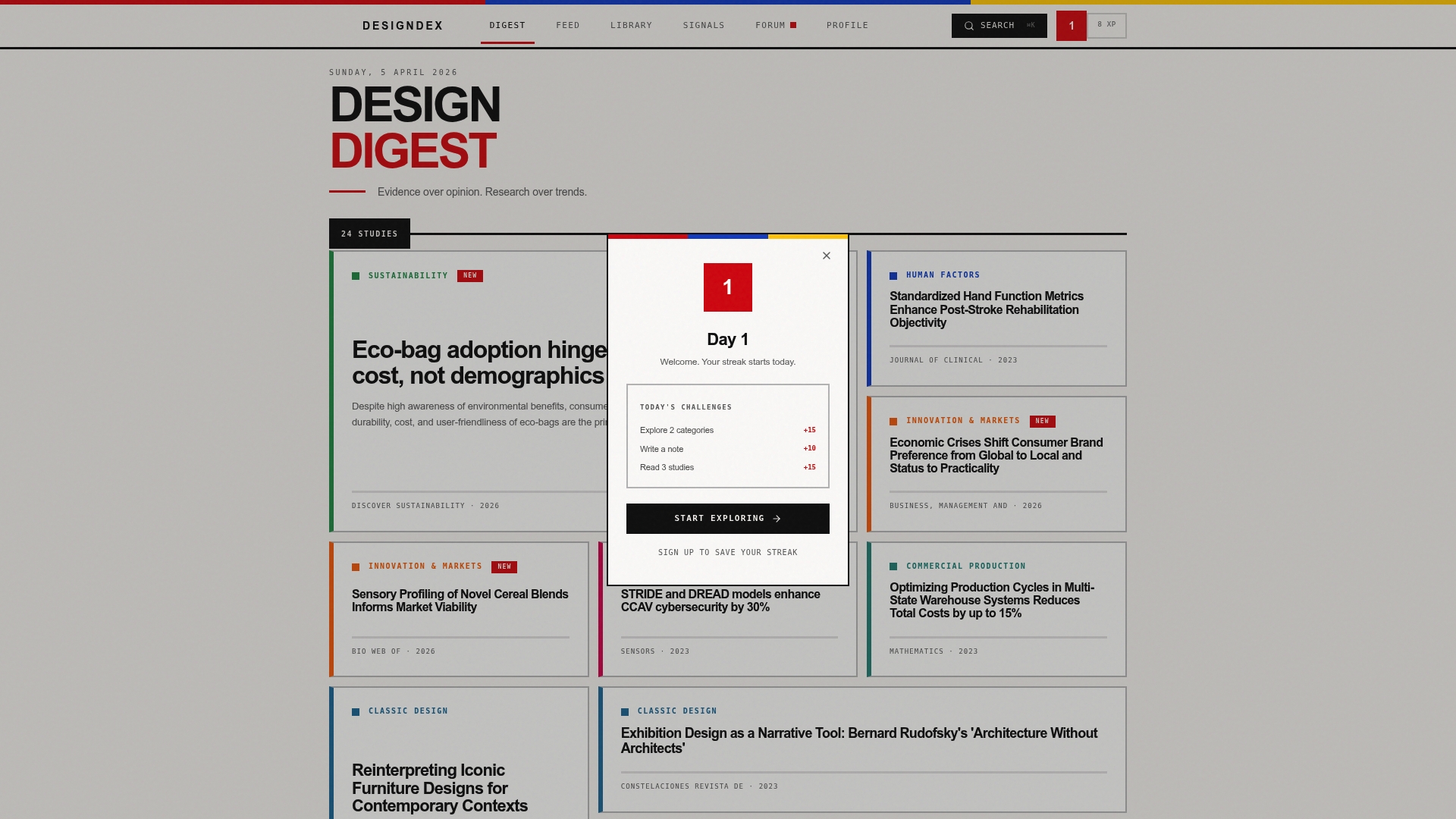
Explore studies on VR immersion in design and usability testing research to build evidence-backed justifications for your most critical design decisions. Subscribe to the Design Digest for daily trend intelligence, citation-ready study breakdowns, and practical frameworks that move your work from intuition to evidence. DesignDex functions as a decision-support infrastructure for designers who need to justify choices, not guess at them.
Frequently asked questions
What is the biggest design trend for 2026?
Imperfect, human-centered aesthetics dominate 2026, with hand-drawn elements, tactile layouts, and visible process marks creating authentic, memorable brand experiences that differentiated work from algorithmically generated output.
How is AI reshaping the design process in 2026?
AI accelerates concepting and compresses workflow timelines, but human strategic oversight remains essential for emotional resonance, cultural sensitivity, and avoiding the undifferentiated output commonly described as 'AI slop.'
What does maximalist design look like in 2026?
2026 maximalism produces layered typographic systems, editorial chaos, and dense visual compositions that reject minimalist conventions in favor of attention-holding complexity; zine and Substack layouts have surged 85% on Canva as a direct indicator.
Are accessibility standards changing design in 2026?
Yes; the EU Accessibility Act 2025 and expanded WCAG standards now position accessibility as a regulatory baseline, requiring designers to integrate multimodal and inclusive UI/UX practices from the earliest project stages.
How can designers stay relevant with fast-changing trends?
Blending trend adoption with authentic cultural alignment and evidence-based decision-making ensures longevity; cultural alignment over trend-chasing consistently produces work that outlasts individual trend cycles.
Recommended
- How to identify design trends: a practical guide
- Contemporary Art's Influence Elevates Graphic Design Beyond Pure Functionality — Design Research Summary | DesignDex
- Design intelligence: a practical guide for better outcomes
- Visual Communication Design Enhances Animated Film Aesthetics and Audience Engagement — Design Research Summary | DesignDex