

TL;DR:
- User research transforms assumptions into validated knowledge, reducing product failure risks.
- Combining qualitative and quantitative methods yields more accurate, actionable insights across project stages.
- Designing for edge cases benefits all users and enhances overall product robustness.
Every dollar invested in UX research yields up to $100 in ROI, a figure that reframes user research from optional overhead to strategic necessity. Yet many design teams still treat it as a late-stage validation step rather than a continuous, decision-shaping practice. This article clarifies what user research is, which methods apply at each project stage, how to structure a research process that generates actionable insights, and why designing for edge cases strengthens outcomes for all users. Whether you are a student building your first research plan or a practicing UX designer justifying budget, the evidence here supports a more rigorous, research-grounded approach.
Table of Contents
- Understanding user research: Definition and core purpose
- User research methods: Qualitative vs quantitative, and common techniques
- The user research process: From discovery to actionable insights
- Designing for edge cases: Why inclusive research benefits all users
- The uncomfortable truth: Why skipping user research sabotages design
- Explore more: DesignDex research and actionable resources
- Frequently asked questions
Key Takeaways
| Point | Details |
|---|---|
| User research drives ROI | Investing in user research yields massive financial and efficiency benefits for design projects. |
| Mix methods for clarity | Combining qualitative and quantitative approaches ensures you capture both depth and scale of user needs. |
| Research is continuous | Effective design embeds user research throughout every stage of the product cycle, not just at the start. |
| Edge cases improve UX | Designing for unusual or extreme scenarios makes products better for everyone. |
Understanding user research: Definition and core purpose
User research is the systematic investigation of user needs, behaviors, motivations, and pain points using empirical methods. Its core purpose is to replace assumption-driven design with evidence-based decision-making, reducing the risk of building products that fail to serve real users. Rather than a single phase or deliverable, user research functions as a continuous analytical layer embedded across the full design and product lifecycle, from early discovery through post-launch evaluation.
The practical value of user research methods extends beyond understanding users. It directly affects project economics: continuous research reduces dev time by 33 to 50%, primarily by surfacing misalignments before they become costly engineering rework. Teams that integrate research early spend fewer cycles correcting avoidable errors and more cycles refining validated solutions.
Core functions of user research include:
- Informing design decisions with real behavioral data rather than stakeholder preference
- Validating concepts and prototypes before significant development investment
- Identifying hidden friction points that internal teams cannot detect due to familiarity bias
- Prioritizing features based on actual user need rather than assumed demand
- Reducing product risk by testing assumptions with representative users before scaling
"User research is not a luxury. It is the mechanism by which design teams transform assumptions into validated knowledge, and validated knowledge into products that work."
User research also addresses what practitioners call "unknown unknowns", the problems and patterns a team does not know they do not know. Structured research methods systematically surface these blind spots, making them visible and actionable. This is particularly critical in complex product domains where diverse user populations interact with systems in ways that internal teams rarely anticipate without deliberate inquiry.
User research methods: Qualitative vs quantitative, and common techniques
Now that the purpose is clear, let's explore the diverse methods and distinctions within user research. The field organizes methods along three primary axes: qualitative versus quantitative, attitudinal versus behavioral, and generative versus evaluative. Understanding these distinctions enables designers to select the right tool for each question.
Qualitative versus quantitative approaches, combined with attitudinal versus behavioral framing, define the structure of most research programs. Qualitative methods surface the why behind user behavior through depth of engagement; quantitative methods measure the what and how many at scale. Neither approach is complete without the other.
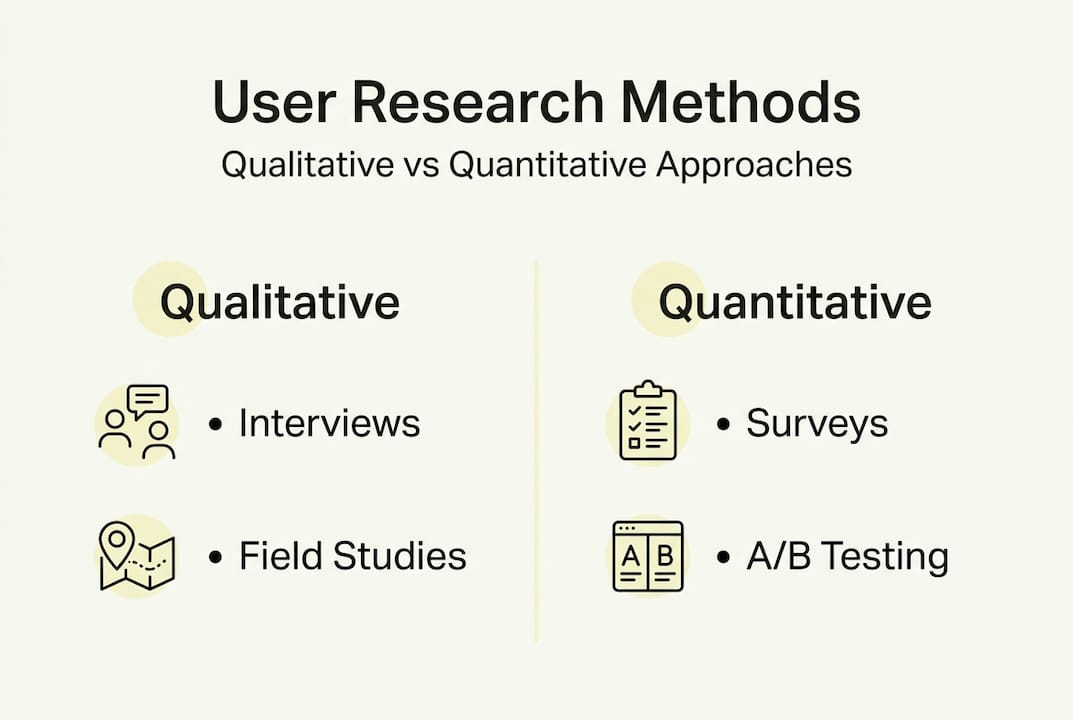
| Dimension | Qualitative | Quantitative |
|---|---|---|
| Goal | Understand motivations and reasoning | Measure frequency and patterns |
| Methods | Interviews, diary studies, field studies | Surveys, A/B tests, analytics |
| Output | Themes, insights, narratives | Statistics, percentages, benchmarks |
| Sample size | Small (5 to 30 participants) | Large (100+ participants) |
| Stage fit | Discovery, early ideation | Validation, post-launch |
Core methodologies recognized across professional UX practice include user interviews, usability testing, surveys, card sorting, A/B testing, journey mapping, field studies, diary studies, and persona development. Each serves a distinct purpose:
- User interviews: Uncover motivations, goals, and mental models through open-ended conversation
- Usability testing: Evaluate whether users can complete tasks efficiently within a given interface
- Surveys: Collect self-reported data on attitudes, preferences, and behaviors at scale
- Card sorting: Reveal how users categorize information, informing information architecture
- A/B testing: Compare two design variants against measurable performance criteria
- Diary studies: Capture longitudinal behavior in natural contexts over days or weeks
Pro Tip: Generative research (interviews, field studies) should precede evaluative research (usability testing, A/B tests). Attempting to validate a solution before fully understanding the problem is a common and expensive sequencing error. Apply design research methodology principles to ensure your method selection aligns with your current stage of inquiry.
The most rigorous programs combine methods: qualitative discovery followed by quantitative validation, then behavioral observation to check whether what users say aligns with what they do. This mixed-method approach, aligned with human-centered design principles, consistently produces more accurate and actionable findings than any single method in isolation.
The user research process: From discovery to actionable insights
Having covered methods, it's vital to understand how to structure research for real-world design projects. A well-executed research program follows a defined process that ensures findings are relevant, reliable, and operationalizable within the design workflow.
The five-stage process for effective user research:
- Define research questions: Articulate specific, answerable questions about user behavior, needs, or pain points; avoid vague briefs like "understand users better"
- Select methods and recruit participants: Match methods to project stage and goals; recruit participants who represent real users, not convenient colleagues
- Conduct research sessions: Execute interviews, observations, or tests with discipline; use structured guides while allowing space for unexpected findings
- Analyze and synthesize findings: Code qualitative data, identify patterns, and translate raw observations into prioritized insights
- Act on insights: Integrate findings into design decisions, communicate results to stakeholders, and document for future reference
Structuring the process around clearly defined questions prevents scope drift and ensures each session contributes measurable value. Equally important is method selection by stage: generative methods for discovery, evaluative methods for iteration, and behavioral analytics for post-launch monitoring.
| Project stage | Recommended methods | Primary output |
|---|---|---|
| Discovery | Interviews, field studies, diary studies | User needs, mental models |
| Ideation | Card sorting, participatory design | Information architecture |
| Prototyping | Usability testing, cognitive walkthrough | Friction points, task failures |
| Post-launch | Surveys, A/B testing, analytics | Performance benchmarks |
The synthesis stage is frequently underinvested. Raw data collected without rigorous affinity mapping or thematic coding does not automatically become insight. Teams that apply design intelligence frameworks to their synthesis process extract significantly more value from the same data. Similarly, design analysis in UX methods formalize how findings connect to specific design decisions.
Pro Tip: Five well-recruited user interviews surface approximately 85% of major usability themes. Starting small is not a compromise; it is an efficient, evidence-supported strategy for rapid learning with limited resources.
Designing for edge cases: Why inclusive research benefits all users
With actionable steps in mind, it's crucial to address edge cases to ensure solutions work universally. Edge cases in user research refer to user scenarios that fall outside the assumed primary use case: shared accounts across family members, low-vision or motor-impaired users, non-native language speakers, users operating under time pressure, or individuals navigating grief, illness, or unusual life circumstances.

These scenarios are not statistical anomalies. They represent real populations with real needs, and they expose structural fragility in products designed exclusively around an idealized primary user. Research and documentation of edge cases consistently demonstrates that these scenarios are both common and consequential, and that designing for them improves the experience for all users.
Common edge case categories designers should research:
- Accessibility states: Low vision, motor impairment, cognitive load, screen reader dependency
- Shared or delegated use: Accounts managed by caregivers, assistants, or family members
- Adversarial behaviors: Bad actors, misuse scenarios, and manipulation attempts
- Lifecycle transitions: Deceased users, account transfers, data recovery after loss
- Connectivity and device constraints: Slow networks, older hardware, small screens
"The curb-cut effect illustrates a fundamental principle of inclusive design: solutions engineered for users at the margins consistently improve usability for everyone."
The curb-cut effect, originally observed in urban planning where sidewalk ramps designed for wheelchair users also benefit cyclists, parents with strollers, and delivery workers, applies directly to digital product design. Legibility research on elderly font size optimization demonstrates that type size improvements initially targeted at older users measurably improve readability for all age groups under challenging conditions. Similarly, VR-based empathy research shows that immersive perspective-taking tools help design teams develop more accurate mental models of users with lived experiences far from their own.
Inclusive research is not a compliance exercise. It is a product quality investment that yields more robust, resilient, and broadly usable outcomes across the full user population.
The uncomfortable truth: Why skipping user research sabotages design
Reflecting on inclusiveness and real-world application, there is an uncomfortable pattern worth naming directly: most design failures are not technical failures. They are research failures. Products built on assumptions rather than evidence routinely miss their markets, frustrate their users, and generate costly rework cycles that dwarf the original research budget.
The data is unambiguous: 42% of startups fail without conducting adequate user research before building. These are not inexperienced teams making obvious errors. Many are skilled designers and engineers who underestimated what they did not know about their users.
The most common rationalizations for skipping research, insufficient time, limited budget, and confidence in existing expertise, are precisely the conditions under which research delivers its highest return. Teams under time pressure cannot afford the cost of building the wrong thing. Teams with limited budgets cannot absorb the expense of late-stage pivots. Even experienced design teams carry human-centered design pitfalls in the form of familiarity bias, designing for users who think and behave like themselves rather than the actual population they serve.
Investing in research early, iterating on real user data, and treating synthesis as a core design competency rather than a reporting formality is the most reliable path to products that perform in the real world.
Explore more: DesignDex research and actionable resources
DesignDex distills peer-reviewed UX and industrial design studies into structured, citation-ready breakdowns that support exactly the kind of evidence-based practice this article describes. For designers integrating user research into active projects, the platform surfaces directly applicable findings.
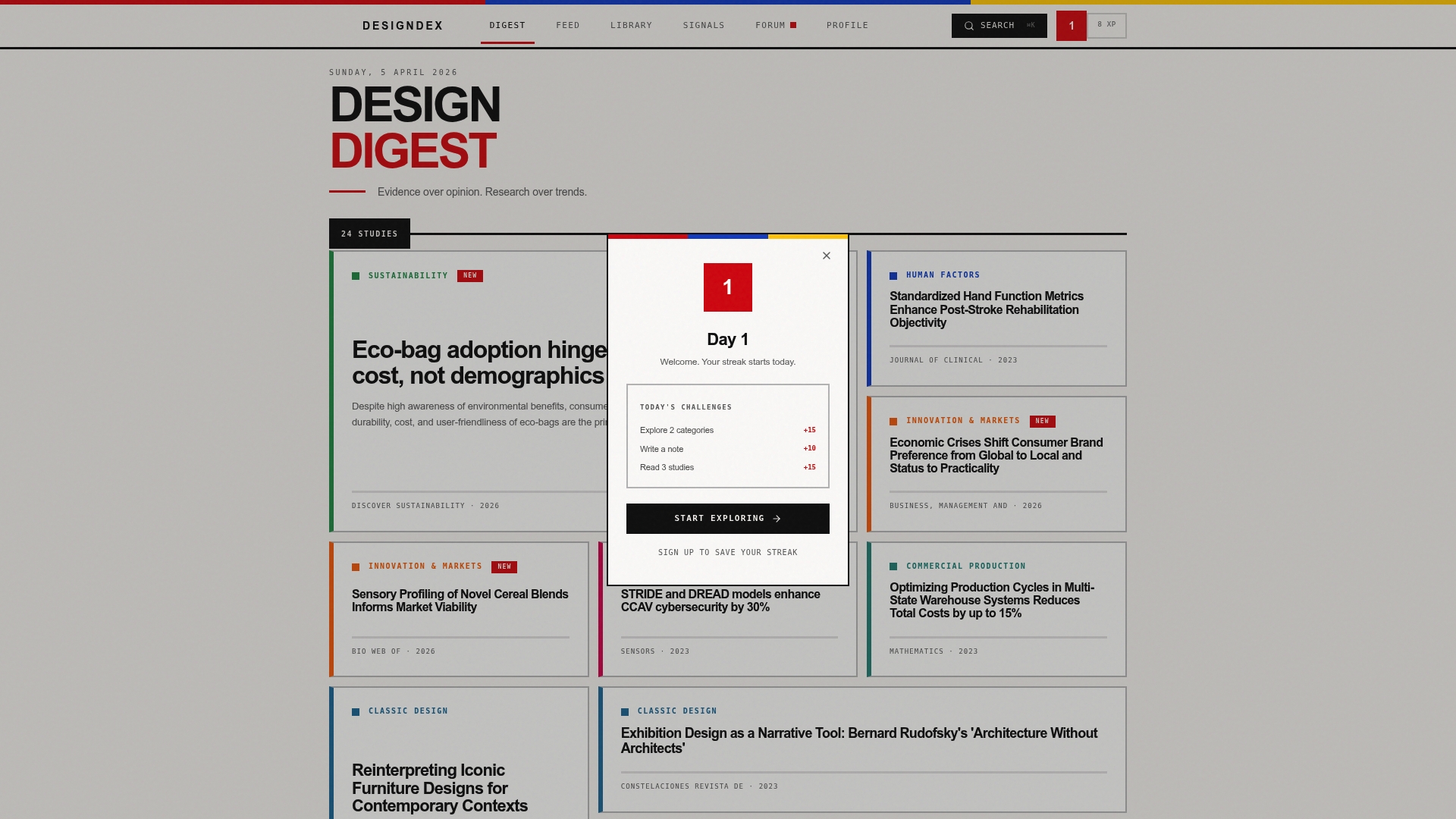
Studies on usability testing outcomes demonstrate measurable interface quality improvements, providing the kind of empirical grounding that justifies research investment to stakeholders. The DesignDex platform updates daily with structured research summaries, trend signals, and methodology breakdowns, equipping designers and students with the evidence needed to make better design decisions without reading full academic papers.
Frequently asked questions
What are the most effective user research methods for new designers?
User interviews and usability testing are highly accessible entry points; 5 interviews surface approximately 85% of major usability themes, making them an efficient starting method for practitioners with limited resources or time.
How does user research improve ROI in design projects?
Evidence indicates that UX research yields up to $100 return for every $1 invested, while continuous research integration reduces development time by 33 to 50% by eliminating costly late-stage rework.
What is the difference between qualitative and quantitative user research?
Qualitative versus quantitative research differ in both method and purpose: qualitative approaches reveal the motivations and reasoning behind user behavior, while quantitative approaches measure the frequency, scale, and statistical significance of those behaviors.
Why should designers prioritize edge cases in user research?
Research on the curb-cut effect confirms that solutions designed for users at the margins produce broadly improved experiences; inclusive research is therefore a product quality strategy, not merely an accessibility compliance requirement.